
Where have all the Baryons gone? Long time passing...
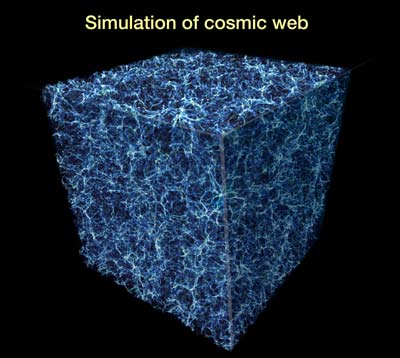
Although the universe contains billions of galaxies, only a small amount of its matter is locked up in these behemoths. Most of the universe's matter that was created during and just after the Big Bang is lost and must be found elsewhere. Now, in an extensive search of the local universe, astronomers say they have definitively found about half of the missing normal matter, called baryons, in the spaces between the galaxies.
Comments:
I posed the question about Baryons between galaxies to a lady scientist who was speaking about <u>accounting for dark matter and cosmic expansion</u> at a meeting of my (former) astronomy club. <br><br>She (and everyone else in the room) looked at me as if my question was stupid.<br><br>"Things" are dispersed throughout space, and there is not a single cubic nanometer of this vacuum that remains unaffected by "static" or passing presence. <br><br>Every time we look through a telescope, we see an image that is surrounded by what we cannot see. I can live with being a bit slow witted. By the same token, sometimes a private can think of something that all the NCOs and officers missed. <br><br>Just as Greek philosophers posed questions about the differences between "something and nothing", astronomy has at least as much (more) to do with acurately deciphering information than gathering it. There - my unanswered smirked at question is answered by real scientists - not pinheads. <i>Please forgive me for trying to understand.</i><br>Ron
If dark matter is non elemental, it is not dark matter, but rather unidentified "existence". As I hinted in my first post, you don't have to be a mental giant to figure out that a few ions per cubic mile in the IGM would add up to an almost inconceivably large number.<br><br>If I make a very massive dot on opposite points of a sphere that represents the limits of the material universe, how do those dots relate to each baryon within that expanding sphere when the dots are departing each other at 1) less 300,000km/s? 2) more than 300,000km/s? 3) 600,000km/sec?<br><br>Yea - I know - I'm full of it. But relativity is too often thought of in one dimension - like a receding Quasar or the photon departing my flashlight. The fact is, however, that the net gravitational vector working on a given point in space is the integration of infinite vectors that represent a fraction of energy, a portion of mass, and an increment of time. We must acknowledge that this is a dynamic relationship whose values only appear static.<br><br>Net gravitational vectors split <i>our</i> universe into two halves one might call the 'push" and the "pull". Gravity - in my opinion - is the most vile, deceptive liar in the universe. In the long run, and hopefully within my lifetime, we will discover that the cosmological constant has simply been a step toward defining the true dynamic.
Well, *I* believe that there is gravity, with a small g, which is the force we think we know and love, whose boson we never seem to be able to capture, and TRUE GRAVITY, G, which accelerates 'stuff' (normal fermions can't catch up to C lightspeed, spin 2/2 bosons are stuck around C, and my hypothetical spin 3/2 diracons (not to be confused with superpartner species of that spin) have to stay faster than C, so are similar to 'tachyons', sort of).<br><br>Now in my wacky (or wacko- take your pick) theory, Higgs bosons, 0/2 spin, decelerate everything, just as true G gravitons accelerate. Because I associate spin with spatiotemporal dimensionality, Higgs are 0-D, and are both everywhere and nowhere, in time and space. Thus they fulfill their supposed roles as theorists claim. But true G is also both everywhere and nowhere- being 4-D, they encompass all of space and time- they cannot be 'localized' in any one place, and any 'wave' they have will be propagated everywhere and everywhen.<br><br>Normal fermions with spin 1/2 are 1-D (zero in space, but one in time, so they are point particles that extend through time). They respond both to Higgs (by differential coupling, thus receiving mass) and to the Graviton. BUT the hypothesized diracons (which are NOT *particles* since they are 3-D) are mirror-image, differentially interacting with G, creating not a quantum tableaux, but one more akin to relativity.<br><br>Diracons, because they draw from true G, MASK TRUE G, leaving only a residual force we think of as lower-case g. Similarly, because they draw from Higgs, fermions MASK the Higgs field from the diracons, and so diracons don't have a true picture of Higgs.<br><br>I believe that the big intergalactic spaces are actually filled up with diracons (which take up room, but have no normal mass).<br><br>In my scheme, I also recognize that there is no absolute reference frame- that is, Hubble expansion of the universe cannot, on the face of it, be distinguished from the coordinated shrinking of matter (coordinated, because despite the rescaling, matter-energy relations stay the same for fermions and bosons, and similarly for bosons and diracons in the opposite direction. Only bosons, being square in the center of the spin system (2/2) have their ideal fixed speed C). So fermionic matter could be thought of as shrinking, and diraconic 'matter' (or whatever it is) expanding.<br><br>The net effect of all this will be that intergalactic spaces continue to expand even as matter clumps collapse- and we see all of this as the effect of 'gravity', when it would really, in this scheme, be a two-sided affair- that is, fermionic matter shrinking makes room for diraconic matter to swell, OR the diraconic matter presses the fermionic and squashes it, making more room for itself. Either way, or both, the net result is the same.<br><br>The remnant fermionic matter left in the large spaces possibly could also have a symmetrical partner in diraconic stuff trapped still in matter clumps- neither would really be 'happy' there- this is a phase separation, like water and oil. Perhaps the remnants fulfill some purpose, for instance by providing minimal outward 'pressure' preventing the fermions from shrinking nearly infinitely, or as fast- similarly perhaps the fermionic matter in between galaxies prevents the expansion of the diracons from happening as fast as it might, or as far.<br><br>But what do I know- I'm just an armchair crank physicist!<br><br>Jess Tauber<br><br>
Funding Member