Will Pluto be Reinstated as a Planet Once Again?
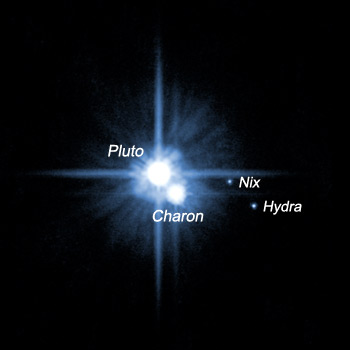
Top scientists and educators will convene at Johns Hopkins University from Aug. 14-16, 2008 to explore a basic, but controversial, question: What is a planet?
“The Great Planet Debate: Science as Process” conference will be held at The Johns Hopkins University Applied Physics Laboratory (APL) in Laurel, Md. to address the processes leading to planet formation and characteristics and the criteria used to define and categorize planets.
“The time is ripe to hold a scientific conference to examine how planets form and evolve, both within our solar system and around other stars, as well as their physical characteristics” says Dr. Mark Sykes, a conference organizer and director of the Planetary Science Institute, Tucson, Arizona. “This event provides researchers with a unique opportunity to examine all sides of this issue and talk about it, face to face. They can also sit down with educators to discuss how to broach the planet definition controversy in the classroom.”
In August 2006, 474 members of the of the International Astronomical Union's (IAU) 10,000 members took part in the vote that stripped Pluto of its status as a planet. Since then, numerous astronomers have expressed concerns that the new definition of a planet is confusing.
Their reactions came after a vote by the IAU meeting in Prague that defined a planet as “a celestial body that is in orbit around the Sun, has sufficient mass for its self-gravity to overcome rigid body forces so that it assumes a nearly round shape, and has cleared the neighborhood around its orbit.” Because Pluto did not meet the last criterion, the IAU demoted it to “dwarf planet” status.
The decision left the solar system with only eight planets. Since its discovery in 1930, Pluto had been considered the solar system’s ninth planet. Under the IAU definition, Pluto and similar bodies fell into a new category of “dwarf planets.” Segments of the planetary science community objected to the IAU criteria, and the debate continues to this day among professional scientists, educators, and the public.
“No votes will be taken at this conference to put specific objects in or out of the family of planets,” says APL’s Dr. Hal Weaver, a conference organizer. “But we will have advocates of the IAU definition and proponents of alternative definitions presenting their cases.”
This includes an open-to-the-public debate between Dr. Sykes of the Planetary Science Institute and Dr. Neil deGrasse Tyson, director of the American Museum of Natural History's Hayden Planetarium in New York.
“This topic provides the perfect opportunity to teach science as a process, not a collection of facts,” says organizing committee member Dr. Keith Noll of the Space Telescope Science Institute in Baltimore. “We also need to stress the importance of incorporating new discoveries to continually improve our understanding of the diverse objects within planetary systems.”
"We're going to do something that the IAU did not, which is discuss what we know about planetary bodies in the solar system and around other stars, and discuss the value of different ways of defining objects as planets and what that means," said Mark V. Sykes.
"If a new consensus emerges it will easily overturn the IAU. This is not an issue," said Neil deGrasse Tyson, "If not, they'll stick with what they've got until something better comes along."
At the time of the IAU decision, Harold (Hal) Weaver, Johns Hopkins University Applied Physics Laboratory stated “Regarding the resolution itself, the situation is still somewhat muddled. What exactly is meant by a planet ‘clearing its neighborhood?' Since many ‘plutinos’ … (including Pluto) … cross Neptune’s orbit, I'd say Neptune's neighborhood still needs some clearing! … It just seems a bit risky to me to base a definition on a theoretical construct (i.e., ‘dynamically cleared regions’) that's only approximate at best and may change significantly as our understanding of planet formation evolves over time. “I further note that there have been particularly large swings in the theories of outer solar system dynamical evolution during the past decade. What was ‘conventional wisdom’ five years ago has been replaced with the latest fad, and I don't expect that situation to change any time soon."
Karl Glazebrook, professor in the Department of Physics and Astronomy at Johns Hopkins added “What is meant by ‘clearing its orbit?’ How does this relate to having an orbit overlapping Neptune? Clearly Neptune has not cleared its orbit. “They should have gone with something clean like a size criterion. Seems to me like a muddled compromise which will just cause more problems and the issue will have to be revisited again.”
William P. Blair, research professor in the Department of Physics and Astronomy and chief of observatory operations for NASA's Far Ultraviolet Spectroscopic Explorer Satellite, operated by JHU: “I think the demotion of Pluto into the realm of other minor objects outside the orbit of Neptune is the most consistent thing to do to straighten out the nomenclature of our solar system. However, I don't find the wording of the official planet definition to be very clear, and hence it will continue to be open to interpretation.
For more information:
http://gpd.jhuapl.edu/
http://www.jhuapl.edu/newscenter/pressreleases/2008/080515.asp
http://www.usatoday.com/tech/science/space/2008-08-05-planet-definition_N.htm
http://www.astromart.com/news/news.asp?news_id=650
http://www.astromart.com/news/news.asp?news_id=568
http://www.astromart.com/news/news.asp?news_id=560
http://www.astromart.com/news/news.asp?news_id=436
http://www.astromart.com/news/news.asp?news_id=645
Astromart News Archive:
http://www.astromart.com/news/search.asp?search=.+&search_btn=Go
Funding Member
