
World’s Largest Optical Telescope to Go Live in 2018
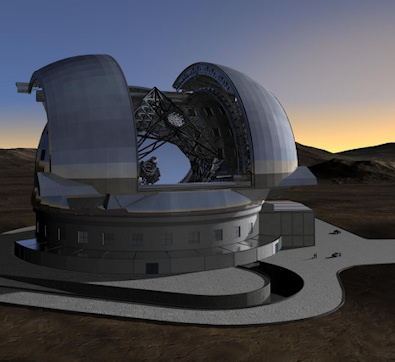
The European Extremely Large Telescope (E-ELT) is a project aiming to provide astronomers with the largest optical-infrared telescope in the world. The project is currently in the detailed design phase and the telescope is expected to take up operations in 2018. With a diameter of 42 m and being fully adaptive from the start, the E-ELT will be more than one hundred times more sensitive than the present-day largest optical telescopes. The E-ELT will vastly advance astrophysical knowledge by enabling detailed studies of planets around other stars, the first galaxies in the Universe, and super-massive black holes.
Comments:
This new EELT telescope will push the limits in dealing with gravity and atmosphere. Putting something larger in earth orbit far beyond the moon will become easier and easier as new technologies in lightweight computer controlled reflective surface membranes suited for zero gravity come on line.<br><br>Low Earth Orbit logistics and assembly technology coming online with the new generation heavy lift rockets will make even vastly larger optical/broadd EM spectrum telescopes - the size of Arecibo - possible in the lifetime of today's teens.<br><br>Updates of the 90 + second burn Saturn 5 F1 Rocketdyne 1.5 million pound thrust first stage engines of the 1966 Apollo program combined with twin 130 second burn 3.3 million pound solid boosters first tested in 2003 will power the forthcoming Aries heavy lift vehicle. No doubt several max lift launches after 2020 could orbit enough materials to build a scopethat would dwarf the EELT. Getting it to orbit would be a time/fuel tradeoff.<br><br>Manned space travel to low earth orbit and the moon should be sufficient to use telescopes as the primary tool for space exploration for the next 100 years. <br><br>Let's see - can we see continents on a wet world orbiting a distant star with a 5 kilometer diameter scope orbiting Mars? Not sure - but certainly more likely than travelling a few dozen light years. Mars can wait fifty years, but knowing what is happening in other solar systems seems vastly more intriguing and productive.
Hello. Humans are tough (ask makarov and lazarev). Humans, you can kick'em upstairs and bring'em back no problem, well, hopefully it's done a little more gently than 18a <img class='' src='http://new.astromart.com/astromart/javascripts/sceditor/emoticons/grin.png' alt='grin' title='grin'/> But mirrors that are so delicate that would rather not be at 1g, are going to be quite in trouble if you attempt to send them up. Even if you manufacture them on the moon, and ship them out from there, chances are they're irrimediably warped and turned into shiny expensive spacejunk by the time their vector reaches parking orbit. Sure we could set up a mirror making facility in a suitable orbit... but.... that one would take quite a lot of fuel.... and quite a lot of time. Daniela
The E-ELT primary is 42 meters with a 6 meter secondary. WOW! In comparison, the Mt. Palomar Hale telescope primary is 200" (5.08 meter).
Funding Member
