Youngstown State Astronomers Make Their Precious Hubble Time Pay Off
When Pat Durrell and his 13-person team of astronomers were granted time to use the Hubble Space Telescope to conduct research, his hope was to discover stars that had been ripped from faraway galaxies.
Durrell, an assistant professor of astronomy at Youngstown State University (YSU), found the stars he was looking for... and much, much more.
"We were looking for these stars, but when we got the images, we said, Hey - we've got some other stuff here," he said.
That stuff was the discovery of a new, never before detected dwarf galaxy and four unknown star clusters.
"It was great," Durrell said. "It was almost like a three-for-one deal. We got lucky."
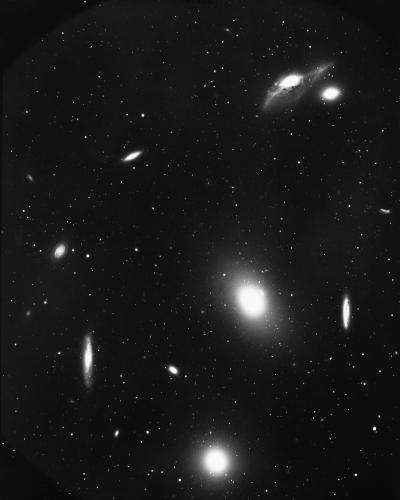
"This image lets us look at the center of a galaxy cluster, which is filled with galaxy interactions," Feldmeier said. "It's like looking at the center of a 50-car pileup while it's happening."
Durrell said it took the team three years to get approval from NASA to use the Hubble Space Telescope for the research. The telescope, launched in 1990, orbits 375 miles above the Earth and provides views of the universe that cannot be made using ground-based telescopes or other satellites.
"Hubble time is very precious," he said, noting that only one of every eight applications for time on the telescope is approved.
The team, headed by Robin Ciardullo, professor of astronomy at Penn State University, was granted 37 orbits of observation (more than 25 hours of data) last spring to study intracluster stars in the Virgo cluster of galaxies about 55 million light years from Earth, or more than 300 trillion miles.
The team found thousands of such intracluster stars -- stars that do not belong to any single galaxy and instead drift through the intergalactic space of a galaxy cluster.
But it also found a previously unknown dwarf galaxy and four new star clusters, which are densely-knitted groups of stars.
"Many times, dwarf galaxies appear only as smudges or fuzzy smears on astronomical photos, but this new dwarf galaxy is extremely clear," Durrell said. "The brightest individual stars of this galaxy are clearly seen."
"It is only with the capabilities of Hubble that we are even able to see the stars in this galaxy, let alone study them in as much detail as we have been able to do," Durrell said.
He said the research group is now writing proposals to NASA for more time on Hubble. Durrell wants to use Hubble to study the Coma galaxy cluster, which is more than five times farther away than the Virgo cluster.
But the future of Hubble, which is about the size of a large school bus, is in question. NASA engineers estimate that the batteries that operate Hubble will run out some time in 2008 or 2009. The last originally planned Space Shuttle mission to service the telescope was cancelled in January 2004 in the wake of the Columbia Shuttle tragedy in February 2003.
"We're hoping that something can be done to keep Hubble up and working for many more years," Durrell said. "We can't do this research without Hubble. We would have to wait for the next generation of space telescopes, and that could be several years away."
For more information: http://cfweb.cc.ysu.edu/news/news_viewnew.cfm?RecNum=435
Funding Member
