Reviews & Articles
Image of the day
About Astromart
My Account
New to Astromart?
Register an account...Need Help?
Researchers Find Clear Evidence of Water on the Moon
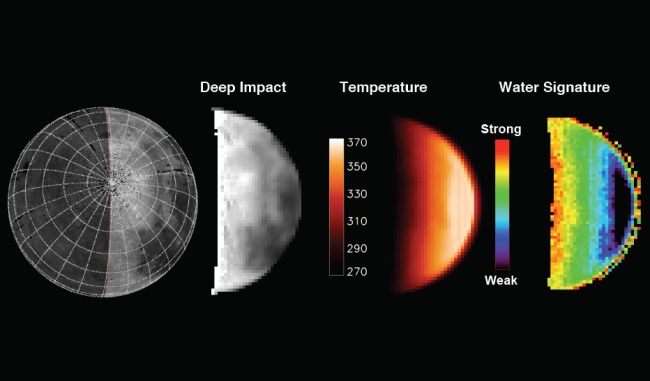
New data from the Deep Impact spacecraft, the Moon Mineralogy Mapper (M3), an instrument aboard India's recently ended Chandrayaan-1 spacecraft, and the Cassini space probe provide, for the first time, clear evidence that water exists on the surface of the Moon.
"The Deep Impact observations of the Moon not only unequivocally confirm the presence of OH/H2O on the lunar surface, but also reveal that the entire lunar surface is hydrated during at least some portions of the lunar day," states University of Maryland astronomer Jessica Sunshine.
Small Amount of Water Yields Big Excitement
"Finding water on the Moon in daylight is a huge surprise, even if it is only a small amount of water and only in the form of molecules stuck to soil," said Sunshine. Prevailing scientific opinion long has been that there probably is no water on the Moon and that, even if it does exist, it would be only in permanently cold, shadowed craters at the lunar poles.
"In the Deep Impact data we're essentially watching water molecules form and then dissipate right in front of our eyes," said Sunshine, who said her first reaction to the M3 data was skepticism.
"We aren't certain yet how this happens," she said, "but our findings suggest a solar driven cycle in which layers of water only a few molecules thick form, dissipate and reform on the surface each lunar day. We postulate that hydrogen ions from the sun are carried by the solar wind to the Moon and there interact with oxygen rich minerals in lunar soil to produce the water [H20] and hydroxyl [OH] molecules that spectral analysis unequivocally show us are there. In a cycle that occurs entirely in daylight, this water is formed in the morning, substantially lost by lunar mid-day, and re-formed as the lunar surface cools towards evening."
"If this is correct, then such hydration via solar wind would be expected to occur throughout the inner Solar System on all airless bodies with oxygen-bearing minerals on their surfaces," Sunshine said.
"Within the context of lunar science, this is a major discovery," Paul G. Lucey, a planetary scientist with the University of Hawaii, said. "There was zero accepted evidence that there was any water at the lunar surface, [but] now it is shown to be easily detectable, though by extremely sensitive methods. As a lunar scientist, when I read about this I was completely blown away," said Lucey, who was not involved in the current research.
Lunar H20 Latest in University of Maryland-Led Deep Impact Science
Although the M3 instrument and its science team made the initial discovery of water in certain areas of the lunar surface, Sunshine said the conclusiveness of the finding of water, the realization it was a surface-wide phenomenon, and the insight into the temperature dependent nature of the process were only possible because of data collected by the Deep Impact spacecraft during it's current extended mission.
Deep Impact was not designed to study the Moon, but for a famous 2005 mission in which it successfully knocked a hole in comet Tempel 1 to find out what was inside. Its data on lunar water were obtained as part of calibration opportunities that occurred during June 2009 and December 2007 flybys of the Earth and Moon needed to get adequate gravity boosts to travel on its mission to a second comet, Hartley 2, which the spacecraft will encounter in November 2010.
"Without the spectral range of Deep Impact's instruments, the M3 discovery of surface water would not have been nearly so definitive, and because the Deep Impact spacecraft took observations at different times of the lunar day, the effect of temperature became very apparent," Sunshine explained.
University of Maryland Astronomer Michael A'Hearn, Deep Impact science team leader, said "I think it is tremendous that the Deep Impact spacecraft, which was the first to detect ice on a cometary nucleus, has now demonstrated the existence of adsorbed water on the Moon. "This great spacecraft and its instruments continue to make important, unexpected discoveries long after the prime mission has ended," he said.
For more information:
http://www.newsdesk.umd.edu/scitech/release.cfm?ArticleID=1972
AstroMart News Archive:
http://www.astromart.com/news/search.asp?search=.+&search_btn=Go
"The Deep Impact observations of the Moon not only unequivocally confirm the presence of OH/H2O on the lunar surface, but also reveal that the entire lunar surface is hydrated during at least some portions of the lunar day," states University of Maryland astronomer Jessica Sunshine.
Small Amount of Water Yields Big Excitement
"Finding water on the Moon in daylight is a huge surprise, even if it is only a small amount of water and only in the form of molecules stuck to soil," said Sunshine. Prevailing scientific opinion long has been that there probably is no water on the Moon and that, even if it does exist, it would be only in permanently cold, shadowed craters at the lunar poles.
"In the Deep Impact data we're essentially watching water molecules form and then dissipate right in front of our eyes," said Sunshine, who said her first reaction to the M3 data was skepticism.
"We aren't certain yet how this happens," she said, "but our findings suggest a solar driven cycle in which layers of water only a few molecules thick form, dissipate and reform on the surface each lunar day. We postulate that hydrogen ions from the sun are carried by the solar wind to the Moon and there interact with oxygen rich minerals in lunar soil to produce the water [H20] and hydroxyl [OH] molecules that spectral analysis unequivocally show us are there. In a cycle that occurs entirely in daylight, this water is formed in the morning, substantially lost by lunar mid-day, and re-formed as the lunar surface cools towards evening."
"If this is correct, then such hydration via solar wind would be expected to occur throughout the inner Solar System on all airless bodies with oxygen-bearing minerals on their surfaces," Sunshine said.
"Within the context of lunar science, this is a major discovery," Paul G. Lucey, a planetary scientist with the University of Hawaii, said. "There was zero accepted evidence that there was any water at the lunar surface, [but] now it is shown to be easily detectable, though by extremely sensitive methods. As a lunar scientist, when I read about this I was completely blown away," said Lucey, who was not involved in the current research.
Lunar H20 Latest in University of Maryland-Led Deep Impact Science
Although the M3 instrument and its science team made the initial discovery of water in certain areas of the lunar surface, Sunshine said the conclusiveness of the finding of water, the realization it was a surface-wide phenomenon, and the insight into the temperature dependent nature of the process were only possible because of data collected by the Deep Impact spacecraft during it's current extended mission.
Deep Impact was not designed to study the Moon, but for a famous 2005 mission in which it successfully knocked a hole in comet Tempel 1 to find out what was inside. Its data on lunar water were obtained as part of calibration opportunities that occurred during June 2009 and December 2007 flybys of the Earth and Moon needed to get adequate gravity boosts to travel on its mission to a second comet, Hartley 2, which the spacecraft will encounter in November 2010.
"Without the spectral range of Deep Impact's instruments, the M3 discovery of surface water would not have been nearly so definitive, and because the Deep Impact spacecraft took observations at different times of the lunar day, the effect of temperature became very apparent," Sunshine explained.
University of Maryland Astronomer Michael A'Hearn, Deep Impact science team leader, said "I think it is tremendous that the Deep Impact spacecraft, which was the first to detect ice on a cometary nucleus, has now demonstrated the existence of adsorbed water on the Moon. "This great spacecraft and its instruments continue to make important, unexpected discoveries long after the prime mission has ended," he said.
For more information:
http://www.newsdesk.umd.edu/scitech/release.cfm?ArticleID=1972
AstroMart News Archive:
http://www.astromart.com/news/search.asp?search=.+&search_btn=Go