Reviews & Articles
Image of the day
About Astromart
My Account
New to Astromart?
Register an account...Need Help?
Wanted: Amateur Astronomers to Help Solve the Mystery of Epsilon Aurigae
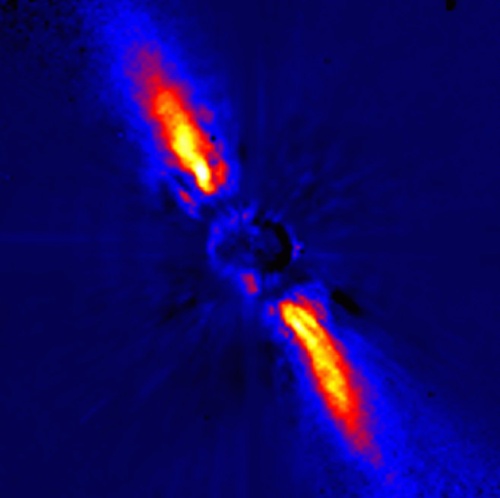
Epsilon Aurigae is an eclipsing binary variable star - a system consisting of two stars orbiting around a common center of mass in a plane along our line of sight. Although epsilon Aurigae has been known as an eclipsing binary for over a century, it isn't yet known what exactly is eclipsing what. The curious light curves of the eclipses have been studied in detail, but they're so infrequent with a period of 27.12 years, that new knowledge is slow in coming -- only three or so occur each century. Although binary star modelers have an idea of what this system is, they are hopeful that a full understanding of this system will come after the next eclipse, which is just starting now. And researchers are looking for amatuer astronomers to help solve the mystery.
It's been a long wait since the last one, and the field of astronomy has come a long way since the 1982-1984 eclipse. Astronomers around the world will be turning telescopes working at nearly all wavelengths of light to study this curious star system over the next several years. All observations, including visual estimates and all forms of instrumental photometry, are needed, and amateur astronomers will be among the observers contributing data during that time. It will take a lot of data to remove the cloud of mystery around epsilon Aurigae.
Johann Fritsch was the first to note the variability of epsilon Aurigae in early 1821, when the star was likely in the midst of a deep eclipse. Serious study of this star did not begin for another 20 years. The German astronomers Argelander and Heis both began "regular" observing once every few years around 1842-1843, and the data from both men showed that the star became significantly fainter around 1847. Both then began observing the star in earnest, with several dozen visual magnitude estimates made during the course of that year's dimming. By September of 1848, epsilon Aurigae became significantly brighter again, reaching its near-normal brightness by the end of that year. But the increased observational coverage proved that there were short term variations as well as the long-term dimming both men had observed over the the previous two years. Although they didn't know it at the time, what they had observed was an extremely long-period eclipsing binary, and one that was interacting as well.
Observers later in the 19th Century recorded another dimming event in 1874-1875, and yet another was recorded in 1901-1902. Hans Ludendorff, who later became director of the Potsdam Observatory, published an early, comprehensive analysis of epsilon Aurigae in 1904, suggesting it was an eclipsing binary. Based on all of the observational evidence to date, Ludendorff suggested the object is similar to the Algol variables, now known to be eclipsing binaries that interact when one star transfers matter to the other. In his depiction, the long-term, large variations come from eclipses of one star in the system by the other, while the short-term variations come from the matter flowing from one star to the other. He suggested the period of this star was 54 1/4 years, with the time between the fadings (27.12 years) being the separation of apparently unequal minima. Ludendorff wasn't far from the mark; although the orbital period is now believed to be the lower value of 27.12 years, epsilon Aurigae is indeed a long-period, eclipsing binary. And, though he may not have known it at the time, his closing pronouncement that epsilon Aurigae was a "strange system" would be as true today as it was in 1904.
Epsilon Aurigae has been a perplexing puzzle since its discovery, and some of the greatest names in astronomy have tried to understand this system. One major problem was the fact that although the eclipse showed a flat bottom that suggested a total eclipse of the F star, the spectral signature of the F star never disappeared, and there was little sign of the eclipsing object in the spectrum. A 1937 paper by three of the greats of observational astronomy -- Gerard Kuiper, Otto Struve, and Bengt Strömgren, all of the Yerkes Observatory -- suggested the system was an eclipsing binary composed of an F2 star and an extremely cool and tenuous star that they describe as "semitransparent". The F star would be fully eclipsed in their model, but its light would then be scattered by the extremely thin atmosphere of the eclipsing star, like our Sun's corona scatters light from its own photosphere. The 1965, Su-Shu Huang outlined many of the problems with the Kuiper, Struve, and Strömgren model and others like it, and introduced the suggestion of an edge-on thick disk as the eclipsing body. Later, in 1971, Robert Wilson introduced a tilted, thin disk with a central opening replacing Huang's thick disk, suggesting that this model could most easily describe all of the observed effects of the eclipses, particularly the mid-eclipse rebrightening.
Huang and subsequent investigators seem to have converged on the thin disk model as the preferred one. But questions still remain about this system. Is the F star a massive supergiant or an early post-asymptotic giant branch star? What is at the center of the eclipsing disk? Is the disk tilted or warped? How massive is the disk? Some of these questions have reasonable answers now, but there are lots of questions left to be answered about epsilon Aurigae, and these answers may be forthcoming over the next several years.
Our understanding of this mysterious variable has grown along with the sophistication of astronomical technology, and while we still don't fully understand the system, we do know a lot more now than we did at the start of the 20th Century. Epsilon Aurigae has been observed in nearly all wavelengths of light. It is known to be bright in the infrared, optical, and ultraviolet. And the star is photometrically and spectroscopically variable at many wavelengths. The primary star has also been resolved using optical interferometry, and has an apparent diameter of about 2.2 milliarcseconds. Its absolute size isn't known because there's no reliable distance measure, but it is assumed to be a giant or supergiant star.
Many observations of this system have been made since the 1982-1984 eclipse. It's important to study the system outside of eclipse to understand the changes that occur during eclipse and we've developed so many more observational capabilities over the past 20 years that weren't available in 1985. These include space-based observatories like Spitzer in the infrared and FUSE in the ultraviolet, ground-based optical interferometers, and more widely available optical and infrared photometers (including those of AAVSO observers).
As we approach the next eclipse, astronomers around the world will be bringing much more telescopic power to bear on this fascinating system during 2009-2011. The eclipse won't completely end until the Spring of 2011, and observations after the eclipse will also provide important information about the system. Visual observers have contributed observations of all eclipses since 1928. So astronomers are going to be concentrating on this object for the next three years at least and amateur astronomers can make important contributions to this campaign.
For more information:
http://www.citizensky.org/
http://www.citizensky.org/content/star-our-project
http://www.aavso.org/vstar/vsots/eps_aur.shtml
http://www.aavso.org/news/press_epsaur.shtml
AstroMart News Archive:
http://www.astromart.com/news/search.asp?search=.+&search_btn=Go
It's been a long wait since the last one, and the field of astronomy has come a long way since the 1982-1984 eclipse. Astronomers around the world will be turning telescopes working at nearly all wavelengths of light to study this curious star system over the next several years. All observations, including visual estimates and all forms of instrumental photometry, are needed, and amateur astronomers will be among the observers contributing data during that time. It will take a lot of data to remove the cloud of mystery around epsilon Aurigae.
Johann Fritsch was the first to note the variability of epsilon Aurigae in early 1821, when the star was likely in the midst of a deep eclipse. Serious study of this star did not begin for another 20 years. The German astronomers Argelander and Heis both began "regular" observing once every few years around 1842-1843, and the data from both men showed that the star became significantly fainter around 1847. Both then began observing the star in earnest, with several dozen visual magnitude estimates made during the course of that year's dimming. By September of 1848, epsilon Aurigae became significantly brighter again, reaching its near-normal brightness by the end of that year. But the increased observational coverage proved that there were short term variations as well as the long-term dimming both men had observed over the the previous two years. Although they didn't know it at the time, what they had observed was an extremely long-period eclipsing binary, and one that was interacting as well.
Observers later in the 19th Century recorded another dimming event in 1874-1875, and yet another was recorded in 1901-1902. Hans Ludendorff, who later became director of the Potsdam Observatory, published an early, comprehensive analysis of epsilon Aurigae in 1904, suggesting it was an eclipsing binary. Based on all of the observational evidence to date, Ludendorff suggested the object is similar to the Algol variables, now known to be eclipsing binaries that interact when one star transfers matter to the other. In his depiction, the long-term, large variations come from eclipses of one star in the system by the other, while the short-term variations come from the matter flowing from one star to the other. He suggested the period of this star was 54 1/4 years, with the time between the fadings (27.12 years) being the separation of apparently unequal minima. Ludendorff wasn't far from the mark; although the orbital period is now believed to be the lower value of 27.12 years, epsilon Aurigae is indeed a long-period, eclipsing binary. And, though he may not have known it at the time, his closing pronouncement that epsilon Aurigae was a "strange system" would be as true today as it was in 1904.
Epsilon Aurigae has been a perplexing puzzle since its discovery, and some of the greatest names in astronomy have tried to understand this system. One major problem was the fact that although the eclipse showed a flat bottom that suggested a total eclipse of the F star, the spectral signature of the F star never disappeared, and there was little sign of the eclipsing object in the spectrum. A 1937 paper by three of the greats of observational astronomy -- Gerard Kuiper, Otto Struve, and Bengt Strömgren, all of the Yerkes Observatory -- suggested the system was an eclipsing binary composed of an F2 star and an extremely cool and tenuous star that they describe as "semitransparent". The F star would be fully eclipsed in their model, but its light would then be scattered by the extremely thin atmosphere of the eclipsing star, like our Sun's corona scatters light from its own photosphere. The 1965, Su-Shu Huang outlined many of the problems with the Kuiper, Struve, and Strömgren model and others like it, and introduced the suggestion of an edge-on thick disk as the eclipsing body. Later, in 1971, Robert Wilson introduced a tilted, thin disk with a central opening replacing Huang's thick disk, suggesting that this model could most easily describe all of the observed effects of the eclipses, particularly the mid-eclipse rebrightening.
Huang and subsequent investigators seem to have converged on the thin disk model as the preferred one. But questions still remain about this system. Is the F star a massive supergiant or an early post-asymptotic giant branch star? What is at the center of the eclipsing disk? Is the disk tilted or warped? How massive is the disk? Some of these questions have reasonable answers now, but there are lots of questions left to be answered about epsilon Aurigae, and these answers may be forthcoming over the next several years.
Our understanding of this mysterious variable has grown along with the sophistication of astronomical technology, and while we still don't fully understand the system, we do know a lot more now than we did at the start of the 20th Century. Epsilon Aurigae has been observed in nearly all wavelengths of light. It is known to be bright in the infrared, optical, and ultraviolet. And the star is photometrically and spectroscopically variable at many wavelengths. The primary star has also been resolved using optical interferometry, and has an apparent diameter of about 2.2 milliarcseconds. Its absolute size isn't known because there's no reliable distance measure, but it is assumed to be a giant or supergiant star.
Many observations of this system have been made since the 1982-1984 eclipse. It's important to study the system outside of eclipse to understand the changes that occur during eclipse and we've developed so many more observational capabilities over the past 20 years that weren't available in 1985. These include space-based observatories like Spitzer in the infrared and FUSE in the ultraviolet, ground-based optical interferometers, and more widely available optical and infrared photometers (including those of AAVSO observers).
As we approach the next eclipse, astronomers around the world will be bringing much more telescopic power to bear on this fascinating system during 2009-2011. The eclipse won't completely end until the Spring of 2011, and observations after the eclipse will also provide important information about the system. Visual observers have contributed observations of all eclipses since 1928. So astronomers are going to be concentrating on this object for the next three years at least and amateur astronomers can make important contributions to this campaign.
For more information:
http://www.citizensky.org/
http://www.citizensky.org/content/star-our-project
http://www.aavso.org/vstar/vsots/eps_aur.shtml
http://www.aavso.org/news/press_epsaur.shtml
AstroMart News Archive:
http://www.astromart.com/news/search.asp?search=.+&search_btn=Go