Review of The Dwarf Mini smart telescope from Dwarf Lab

The new Dwarf Mini is the latest smart telescope from Dwarf Lab. They’re the ones who brought us the amazing Dwarf 2 and Dwarf 3 smart telescopes; which I’ve also had the pleasure of testing and reviewing in the past.

The Dwarf Mini has the unique distinction of being the world’s smallest smart telescope. At only 840 grams (~1.85 lbs). At 3.9" x 7.2" x 2.4" it’s small and light enough to fit in a sweatshirt pocket. It beats all currently available smart scopes on the portability factor. If portability is high on your list of priorities, then you simply can’t beat The Dwarf Mini.
Some Major Stats:
The Dwarf Mini is comprised of: The main scope - A 150mm F/5 refractor, providing a 2.5 degree FOV
-And-
A 6.7mm wide field lens, which provides a 60 Degree FOV
It has 4 hour battery life (published)
It features a Sony IMX662 sensor
Let's move on to packaging.
As is typically the case with products from Dwarf Lab, the unit arrived very well packaged; small but sturdy boxes were used, and all items were double boxed.
Inside the box, you will find:
- The Dwarf Mini
- A good quality charging cable
- A quick start guide
- Micro fiber cleaning cloth
Similar to both The Dwarf 2 and The Dwarf 3 smart telescopes, The Mini boasts quite a few features:
- A 7000 mAh battery with USB charging port
- 4 hours of battery life
- 64GB internal memory
- The ability to polar align, for longer exposures
- Included custom carry case with adjustable strap
- One step / Built-in post processing.
- Temperature range of operation: from 14 Deg. F to 140 Deg. F
This last feature is of considerable interest to me. When I used The Dwarf 3 this past Winter (here in upstate NY) the unit began to exhibit some issues when the temperature dropped to around 32 Deg. F. I was surprised because The Dwarf 3 was also rated to operate at temperatures as low as 14 Deg. F. However, at 32 Deg. F, it began to experience the issues which the documentation listed as things that happen at (below) 14 Deg. F. Mainly, the inability to recognize/draw battery power, and eventually, being unable to continue imaging. This was disappointing – Let’s get back to The Dwarf Mini!
The Dwarf Mini on an old photo tripod I had

Among the features that I find the most interesting are:
- The ability to schedule imaging sessions.
- 'Astro' Filter: 430-690nm Enhances nebulae contrast (by enhancing sensitivity to infra-red).
- 'Duo-Band' Dual Narrowband Filter - HA 656.3nm and OIII 500.7nm (cuts moonlight, city glow and light pollution).
- Up to 90-second exposures with tripod and polar alignment.
- The ability to power down the unit remotely.
- How easy it is to polar align.
Dwarf Mini with external USB power pack attached

As can be seen in photos online, The Dwarf Mini sports a very slick design. I like it very much! Molded in a very nice-looking charcoal gray. Let's not forget, when used in Alt-Az mode, a tripod isn't even needed - It may simply be placed on a sturdy, flat (and preferably level) surface - and away you go!
A quick shot of M13 – I happen to like the customizable banner very much.

In use - I find The Dwarf Mini super-easy to use - Generally speaking, we’re looking at the same 3-4 steps which other (affordable) smart telescopes use:
- Place outside and power on.
- Open arm and allow The Mini to calibrate itself.
- Choose your target object.
- Click the shutter button to start shooting.
I've been well impressed by the auto focus. It works well, is accurate, and doesn't take very long at all. This is a welcome change, after using smart scopes which seemed to take forever to auto focus. If we're being honest, when you're anxious to acquire images, any delays are very unwelcome!
Just a wide field shot – I like how the Mini is also able to capture wide field pics

As outlined above - Since it's so easy to use, The Dwarf Mini would be ideal for just about anyone with an interest in astrophotography. It helps if the end user is familiar with technology, or at the very least, navigating their own cell phone or tablet. I believe that would include most people!
If you've always wanted to try taking pictures of the night sky, the Milky Way, deep sky objects, and the Sun then this would be a wise choice for you. One of the stand-out aspects of The Dwarf Mini is it's ease of use - going from unboxing -to- taking images, in a very short amount of time. No real steep learning curve here.
My point of aim was the star between these two DSO’s and it captured M97 & M108 quite nicely

A typical night under the stars for me, involves taking full advantage of it's remote control capabilities.
In summary, a typical workflow for me goes like this:
- Install the Dwarf Mini on my photo tripod.
- Go outside / decide which constellation or DSO I’d like to image (so I can judge where to place the unit/tripod).
- Power on the unit.
- Locate object and start imaging.
As with all of my Dwarf Mini imaging, I simply use the one-click Auto denoise feature.
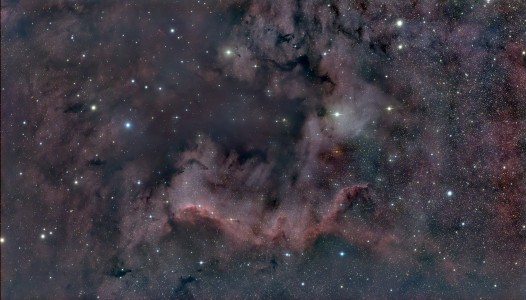
You can easily access, stack, and post process the sub exposures yourself. In my case, I’ve always found the ‘Standard’ built-in (one-click) option to provide great results. It combines what they call ‘Auto’ ‘Star Correction’ and ‘Denoise’. The image goes up to the Dwarf Lab Cloud, and comes back in about a minute (or less, typically) all done! The images shared here were all auto processed this way. I found this method to be sufficient.
The Iris Nebula – From Bortle 4 skies

If you try to get every last bit of battery life from it: You'll find that it stops imaging operations as soon as the unit's battery level reaches 7%. It stops taking photos, and waits for user input. When it first happened, I thought "Hmm...this is interesting; you can only get to 7%..." However, this seems like a good engineering design. I'd rather know that 7% battery life is the cut off time, than the possibility of having images get corrupted or not saved.
As with all smart telescopes, I recommend getting yourself one or even two external USB battery packs (the rechargeable ones everyone uses). Be sure to plug one in even before your unit approaches the 7% battery mark.
I have been impressed with the overall accuracy of the unit. I have not found it to be "off" in any way: If it states it's pointed at an object, it really is pointed there. The Wide Frame Window was in alignment out-of-the-box. This small, wide field of view window, allows you to quickly see the wider "picture" of where the telescope is pointed.
When I saw this feature on The Mini, for the very first time, I didn't think much of it. In fact, I didn't think it would be of much use to me. Now, I don't know how I could get by without it! In a way, it provides you with some peace of mind - knowing that you're pointed in the right place. It is also very useful for keeping an eye on any clouds which may be sneaking in. Also, if for any reason you prefer not to see it - simply click on it, and it disappears.
The Heart Nebula

Pros:
- Super small and easy to deploy anywhere!
- Very easy set-up steps - Take you from 0 -to- imaging in no time!
- The Wide Frame Window - Allows you to see the wide FOV of the area you're focused on at a glance.
- The Apochromatic optics produce wonderful, sharp results with your astrophotos.
- Polar alignment is very easy.
- Virtually One-step post processing via Stellar Studio / Dwarf Lab's cloud.
Cons:
- Battery life doesn't go to 4 full hours
- After locating your target, the unit must initialize for ~30 seconds or so.
If you're expecting 4 hours of battery life, you'll probably be disappointed. I didn't get a full 4 hours during my tests.
In regards to the 2nd Con: I've at least learned that several important functions/activities are taking place during those ~30".
The Dwarf Mini may be ordered directly from Dwarf Lab (dwarflab.com).
In addition, you may shop at your favorite astronomy product reseller’s online store.
This is what your display will look like while imaging

I've been fortunate enough to test and review several affordable smart telescopes so far. In summary, I'd state that I really enjoy using The Dwarf Mini. The software App is robust and easy to use. All things considered, the only real "Con" of any significance, is the slightly-less-than 4 hour battery life I experienced. I really can't find anything else to complain about with this unit. It delivers on all it promises.
The resulting images of deep sky objects speak for themselves!

Clear skies!