Orion 150mm Maksutov-Cassegrainian
The popularity of small Maksutov-Cassegrainian telescopes in recent years is a direct result of their numerous virtues. With the introduction of the Meade ETX series nearly a decade ago and the subsequent offering of the Orion Starmax and Apex Maksutovs, these compound mirror-lens instruments have been brought into the mainstream of amateur astronomy. And what’s not to like? The small Maks boast compact size, light weight, reasonable price, and the promise of fine optical quality. They are ideal for “grab-and-go” applications and travel by air.
But with apertures ranging from 90 to 127 mm ( 3.5 to 5 inches), they fall short of the aperture requirements of many observers. In the 6 inch and larger range, the excellent instruments of Intes-Micro, TEC, and others offer a major upgrade – but at much higher cost.
Enter the new Orion 150mm Mak-Cass. Sold as both a bare-bones optical tube assembly or fully mounted on an Orion SkyView Pro equatorial mount, this Chinese import is affordably priced and readily available. Already having a CG-5 mount, I opted for the optical tube alone along with the new Orion 8 x40mm finderscope.
The scope arrived in perfect condition and immediately impressed me with its hefty construction. This is no lightweight, but a solid all-metal and glass instrument that registers a healthy 12 pounds plus on the scale. The tube is some 17 inches long from the front of the lens cell to the end of the 1.25” visual back. A Vixen/ CG dovetail rail spans almost the entire length of the 7” diameter main tube, allowing for convenient balancing. A dovetail slot for any Orion finder from 6x30 to 9x50mm is provided as well. Fit and finish of the telescope rates as very good, with no cheap components or sloppy workmanship noted. The dark gray finish is attractive and professional in appearance.
The telescope’s interior struck me as being nearly immaculate: dust-free with uniformly aluminized mirrors and nicely coated meniscus corrector.
Mounting the Mak on a CG-5 and attaching the just-introduced Orion 8x40 finder, I inserted a TeleVue enhanced 1.25” diagonal in the visual back. Unfortunately, the scope has no provision for 2-inch hardware. I suspect that a custom 2” visual back could be fabricated, but the small diameter primary baffle would probably cause significant vignetting. This is an instrument clearly designed for higher power viewing with its f/12 focal ratio and an effective focal length of 1800mm. With a 30mm Celestron Ultima eyepiece, the scope yielded a magnification of 60x with a true field-of-view of some .83 degrees – not exactly RFT material, but wide enough to take in most deep-sky objects.
OPTICS
In a word, the optics of the Mak 150 would have to be considered very good – similar in performance to the Orion –Intes Mak-Cass that I owned several years ago. “First light” revealed, despite rather unsteady air, tight stellar images and a cleanly defined airy disk at high magnifications. A prominent first diffraction ring closely matched the ideal for a telescope with a 31 percent central obstruction ( 47mm in this case). Unfortunately, the scope was just a touch out of perfect alignment when the Polaris was viewed at 269x with a Meade UWA 6.7mm in the drawtube. Less than five minutes of fiddling with the recessed push-pull hex screws in the scope’s rear cell easily put the collimation dead-on.
Jupiter, perhaps one of the best tests of optical quality, became the basis of comparison in an impromptu “shootout” between the Mak and my Takahashi FS-102 APO, a telescope of impeccable pedigree and image quality. Top quality TeleVue dielectric star diagonals were used in both scopes to avoid any image degradation. At 138x, using a TV 13mm Plossl, the giant planet was swimming with rich detail in the Mak. Both equatorial belts were resolved into fine detail, with color being apparent and pure. A couple of delicate festoons could be glimpsed in the Equatorial Zone, and the Great Red Spot displayed its classic shape and a pale pinkish cast. Detail in the polar regions, typical of the image provided by a good planetary scope, was subtle but visible. The Tak FS-102 displayed similar detail in the image, with just a touch less brightness at identical magnification. However, the contrast provided by the APO was clearly superior. Though it showed no more detail than the Mak, the razor sharpness it delivered was more aesthetically pleasing and less sensitive to atmospheric turbulence. The strong showing by the Orion scope, however, indicates that it would almost certainly outperform a good 4-inch achromatic refractor on the planets.
A quick glance at the gibbous face of Venus as it descended in the western sky at twilight also yielded a satisfying result. The brilliant disk of the planet displayed a sharp cut-off at 138x and a complete lack of spurious color, except for the expected low-altitude atmospheric dispersion.
The next morning, I dragged myself out of bed at 3:30 AM to catch a view of the last-quarter moon. It was worth the temporary sleep deprivation! Despite mediocre seeing conditions, the image of our planet’s battered satellite was spectacular: the play of light and shadow on the lunar Appenines and heavily cratered southern hemisphere at 138x was unhindered by false color. At 200x, using a 9mm Nagler Type 6, the stark contrast remained, and there was no sign of image breakdown. Nearby Mars displayed a sharply defined gibbous disk with some surface detail, but increasing atmospheric turbulence precluded using adequate magnification. I do suspect, however, that the Mak will be an excellent instrument for detailed observation of the red planet during its coming apparition.
Double star observing with the telescope proved to be a very satisfying experience. Over a period of some half-dozen nights, the Mak showed its worth by resolving a host of multiple stars, some of them rather challenging. A classic test, Epsilon Lyrae, was neatly split into its four components at 90x, and the image at 200x exhibited small, tight airy disks with thin, well-defined first diffraction rings. A very solid and pleasing display.
The much more difficult Delta Cygni revealed its faint, close companion at 130x and above, though not quite as cleanly as the Tak FS-102.
Splitting Antares, normally a frustrating experience, was accomplished with relative ease at 269x using a Meade 6.7mm UWA eyepiece. With haze stabilizing the image of the low-altitude red giant, the tiny companion stood out clearly. Impressive, to be sure. Widely spaced, colorful doubles such as Albireo and Gamma Delphini were also a treat, the pure, accurate color saturation at 90x with a Burgess 20mm wide angle eyepiece making for a lovely sight. The long f/12 focal ratio of the Mak seemed to allow any eyepiece, regardless of cost or optical configuration, to perform well.
Though limited by its relatively narrow field-of-view, this 150mm scope delivered some very nice deep-sky images. Its aperture advantage over Orion’s smaller 127mm Mak is considerable, but the loss of light throughput caused by 2 (approximately) 89 percent reflective mirrors, a thick meniscus corrector, and secondary obstruction give it the magnitude penetration of a 4.5” APO refractor. In fact, side-by-side comparison with my Vixen 114mm ED revealed almost identical image brightness. Under fairly dark semi-rural skies, both telescopes resolved M 13 to the core at 120x and partially resolved M 92 and M 15. Pinpoint stellar images were apparent in both scopes, but those in the refractor appeared somewhat harder and sharper. Compared to the smaller Takahashi FS-102, the Mak held a slight advantage.
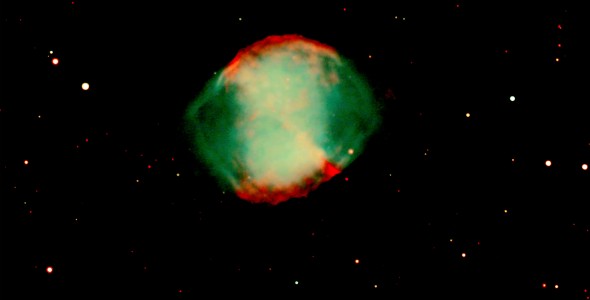
On nebulae ranging from the fairly small M 57 to the very large M 17, the Mak produced visibly better brightness than the Tak and a dead heat with the Vixen. My Orion (Intes) 6” Maksutov-Newtonian, however, beat all three of the other scopes.
For some reason, the refractors, especially the Takahashi FS-102, produced a darker field-of-view than the Orion 150. The Orion Mak has fully baffled primary and secondary mirrors that do a reasonably good job at suppressing stray light, but a bright star just outside of the field will produce a luminous arc in the eyepiece – not terrible, but an indication of a less-than-optimum set-up.
MECHANICS
Though the Orion Mak boasts very good optics and solid construction, it has two noticeable faults: the focuser and placement of the finder scope.
Those familiar with the image shift endemic to most Schmidt-Cassegrainians will feel right at home with the Orion. The “moving mirror” focusing knob has a good feel, but the image moves with it. At first, I believed the image motion to be on the order of 20 arc seconds, but further examination revealed it to be much more – as much as 2 arc-MINUTES! at one point in the focuser’s rotation. At 200x, Jupiter exhibited enough feints, jukes, and darting moves to emulate the great Walter Payton in his heyday. Very irritating for a visual observer and serious trouble for the astrophotographer or ccd imager. The focus also has a tendency to slip as the telescope is moved from horizon to zenith. To be fair to Orion, my particular scope may not be representative of the entire breed. Yet, if Celestron can produce a zero-image-shift C 5, Orion’s provider should be able to do the same.
The placement of the dovetail finder“shoe” at the very back of the optical tube also proved to be an annoyance. The Orion 8x40mm finder, when inserted in place at the holder’s ten O’clock position, protruded well beyond the end of the tube and clipped my left ear as I attempted to view through the main scope. There’s not much head clearance for a left-eyed observer (as I am), and a right-eyed viewer might sustain a nasty blow to the temple if not careful. Using a smaller finderscope would help, but the definitive solution is to move the mounting shoe forward on the tube.
CONCLUSIONS
Overall, this new Orion offering is quite impressive. Optical quality is very good, and the telescope is solidly built and well finished. Its performance is a quantum leap above that of the 4 and 5-inch Maks, and it will hold its own against some very fine (and expensive) 4-inch APO refractors, especially in lunar, planetary, and double star observing. It clearly bests just about any 4-inch achromat, except in wide-field viewing.
Premium US and Russian-built Maksutovs are better, but cost a good deal more than the Orion’s $649.
If the potential buyer can tolerate a mediocre focusing mechanism, the traditional Mak-Cass long cool-down time, and a poorly placed finder, this “Bigger Mak” could be a real find and an unusual bargain. Here, performance, portability, and reasonable cost are wrapped into an attractive package – one that should satisfy many observers.
Clear skies!
Larry Carlino
But with apertures ranging from 90 to 127 mm ( 3.5 to 5 inches), they fall short of the aperture requirements of many observers. In the 6 inch and larger range, the excellent instruments of Intes-Micro, TEC, and others offer a major upgrade – but at much higher cost.
Enter the new Orion 150mm Mak-Cass. Sold as both a bare-bones optical tube assembly or fully mounted on an Orion SkyView Pro equatorial mount, this Chinese import is affordably priced and readily available. Already having a CG-5 mount, I opted for the optical tube alone along with the new Orion 8 x40mm finderscope.
The scope arrived in perfect condition and immediately impressed me with its hefty construction. This is no lightweight, but a solid all-metal and glass instrument that registers a healthy 12 pounds plus on the scale. The tube is some 17 inches long from the front of the lens cell to the end of the 1.25” visual back. A Vixen/ CG dovetail rail spans almost the entire length of the 7” diameter main tube, allowing for convenient balancing. A dovetail slot for any Orion finder from 6x30 to 9x50mm is provided as well. Fit and finish of the telescope rates as very good, with no cheap components or sloppy workmanship noted. The dark gray finish is attractive and professional in appearance.
The telescope’s interior struck me as being nearly immaculate: dust-free with uniformly aluminized mirrors and nicely coated meniscus corrector.
Mounting the Mak on a CG-5 and attaching the just-introduced Orion 8x40 finder, I inserted a TeleVue enhanced 1.25” diagonal in the visual back. Unfortunately, the scope has no provision for 2-inch hardware. I suspect that a custom 2” visual back could be fabricated, but the small diameter primary baffle would probably cause significant vignetting. This is an instrument clearly designed for higher power viewing with its f/12 focal ratio and an effective focal length of 1800mm. With a 30mm Celestron Ultima eyepiece, the scope yielded a magnification of 60x with a true field-of-view of some .83 degrees – not exactly RFT material, but wide enough to take in most deep-sky objects.
OPTICS
In a word, the optics of the Mak 150 would have to be considered very good – similar in performance to the Orion –Intes Mak-Cass that I owned several years ago. “First light” revealed, despite rather unsteady air, tight stellar images and a cleanly defined airy disk at high magnifications. A prominent first diffraction ring closely matched the ideal for a telescope with a 31 percent central obstruction ( 47mm in this case). Unfortunately, the scope was just a touch out of perfect alignment when the Polaris was viewed at 269x with a Meade UWA 6.7mm in the drawtube. Less than five minutes of fiddling with the recessed push-pull hex screws in the scope’s rear cell easily put the collimation dead-on.
Jupiter, perhaps one of the best tests of optical quality, became the basis of comparison in an impromptu “shootout” between the Mak and my Takahashi FS-102 APO, a telescope of impeccable pedigree and image quality. Top quality TeleVue dielectric star diagonals were used in both scopes to avoid any image degradation. At 138x, using a TV 13mm Plossl, the giant planet was swimming with rich detail in the Mak. Both equatorial belts were resolved into fine detail, with color being apparent and pure. A couple of delicate festoons could be glimpsed in the Equatorial Zone, and the Great Red Spot displayed its classic shape and a pale pinkish cast. Detail in the polar regions, typical of the image provided by a good planetary scope, was subtle but visible. The Tak FS-102 displayed similar detail in the image, with just a touch less brightness at identical magnification. However, the contrast provided by the APO was clearly superior. Though it showed no more detail than the Mak, the razor sharpness it delivered was more aesthetically pleasing and less sensitive to atmospheric turbulence. The strong showing by the Orion scope, however, indicates that it would almost certainly outperform a good 4-inch achromatic refractor on the planets.
A quick glance at the gibbous face of Venus as it descended in the western sky at twilight also yielded a satisfying result. The brilliant disk of the planet displayed a sharp cut-off at 138x and a complete lack of spurious color, except for the expected low-altitude atmospheric dispersion.
The next morning, I dragged myself out of bed at 3:30 AM to catch a view of the last-quarter moon. It was worth the temporary sleep deprivation! Despite mediocre seeing conditions, the image of our planet’s battered satellite was spectacular: the play of light and shadow on the lunar Appenines and heavily cratered southern hemisphere at 138x was unhindered by false color. At 200x, using a 9mm Nagler Type 6, the stark contrast remained, and there was no sign of image breakdown. Nearby Mars displayed a sharply defined gibbous disk with some surface detail, but increasing atmospheric turbulence precluded using adequate magnification. I do suspect, however, that the Mak will be an excellent instrument for detailed observation of the red planet during its coming apparition.
Double star observing with the telescope proved to be a very satisfying experience. Over a period of some half-dozen nights, the Mak showed its worth by resolving a host of multiple stars, some of them rather challenging. A classic test, Epsilon Lyrae, was neatly split into its four components at 90x, and the image at 200x exhibited small, tight airy disks with thin, well-defined first diffraction rings. A very solid and pleasing display.
The much more difficult Delta Cygni revealed its faint, close companion at 130x and above, though not quite as cleanly as the Tak FS-102.
Splitting Antares, normally a frustrating experience, was accomplished with relative ease at 269x using a Meade 6.7mm UWA eyepiece. With haze stabilizing the image of the low-altitude red giant, the tiny companion stood out clearly. Impressive, to be sure. Widely spaced, colorful doubles such as Albireo and Gamma Delphini were also a treat, the pure, accurate color saturation at 90x with a Burgess 20mm wide angle eyepiece making for a lovely sight. The long f/12 focal ratio of the Mak seemed to allow any eyepiece, regardless of cost or optical configuration, to perform well.
Though limited by its relatively narrow field-of-view, this 150mm scope delivered some very nice deep-sky images. Its aperture advantage over Orion’s smaller 127mm Mak is considerable, but the loss of light throughput caused by 2 (approximately) 89 percent reflective mirrors, a thick meniscus corrector, and secondary obstruction give it the magnitude penetration of a 4.5” APO refractor. In fact, side-by-side comparison with my Vixen 114mm ED revealed almost identical image brightness. Under fairly dark semi-rural skies, both telescopes resolved M 13 to the core at 120x and partially resolved M 92 and M 15. Pinpoint stellar images were apparent in both scopes, but those in the refractor appeared somewhat harder and sharper. Compared to the smaller Takahashi FS-102, the Mak held a slight advantage.
On nebulae ranging from the fairly small M 57 to the very large M 17, the Mak produced visibly better brightness than the Tak and a dead heat with the Vixen. My Orion (Intes) 6” Maksutov-Newtonian, however, beat all three of the other scopes.
For some reason, the refractors, especially the Takahashi FS-102, produced a darker field-of-view than the Orion 150. The Orion Mak has fully baffled primary and secondary mirrors that do a reasonably good job at suppressing stray light, but a bright star just outside of the field will produce a luminous arc in the eyepiece – not terrible, but an indication of a less-than-optimum set-up.
MECHANICS
Though the Orion Mak boasts very good optics and solid construction, it has two noticeable faults: the focuser and placement of the finder scope.
Those familiar with the image shift endemic to most Schmidt-Cassegrainians will feel right at home with the Orion. The “moving mirror” focusing knob has a good feel, but the image moves with it. At first, I believed the image motion to be on the order of 20 arc seconds, but further examination revealed it to be much more – as much as 2 arc-MINUTES! at one point in the focuser’s rotation. At 200x, Jupiter exhibited enough feints, jukes, and darting moves to emulate the great Walter Payton in his heyday. Very irritating for a visual observer and serious trouble for the astrophotographer or ccd imager. The focus also has a tendency to slip as the telescope is moved from horizon to zenith. To be fair to Orion, my particular scope may not be representative of the entire breed. Yet, if Celestron can produce a zero-image-shift C 5, Orion’s provider should be able to do the same.
The placement of the dovetail finder“shoe” at the very back of the optical tube also proved to be an annoyance. The Orion 8x40mm finder, when inserted in place at the holder’s ten O’clock position, protruded well beyond the end of the tube and clipped my left ear as I attempted to view through the main scope. There’s not much head clearance for a left-eyed observer (as I am), and a right-eyed viewer might sustain a nasty blow to the temple if not careful. Using a smaller finderscope would help, but the definitive solution is to move the mounting shoe forward on the tube.
CONCLUSIONS
Overall, this new Orion offering is quite impressive. Optical quality is very good, and the telescope is solidly built and well finished. Its performance is a quantum leap above that of the 4 and 5-inch Maks, and it will hold its own against some very fine (and expensive) 4-inch APO refractors, especially in lunar, planetary, and double star observing. It clearly bests just about any 4-inch achromat, except in wide-field viewing.
Premium US and Russian-built Maksutovs are better, but cost a good deal more than the Orion’s $649.
If the potential buyer can tolerate a mediocre focusing mechanism, the traditional Mak-Cass long cool-down time, and a poorly placed finder, this “Bigger Mak” could be a real find and an unusual bargain. Here, performance, portability, and reasonable cost are wrapped into an attractive package – one that should satisfy many observers.
Clear skies!
Larry Carlino