
What Was I Thinking!!!
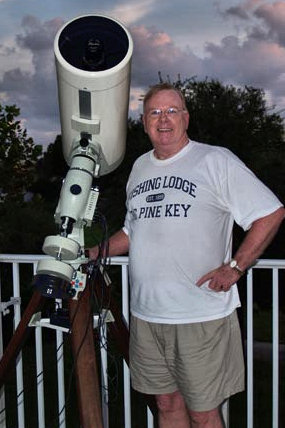
Since this is my second Mewlon 250, I feel well qualified to do this report. I sold my first one, but why, is still a mystery to me. Looking back, I could have put my 6 year old to work to make the extra money we needed, but NOOOO I sold the Mewlon. Oh well, no harm done since I was able to find work and purchase my second Mewlon 250. I was very lucky, looking on Astromart, someone locally had one for sale that was in mint condition. The price was right so it was one happy day, the day I picked it up.
Before I start you need to know that I am an astro imager and next to a good quality mount, only the best optics will get the best results. It would be nice if I could afford a Richey but I can’t, so I bought the next best thing, a Mewlon 250. I’m glad now that I ignored a report that a Dall-Kirkham design supposedly suffers from coma and astigmatism problems because I found that neither exists to any noticeable degree that I would consider detrimental. Maybe the reporter was using a K-Mart eyepiece (not that there is anything wrong with K-Mart). The fact that there are only two glass surfaces in the optical train was a big selling point. IMHO, the less glass in the optical train the better.
The first thing you notice about the scope, besides the superb fit and finish, is the weight. For an aperture of 10 inches you would think the tube would be fairly heavy but the Mewlon 250 is only 27.5 lbs and easily manageable, even for a man of my advanced age. Placing the tube on the mount is a snap, just position the base plate into the holder, tighten the knob and you’re done.
Everything about the Mewlon screams quality, from the rounded opening, which resists moisture buildup from falling on the mirror; to the removable back plate for quick cooling.
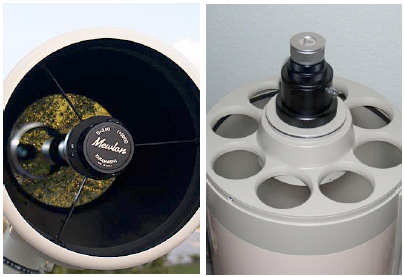
As an imager, the one feature I really like about this scope is the electric focuser. You can do all your focusing while sitting down in front of your computer, from course focus to very fine focusing, just by selecting the speed you want on the hand controller. The movement is very smooth with absolutely no image shift. (a definite plus for imagers)
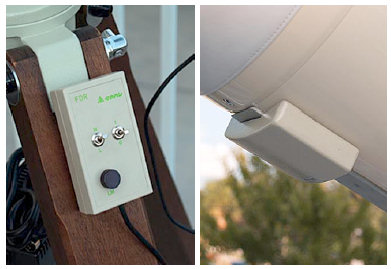
Balancing the scope is easy just slide the magnetic weights to the position desired and walla, your balanced. Add a CCD camera (or for Televue users - the holy hand grenade), just slide the weights to the end of the scope, it’s that easy.
The finder scope, which also subs as a handle (makes it easy to hold the scope when mounting), has no equal. It’s simply the best out there. Optically it’s a teaser to what’s in store next.
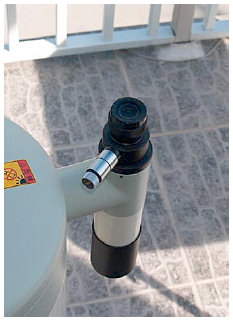
The first time you look through the scope it hits you like a ton of bricks. This is no ordinary scope, this is an exceptional scope. The stars appear almost three dimensional and placed on a jet black background. I have been fortunate to have owned a WO 110 Florostar refractor and the images through that scope were fantastic but don’t compare to this scope. Omega Centauri literally filled the eye piece with pinpoint stars all the way to the edge. In subsequent observing, (yes not all imagers bury their head in a computer screen) I have been able to push the limits of this scope. I’m fortunate to have a dark sky site I can go to in Chiefland Florida. The air can be very still (good seeing) and transparent. A good friend of mine had just purchased a 10” mak cassigrain. We placed both scopes on the double double and started adding power. We got to 1500X and you could still see two stars with a hole you could drive a truck through, mine not his. His turned to mush at 900X. In short the optical performance is second to none. I use Pentax eyepieces for all my observing and have found that they match this scope very well. No coma that I can detect and imperceptible chromatic aberration. Planets just jump at you with detail not seen in lesser scopes. Deep sky and clusters look better through this scope than any other 10’ scopes I have looked through.
For imaging I have the Tak 9.2 reducer attached to my ST-8XE that drops the focal length from 3,000mm to 2,300mm and the f ratio from f12 to f9.6.
The Tak TOA 1.6X extender boosts the focal length from 3,000mm to 4,800mm and f-ratio to f19 perfect for planetaries and clusters.
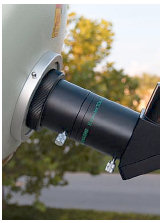
Is this the ultimate lightweight large aperture portable scope? In my opinion YES.
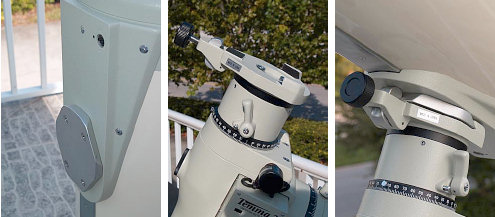
The perfect scope deserves a perfect mount and the EM-200 Temma 2 is the ticket. This mount is in my estimation the finest mount you can buy under $6,000 period. The following will explain why. First of all the tripod is very stable and non adjustable. The reason is in the ingenious way that the mount works. It does not require that you have the mount level, in fact you can set the scope up on the side of a hill and it will still work perfectly.
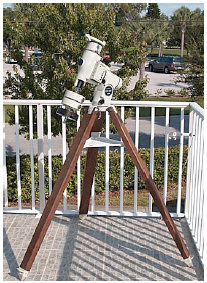
How they accomplish this would require another report, so for brevity, let’s just say it works perfectly. The polar scope is a work of art in it’s own. The illuminator inside the scope is designed to block out other stars so only Polaris is seen (very handy if your in a hurry). Once you tell the scope at what longitude you are (the calibrated scale) you just orient the scope so that the bubble is centered. Set the date and time in the internal scale, place Polaris in the rectangle, tighten everything down and you’re done. The polar scope will align the scope to within 3 arc minutes of the pole. More than enough for most work.
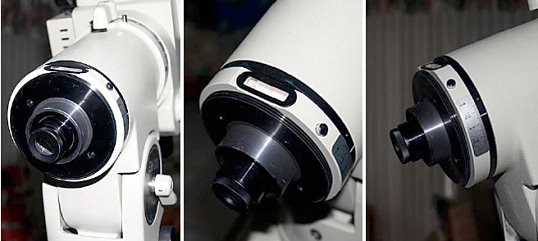
The mount electrical system works on 12 volts or 24 volts. Most will want to use the 24-volt mode since the slewing speed is increased two fold to 700X tracking or 1.6 degrees per second. The EM-200 Temma 2 is fully Go To and has cables for guiding a CCD camera and telescope control through “The Sky” plus other programs.
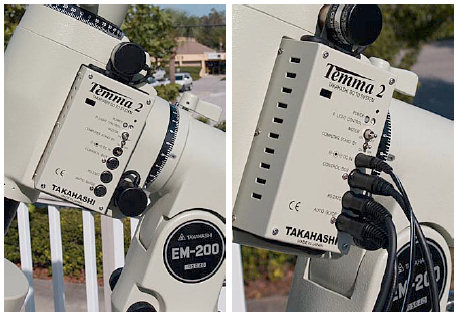
Control of the mount is through a programmable controller that fits perfectly in your hand.
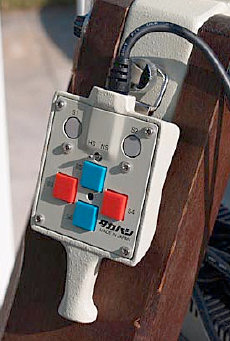
We have all heard the coffee grinders out on the field at night at star parties. The EM-200 is not one of them. The larger, higher-torque precision motors used in the Temma 2 are quiet and sound it. Go To is dead on with only a slight re sync after changing sky quadrants. (east to west). The best part of the mount is the tracking. There is no way to control the period error correction with this mount and believe it or not it doesn’t need it. The mount is capable of +/- 4 arc seconds tracking so that the auto guiders don’t have to work hard at all. This equates to nice round stars and better-looking images.
The clutches hold the largest of scopes (up to 35 lbs) in place with no slippage, In all, I highly recommend this mount and scope combination for anyone who is just an observer who wants the best views possible and for imagers who demand performance. Yes the whole setup is not inexpensive but I for one have found that this combo is by far the best value for the money spent and will continue to pay dividends for many years to come. These two performers are a keeper and NEVER will I part with them again.
What Was I Thinking!!
Mewlon 250 & EM-200 Temma 2 Mount
By John O’Neill
Before I start you need to know that I am an astro imager and next to a good quality mount, only the best optics will get the best results. It would be nice if I could afford a Richey but I can’t, so I bought the next best thing, a Mewlon 250. I’m glad now that I ignored a report that a Dall-Kirkham design supposedly suffers from coma and astigmatism problems because I found that neither exists to any noticeable degree that I would consider detrimental. Maybe the reporter was using a K-Mart eyepiece (not that there is anything wrong with K-Mart). The fact that there are only two glass surfaces in the optical train was a big selling point. IMHO, the less glass in the optical train the better.
The first thing you notice about the scope, besides the superb fit and finish, is the weight. For an aperture of 10 inches you would think the tube would be fairly heavy but the Mewlon 250 is only 27.5 lbs and easily manageable, even for a man of my advanced age. Placing the tube on the mount is a snap, just position the base plate into the holder, tighten the knob and you’re done.
Everything about the Mewlon screams quality, from the rounded opening, which resists moisture buildup from falling on the mirror; to the removable back plate for quick cooling.
As an imager, the one feature I really like about this scope is the electric focuser. You can do all your focusing while sitting down in front of your computer, from course focus to very fine focusing, just by selecting the speed you want on the hand controller. The movement is very smooth with absolutely no image shift. (a definite plus for imagers)
Balancing the scope is easy just slide the magnetic weights to the position desired and walla, your balanced. Add a CCD camera (or for Televue users - the holy hand grenade), just slide the weights to the end of the scope, it’s that easy.
The finder scope, which also subs as a handle (makes it easy to hold the scope when mounting), has no equal. It’s simply the best out there. Optically it’s a teaser to what’s in store next.
The first time you look through the scope it hits you like a ton of bricks. This is no ordinary scope, this is an exceptional scope. The stars appear almost three dimensional and placed on a jet black background. I have been fortunate to have owned a WO 110 Florostar refractor and the images through that scope were fantastic but don’t compare to this scope. Omega Centauri literally filled the eye piece with pinpoint stars all the way to the edge. In subsequent observing, (yes not all imagers bury their head in a computer screen) I have been able to push the limits of this scope. I’m fortunate to have a dark sky site I can go to in Chiefland Florida. The air can be very still (good seeing) and transparent. A good friend of mine had just purchased a 10” mak cassigrain. We placed both scopes on the double double and started adding power. We got to 1500X and you could still see two stars with a hole you could drive a truck through, mine not his. His turned to mush at 900X. In short the optical performance is second to none. I use Pentax eyepieces for all my observing and have found that they match this scope very well. No coma that I can detect and imperceptible chromatic aberration. Planets just jump at you with detail not seen in lesser scopes. Deep sky and clusters look better through this scope than any other 10’ scopes I have looked through.
For imaging I have the Tak 9.2 reducer attached to my ST-8XE that drops the focal length from 3,000mm to 2,300mm and the f ratio from f12 to f9.6.
The Tak TOA 1.6X extender boosts the focal length from 3,000mm to 4,800mm and f-ratio to f19 perfect for planetaries and clusters.
Is this the ultimate lightweight large aperture portable scope? In my opinion YES.
The perfect scope deserves a perfect mount and the EM-200 Temma 2 is the ticket. This mount is in my estimation the finest mount you can buy under $6,000 period. The following will explain why. First of all the tripod is very stable and non adjustable. The reason is in the ingenious way that the mount works. It does not require that you have the mount level, in fact you can set the scope up on the side of a hill and it will still work perfectly.
How they accomplish this would require another report, so for brevity, let’s just say it works perfectly. The polar scope is a work of art in it’s own. The illuminator inside the scope is designed to block out other stars so only Polaris is seen (very handy if your in a hurry). Once you tell the scope at what longitude you are (the calibrated scale) you just orient the scope so that the bubble is centered. Set the date and time in the internal scale, place Polaris in the rectangle, tighten everything down and you’re done. The polar scope will align the scope to within 3 arc minutes of the pole. More than enough for most work.
The mount electrical system works on 12 volts or 24 volts. Most will want to use the 24-volt mode since the slewing speed is increased two fold to 700X tracking or 1.6 degrees per second. The EM-200 Temma 2 is fully Go To and has cables for guiding a CCD camera and telescope control through “The Sky” plus other programs.
Control of the mount is through a programmable controller that fits perfectly in your hand.
We have all heard the coffee grinders out on the field at night at star parties. The EM-200 is not one of them. The larger, higher-torque precision motors used in the Temma 2 are quiet and sound it. Go To is dead on with only a slight re sync after changing sky quadrants. (east to west). The best part of the mount is the tracking. There is no way to control the period error correction with this mount and believe it or not it doesn’t need it. The mount is capable of +/- 4 arc seconds tracking so that the auto guiders don’t have to work hard at all. This equates to nice round stars and better-looking images.
The clutches hold the largest of scopes (up to 35 lbs) in place with no slippage, In all, I highly recommend this mount and scope combination for anyone who is just an observer who wants the best views possible and for imagers who demand performance. Yes the whole setup is not inexpensive but I for one have found that this combo is by far the best value for the money spent and will continue to pay dividends for many years to come. These two performers are a keeper and NEVER will I part with them again.
What Was I Thinking!!
Mewlon 250 & EM-200 Temma 2 Mount
By John O’Neill