Small Scope Nirvana: The TeleVue-76 APO Refractor

[ARTICLEIMGR="1"]
I became interested in small refractors after observing with Al Nagler’s TeleVue-85 at the 2000 Riverside Telescope Maker’s Conference. This was the first time that I had ever looked through an APO refractor, and I was really struck by the beautiful views. The scope revealed wide swaths of sky filled with delicate stellar pinpoints, and deep sky objects were much more impressive than I would have imagined in such a small scope.
Ever since becoming involved in astronomy in the mid 1980s, I had believed that large and larger aperture reflectors were the best scopes for astronomy and felt that refractors were small, elitist scopes. Most of the amateurs I knew enjoyed deep sky observing and used Newtonians or Schmidt-Cassegrains. The occasional refractor at a star party was primarily used for astrophotography.
The delightful views through the TeleVue-85 completely changed my mind about refractors. I had to get one! Excited, I read all of the refractor reviews on the Internet and immersed myself in the refractor zeitgeist. I realized that a small, portable scope with fine optics is actually quite practical. Convenient scopes tend to get used, especially on nights when I’d almost rather stay inside. I decided that I needed to get a TeleVue scope and purchased a Pronto.
I have owned my TeleVue Pronto since 2001. I have really enjoyed the scope, and I have used it more often than any other. The Pronto is easy to setup and provides impressive views. It can be used for many types of observation, from low power Milky Way star fields to high magnification views of planets. The Pronto will easily reveal many deep sky objects. The entire Messier Catalog should be observable, along with the brighter NGC objects.
The Pronto is a 70mm ED doublet that exhibits some false color. At low powers, the scope is essentially an APO. Color becomes noticeable around 70x. For example, the moon in the Pronto exhibits a dull, purple rim along its bright edge. The most brilliant stars display subtle, purple disks, and, with 120x, white stars begin to take on a faint green tint that makes estimation of star colors difficult. I am especially annoyed with this later characteristic. I want stars to appear natural at high magnifications. False color is also evident when observing the bright planets and the moon with the Pronto. Details are apparent, yet the false color is distracting.
Owning the Pronto whetted my appetite for high quality optics. After nearly 5 years, I decided that I needed an APO and purchased a TeleVue-76.
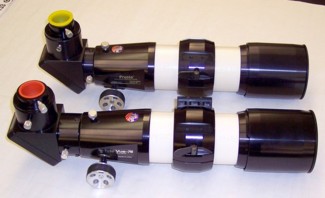
The TeleVue-76 is nearly the twin of my Pronto in appearance and mechanics. As with the Pronto, the TeleVue-76 features a white crinkle-painted tube with black anodized aluminum hardware.
The tube of the TeleVue-76 is a bit shorter than the Pronto due to the newer compression ring fixture for holding the diagonal. The compression ring is more secure than the Pronto’s single setscrew, and it tends to center the diagonal within the drawtube rather than push it from one direction.
The TeleVue-76 uses the same diameter cell as the Pronto’s, yet is fitted with a larger 76mm objective. Both the TeleVue-76 and Pronto have 480mm focal lengths and provide the same set of magnifications. I imagine that Al did this to encourage Pronto owners to upgrade their scopes.
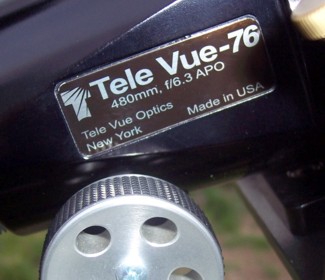
According to the TeleVue-76’s Operating Guide: “This 3-inch aperture telescope has a 480mm focal length, f/6.3 APO doublet diffraction-limited objective.” The optics are also “fully multi-coated.” The scope’s resolution equals “1.5 arc-sec (Dawes Limit for a 3-inch aperture).” The magnification range equals “9x to 200x using TeleVue eyepieces.”
As with all TeleVue products, the construction, materials, and attention to detail are superlative. The TeleVue-76 is one of the highest quality small telescopes available. When holding the scope, you notice its heft and solid assembly. The scope with diagonal and mount ring weighs 7 lbs. Yet the scope fits in a small case that can easily rest on the back seat of a car. It is very portable, especially when used with a small altazimuth mount such as the TeleVue Tele-Pod.
One of the strengths of small refractors is their amazing wide fields. For example, the TeleVue-76 with a 35mm Panoptic yields a magnification of 14x and a 5-degree field. This is the same diameter as ten full moons. This eyepiece in the TeleVue-76 will display the entire Belt of Orion in one view. With such low powers, the TeleVue-76 can provide unique observing opportunities such as viewing both halves of the Veil Nebula in one field, or the entire Andromeda Galaxy. Essentially, this scope has the low power capability of binoculars, yet it can also zoom in and observe planets at high magnifications. These small APOs are versatile telescopes.
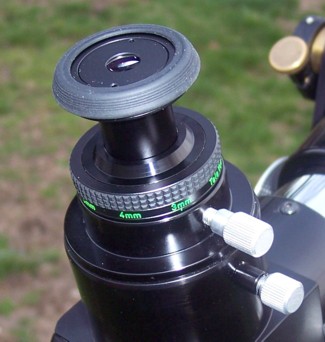
For higher powers, I use a Tele Vue 3mm-6mm Nagler Zoom. The eyepiece features click-stops at each millimeter increment providing powers of 80x, 96x, 120x, and 160x. The views are crisp at all positions with a constant 50-degree apparent field, and the focus also remains the same throughout the range of magnifications. As with all TeleVue eyepieces, the mechanical quality is superb. I really enjoy this eyepiece, and it was designed to compliment short focal length refractors such as the TeleVue-76. The Nagler Zoom doesn’t replace a dedicated high power eyepiece such as a Radian for viewing comfort and apparent field, yet it is a lot of fun to play with. With the zoom feature, the magnification can be adjusted to match the current seeing conditions.
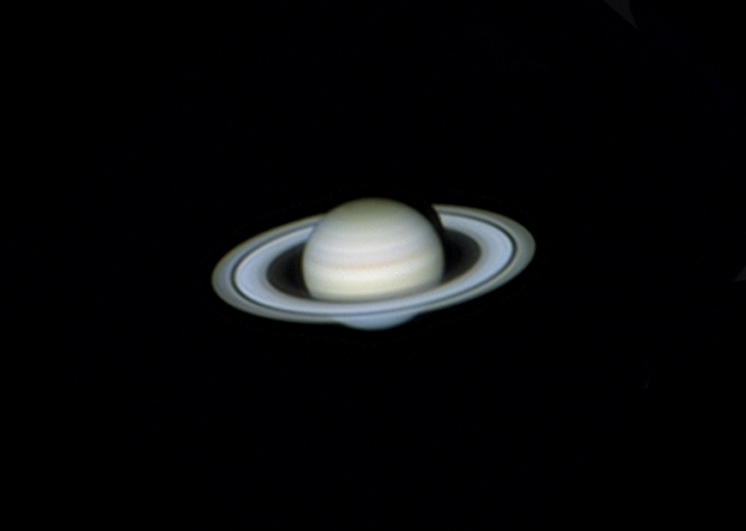
The views through the TeleVue-76 are what you would expect from a high-quality APO: Beautiful wide fields with crisp, pinpoint stars. The scope takes magnification well and reveals significant detail on the moon, sun, and planets. With this scope I have observed dark markings on Mars and cloud bands on the disks of Jupiter and Saturn. The moon is stunning in the TeleVue-76. Lunar shadows are inky black without a trace of purple haze. Double stars are particularly nice in the scope and retain their true colors at high magnifications. Even with three inches of aperture, the scope can reveal a surprising number of deep sky objects. All of the Messier and bright NGC objects are observable. The scope also provides exquisite views of open clusters due to its pinpoint resolution of stars.
The Pronto and TeleVue-76 are very similar scopes. Was the upgrade worth the money? I think so. The mechanics of each scope are similar, and at low powers the Pronto and TeleVue-76 are close in performance, yet the APO optics of the TeleVue-76 provide a substantial improvement in the scope’s performance at high magnifications when compared to the older Pronto.
The TeleVue-76 allows me to maximize the small amount of available time that I have for astronomy. The scope is convenient and provides some of the best views obtainable at this aperture. The TeleVue-76 can be used for a variety of observing, from low power star fields to crisp, high magnification views of the sun, moon, and planets.
The TeleVue-76 functions as a new and improved version of the TeleVue Pronto. The Pronto has been a great scope, and it provided me with an introduction to fine optics and the joy of small scope use. Yet the TeleVue-76 is everything that I wished the Pronto had been. I really love the scope, and it is a lot of fun to own and use such a quality instrument.
Click here for more about this subject. -Ed.
I became interested in small refractors after observing with Al Nagler’s TeleVue-85 at the 2000 Riverside Telescope Maker’s Conference. This was the first time that I had ever looked through an APO refractor, and I was really struck by the beautiful views. The scope revealed wide swaths of sky filled with delicate stellar pinpoints, and deep sky objects were much more impressive than I would have imagined in such a small scope.
Ever since becoming involved in astronomy in the mid 1980s, I had believed that large and larger aperture reflectors were the best scopes for astronomy and felt that refractors were small, elitist scopes. Most of the amateurs I knew enjoyed deep sky observing and used Newtonians or Schmidt-Cassegrains. The occasional refractor at a star party was primarily used for astrophotography.
The delightful views through the TeleVue-85 completely changed my mind about refractors. I had to get one! Excited, I read all of the refractor reviews on the Internet and immersed myself in the refractor zeitgeist. I realized that a small, portable scope with fine optics is actually quite practical. Convenient scopes tend to get used, especially on nights when I’d almost rather stay inside. I decided that I needed to get a TeleVue scope and purchased a Pronto.
I have owned my TeleVue Pronto since 2001. I have really enjoyed the scope, and I have used it more often than any other. The Pronto is easy to setup and provides impressive views. It can be used for many types of observation, from low power Milky Way star fields to high magnification views of planets. The Pronto will easily reveal many deep sky objects. The entire Messier Catalog should be observable, along with the brighter NGC objects.
The Pronto is a 70mm ED doublet that exhibits some false color. At low powers, the scope is essentially an APO. Color becomes noticeable around 70x. For example, the moon in the Pronto exhibits a dull, purple rim along its bright edge. The most brilliant stars display subtle, purple disks, and, with 120x, white stars begin to take on a faint green tint that makes estimation of star colors difficult. I am especially annoyed with this later characteristic. I want stars to appear natural at high magnifications. False color is also evident when observing the bright planets and the moon with the Pronto. Details are apparent, yet the false color is distracting.
Owning the Pronto whetted my appetite for high quality optics. After nearly 5 years, I decided that I needed an APO and purchased a TeleVue-76.
The TeleVue-76 is nearly the twin of my Pronto in appearance and mechanics. As with the Pronto, the TeleVue-76 features a white crinkle-painted tube with black anodized aluminum hardware.
The tube of the TeleVue-76 is a bit shorter than the Pronto due to the newer compression ring fixture for holding the diagonal. The compression ring is more secure than the Pronto’s single setscrew, and it tends to center the diagonal within the drawtube rather than push it from one direction.
The TeleVue-76 uses the same diameter cell as the Pronto’s, yet is fitted with a larger 76mm objective. Both the TeleVue-76 and Pronto have 480mm focal lengths and provide the same set of magnifications. I imagine that Al did this to encourage Pronto owners to upgrade their scopes.
According to the TeleVue-76’s Operating Guide: “This 3-inch aperture telescope has a 480mm focal length, f/6.3 APO doublet diffraction-limited objective.” The optics are also “fully multi-coated.” The scope’s resolution equals “1.5 arc-sec (Dawes Limit for a 3-inch aperture).” The magnification range equals “9x to 200x using TeleVue eyepieces.”
As with all TeleVue products, the construction, materials, and attention to detail are superlative. The TeleVue-76 is one of the highest quality small telescopes available. When holding the scope, you notice its heft and solid assembly. The scope with diagonal and mount ring weighs 7 lbs. Yet the scope fits in a small case that can easily rest on the back seat of a car. It is very portable, especially when used with a small altazimuth mount such as the TeleVue Tele-Pod.
One of the strengths of small refractors is their amazing wide fields. For example, the TeleVue-76 with a 35mm Panoptic yields a magnification of 14x and a 5-degree field. This is the same diameter as ten full moons. This eyepiece in the TeleVue-76 will display the entire Belt of Orion in one view. With such low powers, the TeleVue-76 can provide unique observing opportunities such as viewing both halves of the Veil Nebula in one field, or the entire Andromeda Galaxy. Essentially, this scope has the low power capability of binoculars, yet it can also zoom in and observe planets at high magnifications. These small APOs are versatile telescopes.
For higher powers, I use a Tele Vue 3mm-6mm Nagler Zoom. The eyepiece features click-stops at each millimeter increment providing powers of 80x, 96x, 120x, and 160x. The views are crisp at all positions with a constant 50-degree apparent field, and the focus also remains the same throughout the range of magnifications. As with all TeleVue eyepieces, the mechanical quality is superb. I really enjoy this eyepiece, and it was designed to compliment short focal length refractors such as the TeleVue-76. The Nagler Zoom doesn’t replace a dedicated high power eyepiece such as a Radian for viewing comfort and apparent field, yet it is a lot of fun to play with. With the zoom feature, the magnification can be adjusted to match the current seeing conditions.
The views through the TeleVue-76 are what you would expect from a high-quality APO: Beautiful wide fields with crisp, pinpoint stars. The scope takes magnification well and reveals significant detail on the moon, sun, and planets. With this scope I have observed dark markings on Mars and cloud bands on the disks of Jupiter and Saturn. The moon is stunning in the TeleVue-76. Lunar shadows are inky black without a trace of purple haze. Double stars are particularly nice in the scope and retain their true colors at high magnifications. Even with three inches of aperture, the scope can reveal a surprising number of deep sky objects. All of the Messier and bright NGC objects are observable. The scope also provides exquisite views of open clusters due to its pinpoint resolution of stars.
The Pronto and TeleVue-76 are very similar scopes. Was the upgrade worth the money? I think so. The mechanics of each scope are similar, and at low powers the Pronto and TeleVue-76 are close in performance, yet the APO optics of the TeleVue-76 provide a substantial improvement in the scope’s performance at high magnifications when compared to the older Pronto.
The TeleVue-76 allows me to maximize the small amount of available time that I have for astronomy. The scope is convenient and provides some of the best views obtainable at this aperture. The TeleVue-76 can be used for a variety of observing, from low power star fields to crisp, high magnification views of the sun, moon, and planets.
The TeleVue-76 functions as a new and improved version of the TeleVue Pronto. The Pronto has been a great scope, and it provided me with an introduction to fine optics and the joy of small scope use. Yet the TeleVue-76 is everything that I wished the Pronto had been. I really love the scope, and it is a lot of fun to own and use such a quality instrument.
Click here for more about this subject. -Ed.
Funding Member