STELLARVUE NIGHTHAWK BV (aka SV80BV)

BACKGROUND
Over the past year or so, the binoviewing market has been shaken up by the introduction of a slew of Chinese-made, entry level binoviewers. These binoviewers are made by Norin Optech in Guangzhou, China, and are marketed by Stellarvue, Burgess Optical, Celestron, Orion, William Optic, and others. There are subtle differences between the versions sold by the various resellers, some merely cosmetic, others dealing with minor customizations such as the type and configuration of the eyepiece holders and the size of the field stop. At least one of the re-sellers, Stellarvue, offers binoviewer-friendly versions of several of their popular refractors which allow the use of binoviewers without the introduction of a correction lens into the light path. The correction lens, sometimes called an optical correction adapter (OCA) or other similar name, is typically needed in a refractor because the binoviewer adds several inches into the overall light path, which is more than can be compensated for by focuser travel alone.
This topic for this review is the Stellarvue Nighthawk BV, which is based on the telescope formerly known as the Stellarvue SV80/9D, a well-corrected 80mm f-9.4 doublet achromat. The SV80/9D was always a sleeper in the Stellarvue lineup. Despite its noticeably better performance, it never attained the popularity of its f-6 sibling, probably due to the fact that it was not “airline portable.” The Nighthawk BV is nothing more than a Stellarvue SV80/9D with the optical tube assembly (OTA) shortened by approximately 4 inches, which is the length the light passing through the binoviewer adds to the optical path. Before going further, let’s make one thing clear – despite the use of “Nighthawk” in this telescope’s name, it is a totally different animal than the 80mm/f-6 Nighthawk Classic and the newer Nighthawk II. The Nighthawk BV not only has a longer focal length (750mm), it also uses a glass type with a higher Abbe number than the f-6 Nighthawk in one of the elements. For those new to this hobby, the short definition of the Abbe number is a value used to define color dispersion — the higher the number, the better the color dispersion. It is named after the German optician who developed the mathematical formula for determining this value, Ernst Abbe (1840-1905), who was a professor at the University of Jena and was a co-founder of Ziess Optics. The typical crown/flint glass used in achromatic refractors have an Abbe number in the low 60's. At somewhere between 70 and 80, depending upon which authority is speaking, the glass becomes “extra-low dispersion” (ED) type, and at 90 and above it is considered “super-low dispersion” (SD). Glass types in the SD range are what are typically found in premium apochromatic refractors. While Vic Maris, the owner of Stellarvue, declines to call the SV80D an “ED” refractor, he has nevertheless stated that the Abbe number for the glass used in the lens is “above 70.”
Vic chose to use the 80/9D as the basis for the Stellarvue BV-friendly scope for a couple of reasons. First and perhaps foremost is the inherently better performance of the longer focal ratio and the chosen glass. The second reason for choosing the SV80/9D is the longer physical length of its OTA. As discussed above, introducing a binoviewer into the light train of a refractor adds approximately 4" to the overall optical path. There are two practical ways to compensate for this increased light path — insert a correction lens ahead of the binoviewer or simply shorten the telescope’s optical tube. Other binoviewer manufacturers such as Denkmeier and Siebert offer correction lenses, and other telescope manufacturers have offered special “shortened” versions of their optical tubes in the past. However, because the corrector lens (essentially a short Barlow) increases the overall focal ratio and increases magnification with any given eyepiece, thus narrowing the apparent field of view, Stellarvue has chosen the latter approach with the Nighthawk BV. One might ask why the shorter and more popular Nighthawk Classic or Nighthawk II was not used. The answer is simple — if 4" is cut out of an 80mm/f-6 optical tube of the, it will be almost impossible to balance the assembled telescope, including focuser, diagonal, binoviewer, and a pair of eyepieces. The assembly becomes too tail-heavy, especially if using an alt-az mount where proper balance is essential for motion about the up-down altitude axis. Oh yeah, remember the “airline portable” issue mentioned above? Cutting 4 inches out of the tube suddenly makes the Nighthawk BV fit into an airline carry-on case which can be stored in an overhead storage bin (except perhaps on those dad-blasted regional jets that seem to popping up on everything except transcontinental flights). Airline portability has become one of the primary criteria in selecting a small refractor for travel, and is perhaps the primary reason why the SV80/9D, despite its superior optics, has never achieved the popularity of the SV Nighthawk or any of the f-6-ish refractors offered by other manufacturers.
The next question one might ask is, “Wait a minute...if you cut 4 inches out of the OTA, can it still be used in monovision mode with a single eyepiece?” The answer is yes. Stellarvue provides a CNC-machined, 4.75 inch long, full diameter tube extension which can be added ahead of the focuser to bring the OTA back to its full, native focal length. This overcomes any concerns of light cut-off or vignetting which may occur if a smaller diameter extension tube is inserted between the focuser and diagonal, especially important if the basis OTA is a “short tube” to begin with.
THE PACKAGE
At the time I purchased my Nighthawk BV (November 2005), Stellarvue was offering a complete introductory package which included the optical tube assembly including the 4.75 inch extension, Stellarvue’s version of the Norin Optech binoviewer, a Stellarvue Model 1029 dielectric coated collimateable 2" diagonal, two deluxe tube rings, a pair of 23mm fully multi-coated (FMC) eyepieces, a Stellarvue standard red dot finder, and a padded, airline carry-on size case. At the time this review was written (June 2006), the Stellarvue website no longer lists the complete package. However, all the above components can be purchased separately at a price only slightly higher than the introductory offer. The fact that the excellent Stellarvue 1029 two-inch diagonal can be bought at a sizeable discount if purchased at the time as the OTA contributes to this price parity.
It should be noted that in order to simplify the Stellarvue lineup, the original SV80/9D, with its one-piece OTA, has been replaced by the current two-piece OTA and re-designated as the Nighthawk BV. Otherwise the specifications – and more importantly the optics – are the same as the SV80/9D. To further confuse matters, the BV-friendly version of this telescope, as offered in the package I purchased, was for a brief time called the SV80BV, but that designation was discontinued and replaced by the name now used by Stellarvue, the Nighthawk BV. Despite the new designation, this OTA should not be confused with the Stellarvue Nighthawk Classic or Nighthawk II, both of which use an 80mm/F-6 objective. This review will continue to use the original SV80/9D designation when discussing the original one-piece OTA and use the Nighthawk BV designation for the current two-piece OTA.
The telescope arrived well-packed in a Stellarvue C-8 padded, reinforced case. The case is constructed of black, leather-lookalike vinyl, with an embroidered Stellarvue log on the top, a sturdy handle on the front, and a shoulder strap that attaches to D-rings on the sides. The interior is accessed by a continuous zipper that has two slides. The normal configuration would be to have the slides meet in the center, although both slides can be zipped around to either side of the case should one desire. The case has moveable dividers that can be arranged to accommodate the OTA in the “short” configuration with the focuser attached, as well as the binoviewer, diagonal, extension tube, eyepieces and other accessories. This works fine if you leave the accessories in their individual boxes, but I would prefer to have foam fillers with cut-outs for the accessories rather than the adjustable dividers. I therefore used some of the polystyrene packing foam to create custom inserts with cut-outs for the various accessories – not the best looking solution, but serviceable. It should be noted that the C-8 case dimensions are 25" x 17" x 7-1/2", making too large to qualify as “airline carry-on” size. The smaller Stellarvue C-7 case would be a better choice for airline travelers.
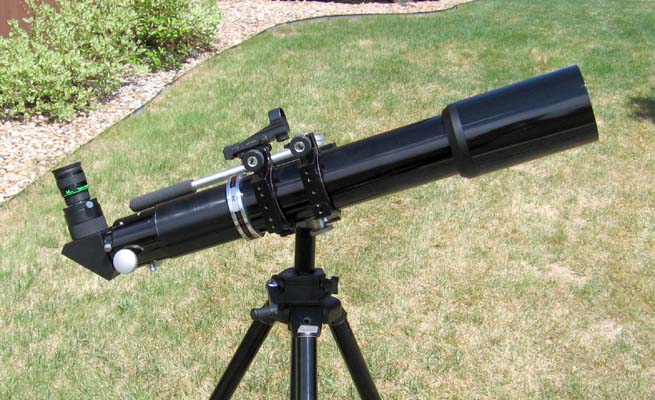
The OTA exhibits the typical Stellarvue “built like a tank” construction, with a heavy-walled, CNC-machined aluminum tube and a sliding dewshield with screw-on dust cover. The finish is a glossy black powder coat. The interior of the optical tube has an ultra-flat black textured finish, plus three knife-edge baffles. The focuser is the same Chinese 2" Crayford used on the current Nighthawk series telescopes, and is similar in appearance to those used on a number of other 80mm achromats. The focuser and the objective lens are the only components of the OTA that are not built in the Stellarvue shop in Auburn, California. While this focuser cannot compare with the Starlight Instruments Feather Touch on my SV85S, it is a definite step up from the rack-and-pinion focuser on my older Nighthawk. Operation is very smooth, with approximately 80mm of total focus travel. Both the main focuser and the 1.25" eyepiece adapter have brass compression rings rather than set screws. The focuser moves approximately 13mm per turn, and has Allen-head set screws for tension adjustment plus a locking screw to prevent slippage when using a heavy eyepiece or mounting a camera.. Because the OTA has been shortened for use with the binoviewers, a 4.75-inch long, CNC-machined, screw-in extension tube is provided for conventional monovision viewing with a single eyepiece. As noted above, this extension tube is what sets the Nighthawk BV apart from its predecessor, the SV80/9D – the latter did not have a two-piece OTA. Otherwise, the optics and specifications are the same. The interior of the extension tube has the same ultra-flat black, textured finish as the main tube to prevent reflections. To use the extension tube, the focuser is unscrewed from the end of the main tube, the extension tube is screwed into place, and the focuser is then screwed into the end of the extension tube, bringing the telescope back to its full 750mm focal length. Earlier Nighthawk BV telescopes utilized a 2" diameter extension tube which was inserted between the focuser and diagonal. The current screw-in extension tube provides a more stable assembly with less stress on the focuser. Nighthawk BVs ordered after late fall 2005 have the full-size extension tube.
The air-spaced, hand-figured doublet lens is mounted in a heavy, CNC-machined aluminum cell, which is adjustable and collimatable should the need arise. Because each Stellarvue telescope is meticulously aligned and star tested by Vic Maris before it is shipped, collimation by the user is seldom required. It’s nice to know that it can be done, however. This cell design is one of the features that sets the Stellarvue line apart from its competition. Vic and his crew also fine-tune the binoviewers before shipping them, adding custom machined helical focusers for each eyepiece and re-aligning prisms where required. Units that don’t pass the Stellarvue quality control process are returned to the factory in China.
Included in the Nighthawk BV package are a pair of Stellarvue 23mm FMC eyepieces. These oculars and are listed as having a 50 degree apparent field of view. These eyepieces are manufactured in Taiwan to Stellarvue’s specifications and matched as pairs before shipping. I opted to also purchase a pair of 15mm FMC widefield (68 degree AFOV) eyepieces as well, giving me a choice of 32.6x or 50x magnification. I’ll probably add another pair of eyepieces in the 8 to 10mm range (94x or 75x, respectively) to provide an inexpensive collection for casual to semi-serious viewing . Since this telescope was actually purchased primarily for my wife’s use and she meets the criteria for a casual to semi-serious observer, this eyepiece collection should serve her well. More serious observers will probably want to eventually purchase one or more sets of premium eyepieces for use in this system. Televue Naglers or Panoptics have been reported to perform well in the Nighthawk BV, and are in fact recommended by Vic as an upgrade even though Stellarvue does not sell Televue eyepieces. When purchasing eyepieces for use in this binoviewer (or its other-branded cousins), it should be noted that the relatively small field stops of the binoviewer will cause vignetting in most eyepieces with focal lengths longer than 25mm. The suppled 23mm eyepieces provide a fully-illuminated field of view, with no vignetting.
PERFORMANCE
OK, enough of the background information – how does the Nighthawk BV perform? Well, the performance overall, as would be expected, is the same as the SV80/9D. Star tests with and without a diagonal show perfect airy disc patterns, with the slightest hint of magenta and green as the focuser is moved inside and outside of focus. Bright objects like the limb of the moon and Venus, and bright stars like Vega or Sirius show a slight amount of chromatic aberration. Using the supplied 23mm FMC eyepieces in the binoviewer allows excellent views of large open clusters. The standard quote, “You won’t believe the Double Cluster in a binoviewer” certainly applies here. Adding appropriate filters provides pleasant views of favorite nebulae, such as the Orion Nebula (M42), Lagoon and Trifed Nebulae (M8 and M20, respectively). The Nighthawk BV provides amazingly good views of the North American Nebula (Caldwell 20) and the two components of the nearby Veil Nebula (Caldwell 33 and 34) under dark skies, although the views would certainly be better in 2-inch eyepieces. The Moon, of course, is gorgeous in both the 23mm and the 15mm eyepieces. The view truly does seem almost three-dimensional when using both eyes, and I often find myself spending an hour or more simply cruising up and down the lunar terminator, exploring the mountains, valleys, and rilles that are highlighted along the shadow line. The binovewers will not realistically support the higher magnifications most of us use for planetary observation, so here’s where the extension tube is inserted and it’s back to viewing in the cyclops mode. This is where the Nighthawk BV excels – it stands out at the head of the pack of 80mm achromats for planetary (and detailed Lunar) observations. Unfortunately my 62-year-old eyes and their floaters are not compatible with the small exit pupils that result from extremely high magnifications in small refractors, so I seldom view at more than 125x to perhaps 150x. Other Nighthawk BV or SV80/9D owners are unanimous in their praise of its performance as a planetary telescope, and routinely use magnifications upwards of 200x to 220x under steady skies.
Out of curiosity, I set up the Nighthawk BV (in monovision mode) side-by-side with two other Stellarvue scopes of like aperture for comparison. The other two telescopes were a Stellarvue Nighthawk, an 80mm/f-6 doublet achromat which is familiar to many readers, and a Stellarvue SV85S, an 85mm/f-6.9 doublet apochromat. My Nighthawk is the functional equivalent to the current Nighthawk Classic, with the exception that it has the older rack and pinion focuser rather than the current single-speed Chinese Crayford. It is the same as the model reviewed by Alan Dyer in the September, 2003 issue of Sky & Telescope, where he described it as performing “better than any short-focus achromat I have seen, rivaling telescopes billed as semi-apochromatic.” In the same article, Dyer had this to say about the SV85S: “The optical performance of the SV85S in all respects (lack of aberrations, well-baffled contrast, field flatness, and freedom from false color) was equal, if not superior, to any other two-element apo I’ve tested.” The SV85S reviewed by Dyer utilized a JMI DX-1 two-speed Crayford focuser whereas my example telescope has a Feather Touch two-speed Crayford focuser. In addition, it has a black tube rather than the white tube readers will see if they go back and read the S&T review. This wonderful little telescope has been discontinued by Stellarvue and replaced with the current SV80S and SV80L triplet apos.
I mounted all three telescopes on alt-az mounts — the Nighthawk on a Universal Astronomics Unistar Light Deluxe on a Bogen 3246 tripod, the SV85S on a Stellarvue M1D on a Bogen 3236 tripod, and the Nighthawk BV on a Unistar Deluxe on a Bogen 3068 tripod. All these mounts have large Teflon® bearing surfaces, and move very smoothly in both axes once the OTA is initially balanced. Identical 2" Stellarvue dielectric diagonals were used in all three telescopes. The eyepieces used were all Televue Radians, varying from 18mm to 4mm in focal lengths. Tests were performed swapping the same eyepiece in each of the three telescopes, and also by using different eyepieces to approximate the same magnification in each of the three different OTA focal lengths.
Some reviewers feel that comparing telescopes at the same or approximately the same magnification gives a truer indication of performance than a comparison using the same eyepiece at different magnifications. While this point may be argued, it is nonetheless fortuitous that my eyepiece collection allows approximate magnification matches so testing can be done both ways. Approximate matches for all three telescopes occur at 41x to 48x, 53x to 60x, and 75x to 80x. In addition, an approximate match for the Nighthawk BV and SV85S occurs at 94x to 97x. Lacking the instrumentation to perform truly quantitative tests I can simply report only subjective comparisons, but the short story is the Nighthawk BV is closer in performance to the SV85S apo than it is to the Nighthawk. Using magnifications as close to 100x as I could approximate with my eyepiece collection and looking at the limb of the Moon, there is noticeable color in the Nighthawk, very slight color in the Nighthawk BV, and no noticeable color in the SV85S. On bright stars like Vega and Sirius, the same holds true – even racking all three telescopes in and out of focus, the relative color remains the same. The SV85S apo is, as to be expected, the clear winner in all cases, but the Nighthawk BV is not far behind. Based on this comparison, one would certainly be tempted to use the popular marketing term “semi-apo” for the Nighthawk BV.
In conclusion, I would highly recommend the Nighthawk BV to anyone looking for a well-corrected, moderately-priced, achromatic refractor. The fact that when purchased as a complete package one gets a telescope, high quality diagonal, a pair of eyepieces and a binoviewer for less than the price of many of the “premium” binoviewers alone makes this an outstanding bargain. For those whose budget can’t stretch to the full package, Stellarvue continues to offer OTA alone, so one could purchase the OTA now and use it for traditional mono viewing and add the binoviewer later. This is an attractive option for those who already have a binoviewer or wish to skip directly to a premium binoviewer, and still have an airline portable package.
SPECIFICATIONS
Manufacturer:
Stellarvue, Inc.
11820 Kemper Rd.
Auburn, CA 95603
(530) 823-7796
Vital Statics:
80mm air-spaced doublet achromat
750mm focal length (f-9.4)
Price:
Package $799.00 US at time of purchase (November, 2005)
OTA only $499.00
Includes:
Optical tube assembly, 2" dielectric diagonal, “deluxe” mounting rings (2), red dot finder, one pair 23mm FMC eyepieces, extension tube for mono viewing, reinforced soft carrying case
THE AUTHOR
Jim Carpenter has been an active amateur astronomer for approximately ten years. He has owned a number of telescopes, including MCTs, SCTs, Dobsonian-mounted Newtonians, and refractors. He purchased his first Stellarvue telescope, an AT1002, in June of 2002 and has been hooked on refractors ever since. He is the current moderator of Astromart’s Stellarvue and Ham Radio forums. He and his wife, Jeanette, observe in the mountains of Colorado or at the Denver Astronomical Society’s dark sky site on the plains east of Denver.
Click here for more about 80mm Stellarvue scopes. -Ed.
Over the past year or so, the binoviewing market has been shaken up by the introduction of a slew of Chinese-made, entry level binoviewers. These binoviewers are made by Norin Optech in Guangzhou, China, and are marketed by Stellarvue, Burgess Optical, Celestron, Orion, William Optic, and others. There are subtle differences between the versions sold by the various resellers, some merely cosmetic, others dealing with minor customizations such as the type and configuration of the eyepiece holders and the size of the field stop. At least one of the re-sellers, Stellarvue, offers binoviewer-friendly versions of several of their popular refractors which allow the use of binoviewers without the introduction of a correction lens into the light path. The correction lens, sometimes called an optical correction adapter (OCA) or other similar name, is typically needed in a refractor because the binoviewer adds several inches into the overall light path, which is more than can be compensated for by focuser travel alone.
This topic for this review is the Stellarvue Nighthawk BV, which is based on the telescope formerly known as the Stellarvue SV80/9D, a well-corrected 80mm f-9.4 doublet achromat. The SV80/9D was always a sleeper in the Stellarvue lineup. Despite its noticeably better performance, it never attained the popularity of its f-6 sibling, probably due to the fact that it was not “airline portable.” The Nighthawk BV is nothing more than a Stellarvue SV80/9D with the optical tube assembly (OTA) shortened by approximately 4 inches, which is the length the light passing through the binoviewer adds to the optical path. Before going further, let’s make one thing clear – despite the use of “Nighthawk” in this telescope’s name, it is a totally different animal than the 80mm/f-6 Nighthawk Classic and the newer Nighthawk II. The Nighthawk BV not only has a longer focal length (750mm), it also uses a glass type with a higher Abbe number than the f-6 Nighthawk in one of the elements. For those new to this hobby, the short definition of the Abbe number is a value used to define color dispersion — the higher the number, the better the color dispersion. It is named after the German optician who developed the mathematical formula for determining this value, Ernst Abbe (1840-1905), who was a professor at the University of Jena and was a co-founder of Ziess Optics. The typical crown/flint glass used in achromatic refractors have an Abbe number in the low 60's. At somewhere between 70 and 80, depending upon which authority is speaking, the glass becomes “extra-low dispersion” (ED) type, and at 90 and above it is considered “super-low dispersion” (SD). Glass types in the SD range are what are typically found in premium apochromatic refractors. While Vic Maris, the owner of Stellarvue, declines to call the SV80D an “ED” refractor, he has nevertheless stated that the Abbe number for the glass used in the lens is “above 70.”
Vic chose to use the 80/9D as the basis for the Stellarvue BV-friendly scope for a couple of reasons. First and perhaps foremost is the inherently better performance of the longer focal ratio and the chosen glass. The second reason for choosing the SV80/9D is the longer physical length of its OTA. As discussed above, introducing a binoviewer into the light train of a refractor adds approximately 4" to the overall optical path. There are two practical ways to compensate for this increased light path — insert a correction lens ahead of the binoviewer or simply shorten the telescope’s optical tube. Other binoviewer manufacturers such as Denkmeier and Siebert offer correction lenses, and other telescope manufacturers have offered special “shortened” versions of their optical tubes in the past. However, because the corrector lens (essentially a short Barlow) increases the overall focal ratio and increases magnification with any given eyepiece, thus narrowing the apparent field of view, Stellarvue has chosen the latter approach with the Nighthawk BV. One might ask why the shorter and more popular Nighthawk Classic or Nighthawk II was not used. The answer is simple — if 4" is cut out of an 80mm/f-6 optical tube of the, it will be almost impossible to balance the assembled telescope, including focuser, diagonal, binoviewer, and a pair of eyepieces. The assembly becomes too tail-heavy, especially if using an alt-az mount where proper balance is essential for motion about the up-down altitude axis. Oh yeah, remember the “airline portable” issue mentioned above? Cutting 4 inches out of the tube suddenly makes the Nighthawk BV fit into an airline carry-on case which can be stored in an overhead storage bin (except perhaps on those dad-blasted regional jets that seem to popping up on everything except transcontinental flights). Airline portability has become one of the primary criteria in selecting a small refractor for travel, and is perhaps the primary reason why the SV80/9D, despite its superior optics, has never achieved the popularity of the SV Nighthawk or any of the f-6-ish refractors offered by other manufacturers.
The next question one might ask is, “Wait a minute...if you cut 4 inches out of the OTA, can it still be used in monovision mode with a single eyepiece?” The answer is yes. Stellarvue provides a CNC-machined, 4.75 inch long, full diameter tube extension which can be added ahead of the focuser to bring the OTA back to its full, native focal length. This overcomes any concerns of light cut-off or vignetting which may occur if a smaller diameter extension tube is inserted between the focuser and diagonal, especially important if the basis OTA is a “short tube” to begin with.
THE PACKAGE
At the time I purchased my Nighthawk BV (November 2005), Stellarvue was offering a complete introductory package which included the optical tube assembly including the 4.75 inch extension, Stellarvue’s version of the Norin Optech binoviewer, a Stellarvue Model 1029 dielectric coated collimateable 2" diagonal, two deluxe tube rings, a pair of 23mm fully multi-coated (FMC) eyepieces, a Stellarvue standard red dot finder, and a padded, airline carry-on size case. At the time this review was written (June 2006), the Stellarvue website no longer lists the complete package. However, all the above components can be purchased separately at a price only slightly higher than the introductory offer. The fact that the excellent Stellarvue 1029 two-inch diagonal can be bought at a sizeable discount if purchased at the time as the OTA contributes to this price parity.
It should be noted that in order to simplify the Stellarvue lineup, the original SV80/9D, with its one-piece OTA, has been replaced by the current two-piece OTA and re-designated as the Nighthawk BV. Otherwise the specifications – and more importantly the optics – are the same as the SV80/9D. To further confuse matters, the BV-friendly version of this telescope, as offered in the package I purchased, was for a brief time called the SV80BV, but that designation was discontinued and replaced by the name now used by Stellarvue, the Nighthawk BV. Despite the new designation, this OTA should not be confused with the Stellarvue Nighthawk Classic or Nighthawk II, both of which use an 80mm/F-6 objective. This review will continue to use the original SV80/9D designation when discussing the original one-piece OTA and use the Nighthawk BV designation for the current two-piece OTA.
The telescope arrived well-packed in a Stellarvue C-8 padded, reinforced case. The case is constructed of black, leather-lookalike vinyl, with an embroidered Stellarvue log on the top, a sturdy handle on the front, and a shoulder strap that attaches to D-rings on the sides. The interior is accessed by a continuous zipper that has two slides. The normal configuration would be to have the slides meet in the center, although both slides can be zipped around to either side of the case should one desire. The case has moveable dividers that can be arranged to accommodate the OTA in the “short” configuration with the focuser attached, as well as the binoviewer, diagonal, extension tube, eyepieces and other accessories. This works fine if you leave the accessories in their individual boxes, but I would prefer to have foam fillers with cut-outs for the accessories rather than the adjustable dividers. I therefore used some of the polystyrene packing foam to create custom inserts with cut-outs for the various accessories – not the best looking solution, but serviceable. It should be noted that the C-8 case dimensions are 25" x 17" x 7-1/2", making too large to qualify as “airline carry-on” size. The smaller Stellarvue C-7 case would be a better choice for airline travelers.
The OTA exhibits the typical Stellarvue “built like a tank” construction, with a heavy-walled, CNC-machined aluminum tube and a sliding dewshield with screw-on dust cover. The finish is a glossy black powder coat. The interior of the optical tube has an ultra-flat black textured finish, plus three knife-edge baffles. The focuser is the same Chinese 2" Crayford used on the current Nighthawk series telescopes, and is similar in appearance to those used on a number of other 80mm achromats. The focuser and the objective lens are the only components of the OTA that are not built in the Stellarvue shop in Auburn, California. While this focuser cannot compare with the Starlight Instruments Feather Touch on my SV85S, it is a definite step up from the rack-and-pinion focuser on my older Nighthawk. Operation is very smooth, with approximately 80mm of total focus travel. Both the main focuser and the 1.25" eyepiece adapter have brass compression rings rather than set screws. The focuser moves approximately 13mm per turn, and has Allen-head set screws for tension adjustment plus a locking screw to prevent slippage when using a heavy eyepiece or mounting a camera.. Because the OTA has been shortened for use with the binoviewers, a 4.75-inch long, CNC-machined, screw-in extension tube is provided for conventional monovision viewing with a single eyepiece. As noted above, this extension tube is what sets the Nighthawk BV apart from its predecessor, the SV80/9D – the latter did not have a two-piece OTA. Otherwise, the optics and specifications are the same. The interior of the extension tube has the same ultra-flat black, textured finish as the main tube to prevent reflections. To use the extension tube, the focuser is unscrewed from the end of the main tube, the extension tube is screwed into place, and the focuser is then screwed into the end of the extension tube, bringing the telescope back to its full 750mm focal length. Earlier Nighthawk BV telescopes utilized a 2" diameter extension tube which was inserted between the focuser and diagonal. The current screw-in extension tube provides a more stable assembly with less stress on the focuser. Nighthawk BVs ordered after late fall 2005 have the full-size extension tube.
The air-spaced, hand-figured doublet lens is mounted in a heavy, CNC-machined aluminum cell, which is adjustable and collimatable should the need arise. Because each Stellarvue telescope is meticulously aligned and star tested by Vic Maris before it is shipped, collimation by the user is seldom required. It’s nice to know that it can be done, however. This cell design is one of the features that sets the Stellarvue line apart from its competition. Vic and his crew also fine-tune the binoviewers before shipping them, adding custom machined helical focusers for each eyepiece and re-aligning prisms where required. Units that don’t pass the Stellarvue quality control process are returned to the factory in China.
Included in the Nighthawk BV package are a pair of Stellarvue 23mm FMC eyepieces. These oculars and are listed as having a 50 degree apparent field of view. These eyepieces are manufactured in Taiwan to Stellarvue’s specifications and matched as pairs before shipping. I opted to also purchase a pair of 15mm FMC widefield (68 degree AFOV) eyepieces as well, giving me a choice of 32.6x or 50x magnification. I’ll probably add another pair of eyepieces in the 8 to 10mm range (94x or 75x, respectively) to provide an inexpensive collection for casual to semi-serious viewing . Since this telescope was actually purchased primarily for my wife’s use and she meets the criteria for a casual to semi-serious observer, this eyepiece collection should serve her well. More serious observers will probably want to eventually purchase one or more sets of premium eyepieces for use in this system. Televue Naglers or Panoptics have been reported to perform well in the Nighthawk BV, and are in fact recommended by Vic as an upgrade even though Stellarvue does not sell Televue eyepieces. When purchasing eyepieces for use in this binoviewer (or its other-branded cousins), it should be noted that the relatively small field stops of the binoviewer will cause vignetting in most eyepieces with focal lengths longer than 25mm. The suppled 23mm eyepieces provide a fully-illuminated field of view, with no vignetting.
PERFORMANCE
OK, enough of the background information – how does the Nighthawk BV perform? Well, the performance overall, as would be expected, is the same as the SV80/9D. Star tests with and without a diagonal show perfect airy disc patterns, with the slightest hint of magenta and green as the focuser is moved inside and outside of focus. Bright objects like the limb of the moon and Venus, and bright stars like Vega or Sirius show a slight amount of chromatic aberration. Using the supplied 23mm FMC eyepieces in the binoviewer allows excellent views of large open clusters. The standard quote, “You won’t believe the Double Cluster in a binoviewer” certainly applies here. Adding appropriate filters provides pleasant views of favorite nebulae, such as the Orion Nebula (M42), Lagoon and Trifed Nebulae (M8 and M20, respectively). The Nighthawk BV provides amazingly good views of the North American Nebula (Caldwell 20) and the two components of the nearby Veil Nebula (Caldwell 33 and 34) under dark skies, although the views would certainly be better in 2-inch eyepieces. The Moon, of course, is gorgeous in both the 23mm and the 15mm eyepieces. The view truly does seem almost three-dimensional when using both eyes, and I often find myself spending an hour or more simply cruising up and down the lunar terminator, exploring the mountains, valleys, and rilles that are highlighted along the shadow line. The binovewers will not realistically support the higher magnifications most of us use for planetary observation, so here’s where the extension tube is inserted and it’s back to viewing in the cyclops mode. This is where the Nighthawk BV excels – it stands out at the head of the pack of 80mm achromats for planetary (and detailed Lunar) observations. Unfortunately my 62-year-old eyes and their floaters are not compatible with the small exit pupils that result from extremely high magnifications in small refractors, so I seldom view at more than 125x to perhaps 150x. Other Nighthawk BV or SV80/9D owners are unanimous in their praise of its performance as a planetary telescope, and routinely use magnifications upwards of 200x to 220x under steady skies.
Out of curiosity, I set up the Nighthawk BV (in monovision mode) side-by-side with two other Stellarvue scopes of like aperture for comparison. The other two telescopes were a Stellarvue Nighthawk, an 80mm/f-6 doublet achromat which is familiar to many readers, and a Stellarvue SV85S, an 85mm/f-6.9 doublet apochromat. My Nighthawk is the functional equivalent to the current Nighthawk Classic, with the exception that it has the older rack and pinion focuser rather than the current single-speed Chinese Crayford. It is the same as the model reviewed by Alan Dyer in the September, 2003 issue of Sky & Telescope, where he described it as performing “better than any short-focus achromat I have seen, rivaling telescopes billed as semi-apochromatic.” In the same article, Dyer had this to say about the SV85S: “The optical performance of the SV85S in all respects (lack of aberrations, well-baffled contrast, field flatness, and freedom from false color) was equal, if not superior, to any other two-element apo I’ve tested.” The SV85S reviewed by Dyer utilized a JMI DX-1 two-speed Crayford focuser whereas my example telescope has a Feather Touch two-speed Crayford focuser. In addition, it has a black tube rather than the white tube readers will see if they go back and read the S&T review. This wonderful little telescope has been discontinued by Stellarvue and replaced with the current SV80S and SV80L triplet apos.
I mounted all three telescopes on alt-az mounts — the Nighthawk on a Universal Astronomics Unistar Light Deluxe on a Bogen 3246 tripod, the SV85S on a Stellarvue M1D on a Bogen 3236 tripod, and the Nighthawk BV on a Unistar Deluxe on a Bogen 3068 tripod. All these mounts have large Teflon® bearing surfaces, and move very smoothly in both axes once the OTA is initially balanced. Identical 2" Stellarvue dielectric diagonals were used in all three telescopes. The eyepieces used were all Televue Radians, varying from 18mm to 4mm in focal lengths. Tests were performed swapping the same eyepiece in each of the three telescopes, and also by using different eyepieces to approximate the same magnification in each of the three different OTA focal lengths.
Some reviewers feel that comparing telescopes at the same or approximately the same magnification gives a truer indication of performance than a comparison using the same eyepiece at different magnifications. While this point may be argued, it is nonetheless fortuitous that my eyepiece collection allows approximate magnification matches so testing can be done both ways. Approximate matches for all three telescopes occur at 41x to 48x, 53x to 60x, and 75x to 80x. In addition, an approximate match for the Nighthawk BV and SV85S occurs at 94x to 97x. Lacking the instrumentation to perform truly quantitative tests I can simply report only subjective comparisons, but the short story is the Nighthawk BV is closer in performance to the SV85S apo than it is to the Nighthawk. Using magnifications as close to 100x as I could approximate with my eyepiece collection and looking at the limb of the Moon, there is noticeable color in the Nighthawk, very slight color in the Nighthawk BV, and no noticeable color in the SV85S. On bright stars like Vega and Sirius, the same holds true – even racking all three telescopes in and out of focus, the relative color remains the same. The SV85S apo is, as to be expected, the clear winner in all cases, but the Nighthawk BV is not far behind. Based on this comparison, one would certainly be tempted to use the popular marketing term “semi-apo” for the Nighthawk BV.
In conclusion, I would highly recommend the Nighthawk BV to anyone looking for a well-corrected, moderately-priced, achromatic refractor. The fact that when purchased as a complete package one gets a telescope, high quality diagonal, a pair of eyepieces and a binoviewer for less than the price of many of the “premium” binoviewers alone makes this an outstanding bargain. For those whose budget can’t stretch to the full package, Stellarvue continues to offer OTA alone, so one could purchase the OTA now and use it for traditional mono viewing and add the binoviewer later. This is an attractive option for those who already have a binoviewer or wish to skip directly to a premium binoviewer, and still have an airline portable package.
SPECIFICATIONS
Manufacturer:
Stellarvue, Inc.
11820 Kemper Rd.
Auburn, CA 95603
(530) 823-7796
Vital Statics:
80mm air-spaced doublet achromat
750mm focal length (f-9.4)
Price:
Package $799.00 US at time of purchase (November, 2005)
OTA only $499.00
Includes:
Optical tube assembly, 2" dielectric diagonal, “deluxe” mounting rings (2), red dot finder, one pair 23mm FMC eyepieces, extension tube for mono viewing, reinforced soft carrying case
THE AUTHOR
Jim Carpenter has been an active amateur astronomer for approximately ten years. He has owned a number of telescopes, including MCTs, SCTs, Dobsonian-mounted Newtonians, and refractors. He purchased his first Stellarvue telescope, an AT1002, in June of 2002 and has been hooked on refractors ever since. He is the current moderator of Astromart’s Stellarvue and Ham Radio forums. He and his wife, Jeanette, observe in the mountains of Colorado or at the Denver Astronomical Society’s dark sky site on the plains east of Denver.
Click here for more about 80mm Stellarvue scopes. -Ed.
Funding Member