
Image of the day

Captured by
Mark Eby

M33 Triangulum Galaxy

My Account

New to Astromart?

Register an account...

Need Help?

4 Hole Aperture Mask

Started by fblue, 11/27/2003 01:21AM
Posted 11/27/2003 01:21AM Opening Post
Ok, I have given it a lot of thought and I believe I have the answer to why the 4 hole aperture mask works.
The 4 holes are superimposed one upon the other like stacked images taken with a camera when brought to focus. Because of this it actually acts like a one hole mask. If you were looking at 4 holes separately, then there would be large spider veins between the holes and you would have spikes.
Just as a one hole mask removes spikes, so does the 4 hole mask.
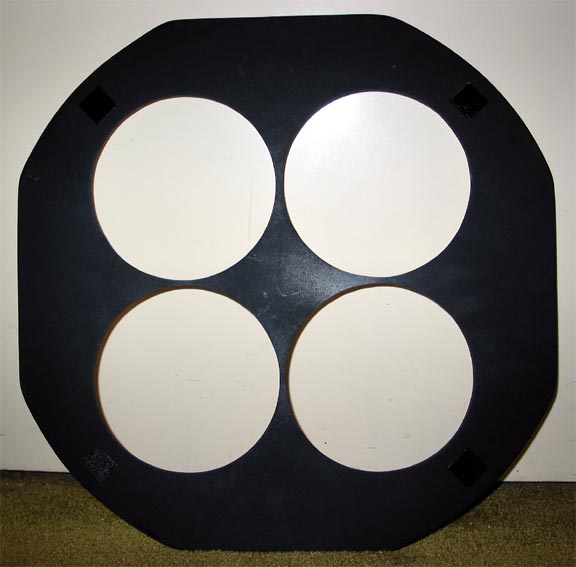
Attached is a picture of my four 6.5" hole mask for my 15" DOB. It is a better mask than the original one I made with 1" more aperture per hole for better throughput.
Am I wrong here, or on the right track?
I mean the thing works like a charm, so there must be a logical reason for it to work.
Floyd

Attached Image:

fblue's attachment for post 11072

[SIZE="Large"][/SIZE][COLOR="Blue"][/COLOR] Floyd Blue grin
Amateur Imager
Posted 11/27/2003 01:29AM #1
Floyd,

I think in a sense you are correct, although there are various ways of looking at it. The Airy disk for a 1-hole mask would be larger, though, and I think there are very short spikes created within that general (and obviously tiny) area. It would take fairly good seeing and very high magnification to get a good look at this. Certainly there are no long spikes emanating from bright objects to detract from the view.
--
Mike
Posted 11/27/2003 08:08PM #2
Hi Floyd
What an interesting experiment!! In an effort to better UNDERSTAND what is happening to the image quality, may I suggest a further experiment. Replace the mask with the array of four inch holes with another mask with an array of as many 1 inch holes as you can fit onto the mask ... something like this if you see what I mean ...

ooo
ooooooo
ooooooooo
ooooooooooo
ooooooooo
ooooooo
ooo

Then you have 3 things to compare:
A. no mask
B. 4 inch mask and
C. 1 inch mask

And do this on at least two evenings. One evening with excellent seeing, and one evening with poor seeing. (You could even try transparent and poorly transparent sky as further variations ... but you don't want to introduce too many variables in the beginning or you many find the analysis gets too complicated. Remember KIS = Keep It Simple!)

And do of course DOCUMENT everything carefully just as any scientist would do ;-)

Hopefully you will give you a FEELING as to what is happening to the image when the holes are added. Then you can perhaps formulate a HYPOTHESIS (write it down) and then TEST IT by making another mask with, say, 1/2 inch holes. (Again, just like a scientist would do ...)

Thanks for an interesting thread ...
Best wishes
Anthony
Posted 11/28/2003 09:32PM #3
"The 4 holes are superimposed one upon the other like stacked images taken with a camera when brought to focus. Because of this it actually acts like a one hole mask."

Ummmm, Nope... it DOES NOT act as a "one-holed" (AKA aperture) mask!

Multi-holed (AKA Hartmann mask/Scheiner disk) masks are *ONLY* used for focusing and are removed for viewing or imaging with good reason: the images they produce are extremely sensitive to changes in focus normally encountered.

About multi-holed masks:

Each opening acts as an individual off-axis telescope, producing its own unique image. As an eyepiece (or camera, etc.) is moved closer or further from focus, the OA image will move across the field of view. This is most apparent when the OA image source is a point source of light (a star).

Focusing a single image can be ambiguous (more forgiving!), as there is often some latitude or "sweet" spot where small changes seem to have little or no effect. When multiple OA images are used (ie; from a multi-holed focusing mask), the center of each focused "sweet-spot" (even if it is difficult to tell where each individual one might be) intersect at one unique point, (drum roll please...) "Critical Focus"!

So... here's the scenario: However many holes you have, you'll have separate images when out of focus. As you approach focus, those images converge. When you have a single image, Voilá, you have attained Critical Focus.

Thus the very attributes that make them ideal as focusing aids (diverging images), usually make them ill-suited for use as aperture masks. If left in place, any small changes in focus will cause the individual images to diverge (smear!)

But hey, if it works for ya', use it! shocked)

Ciao,

Paul

--- http://www.astro-nut.com ---
