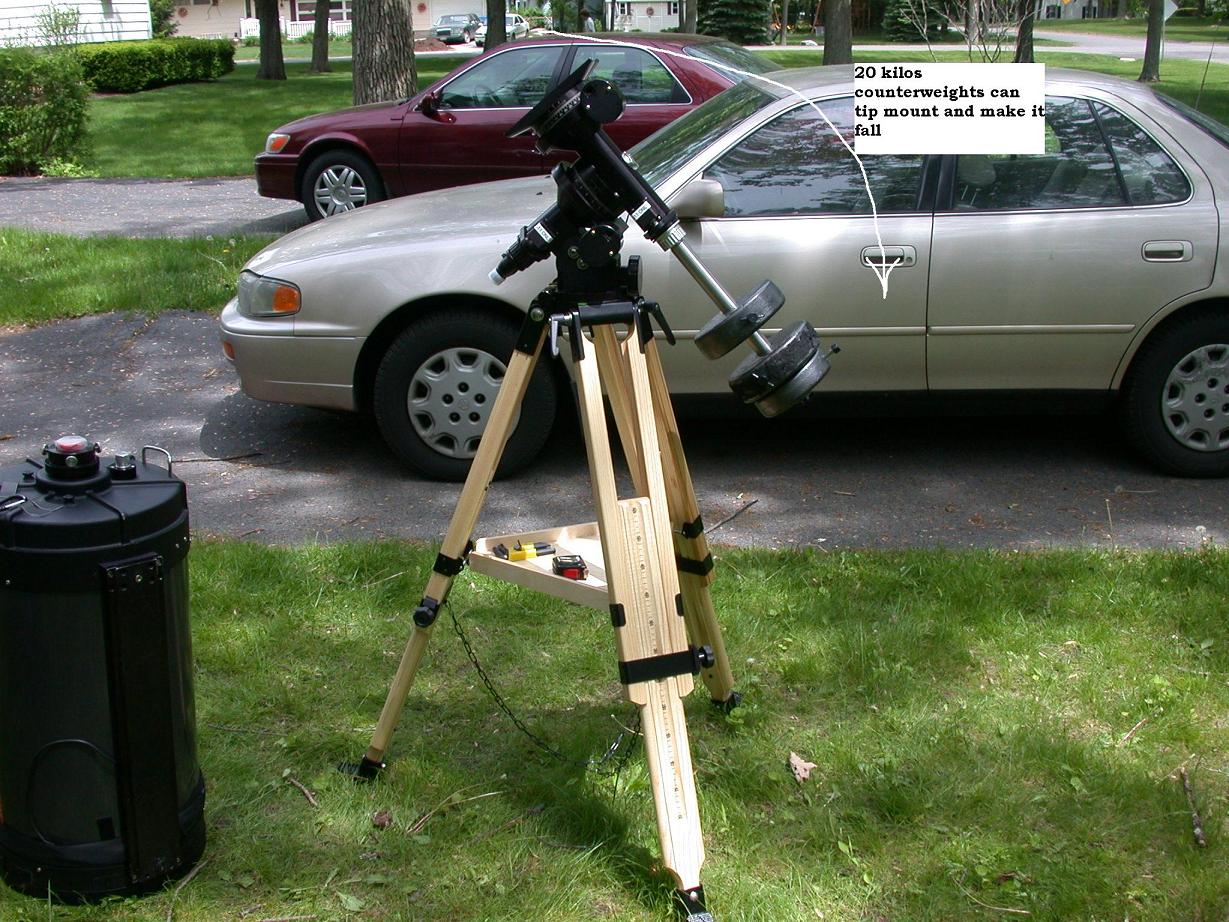

When I was working with Berlebach on their eventual Losmandy compatible tripod designs, the prototype they send me had the counterweight positioned BETWEEN two legs, not OVER one leg.
I found this to be very unstable: it doesn't take much of a push to "go over" when you have the center of gravity between two legs.
I noticed this because I see a vendor here advertising the desirability of 360 degree adapter rotation for setup. This is not unique to this person: I know of a few other cases. It seems to me that it is not a good idea at all, and that AP was right to put a stop in the amount of adjustment they give you. If you are "allowed" by the mount to position exactly between two legs with the counterweights, you are at risk for tip over.
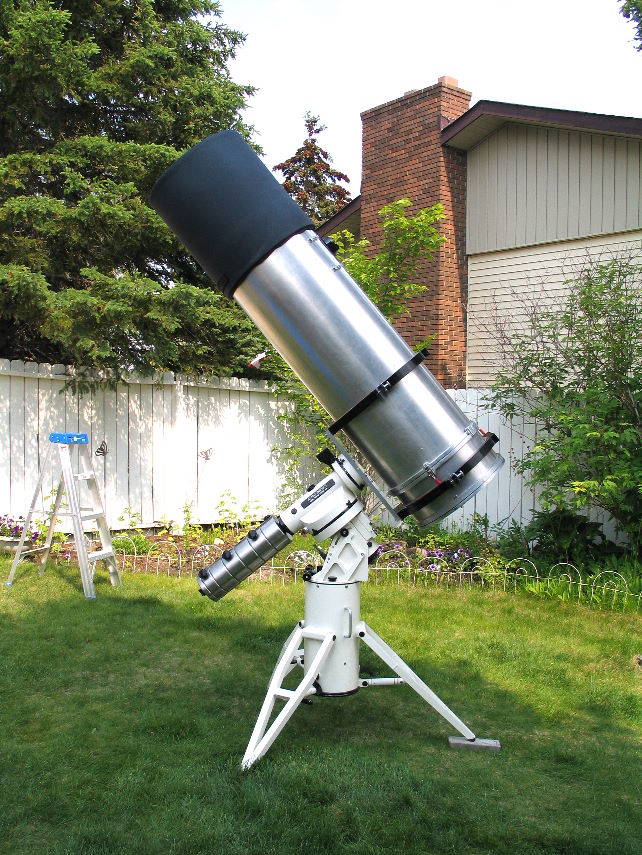
I hope the picture here makes this clear. The risk may be minimal with a light mount but if I were setting up and had radically misplaced true N I would rather lift the entire tripod and move it to get closer rather than observe all night with the counterweight and telescope mass perched overhanging the two extended legs. I discovered this truth with the prototype Berlebach and the C14/G11.
Long story short: I always thought it would be nice to have infinite or 360 degree adjustment but when I came face to face with reality I discovered that it wasn't a real good idea. I have another pic of the Berlebach prototype which did not get marketed that way.
I have also seen some folks set up counterweights between-the-tripod-legs, and I consider this a no-no. Regrettably the lower your latitude the greater your temptation to set up this way, and I suspect, the worse the results. In a low latitude with the counterweight over the tripod leg the shaft might actually hit the leg. Put it this way. In a low latitude if I were observing with the counterwegiht *between* two legs I would stake down the rear leg as a failsafe. I've been in too many situations where the wind suddenly kicked up. A tripod is impossible to knock over when force is applied from between two legs against an extended leg. It is EASY to knock over when force is applied from behind one leg toward the empty space between the two other legs.
regards
Greg N
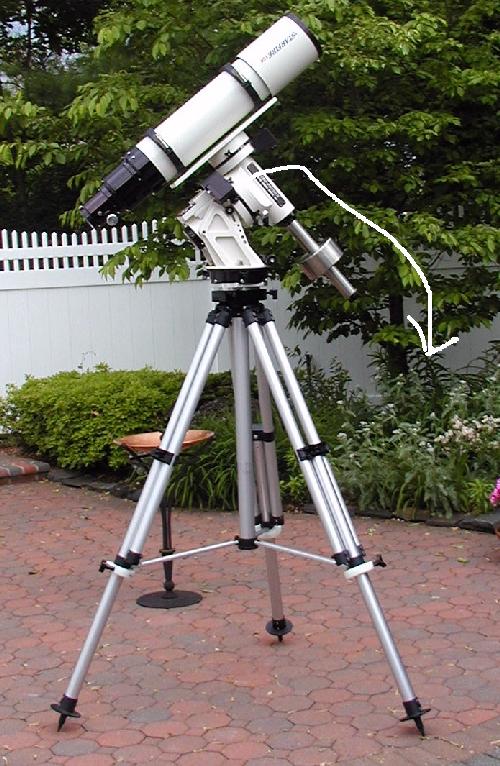
I found this to be very unstable: it doesn't take much of a push to "go over" when you have the center of gravity between two legs.
I noticed this because I see a vendor here advertising the desirability of 360 degree adapter rotation for setup. This is not unique to this person: I know of a few other cases. It seems to me that it is not a good idea at all, and that AP was right to put a stop in the amount of adjustment they give you. If you are "allowed" by the mount to position exactly between two legs with the counterweights, you are at risk for tip over.
I hope the picture here makes this clear. The risk may be minimal with a light mount but if I were setting up and had radically misplaced true N I would rather lift the entire tripod and move it to get closer rather than observe all night with the counterweight and telescope mass perched overhanging the two extended legs. I discovered this truth with the prototype Berlebach and the C14/G11.
Long story short: I always thought it would be nice to have infinite or 360 degree adjustment but when I came face to face with reality I discovered that it wasn't a real good idea. I have another pic of the Berlebach prototype which did not get marketed that way.
I have also seen some folks set up counterweights between-the-tripod-legs, and I consider this a no-no. Regrettably the lower your latitude the greater your temptation to set up this way, and I suspect, the worse the results. In a low latitude with the counterweight over the tripod leg the shaft might actually hit the leg. Put it this way. In a low latitude if I were observing with the counterwegiht *between* two legs I would stake down the rear leg as a failsafe. I've been in too many situations where the wind suddenly kicked up. A tripod is impossible to knock over when force is applied from between two legs against an extended leg. It is EASY to knock over when force is applied from behind one leg toward the empty space between the two other legs.
regards
Greg N
Attached Image:
"Scope will get you through times of no money better than money will get you through times of no scope." --Freewheelin' Franklin