Image of the day

Captured by
GERALD KREITZBURG

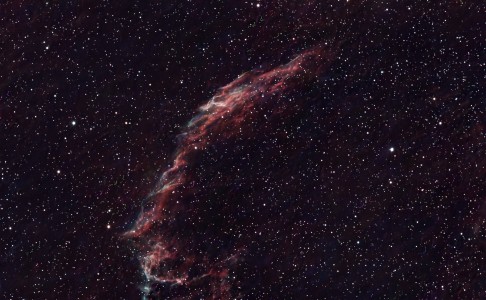
Eastern Veil Nebula

My Account

New to Astromart?

Register an account...

Need Help?

Dobs planetary nudging?

Started by ronbee, 02/19/2003 03:49PM
Posted 02/19/2003 03:49PM Opening Post
I was out observing Jovian moon for an eclipse/occulation last night. Io and Europe came so close I couldn't split it with my 4" APO at 586x (the seeing was steady). I was using the slow motion knob (RA axis) on my EQ mount to track (I've gotten new batteries for my drives but haven't put them in yet :-().

A thought occur to me especially in the light of the SCT prose. I can manual track my refractor at 220x with no problem and 293x is just about the limit of tolerance; 586x was miserable. Not only did the image fly through my 60d AFOV very quickly, but it's also vibration induced by tracking. With an 8" Dobs, I should be able to reach 400x in steady steady providing the PDHQ mirror is really good.

The question is: how do you find Dobs nudging at high magnification? Is there vibration after you taken your hand of after nudging (BTW, there's little or no vibration at 293x with my slow motion providing I don't let it go springing ;-)? For example when I touch the focuser of my refractor and let go, there's always vibration afterward. What's the maximum tolerable magnification with nudging
on the 8"/10" Dobs before it becomes a pain?

Thanks,
Ron B[ee]
Posted 02/19/2003 03:56PM #1
Ron,

With my Portaball, I can had track at ~250X without becoming too terribly frustrated.

But an equatorial platform does look attractive, particularly for high magnifications.

-Barry R. Fernelius
Posted 02/19/2003 03:59PM #2
I don't like to go over 200x. 150x is even better. I have a 4.8 Nagler that gives ~156x and that is OK since the field is so wide. I sidestep the problem with my larger Dob by using a Dob Driver II.

Charlie

Fort Lewis Observatory: (37.238, -108.052) ~2360m (7744 ft.) elevation.
Darkness - typically 6.5+
Scope - Meade 16" LX200; f6.3 focal reducer
Focus - JMI Smart focus
Camera - SBIG ST-10XE; (~.5"/pixel)
Guiding - AO-8 and/or Meade 5"/DSI/PHD
http://www.fortlewis.edu/observatory
Posted 02/19/2003 06:25PM #3
Or get a Newtonian you can put on your equatorial mount and track like you do now. Also, I like to find objects by sweeping right-ascension and declination, which you lose with alt-ax mountings.

I took a couple of pictures last night with my equatorially mounted 6" f/8 reflector last night (above). This scope is a nice compromise between my TV85 (smallish aperture) and C8 (long cooldown).

Bruce Housey.

Attached Image:

bhousey's attachment for post 65086
Posted 02/19/2003 06:25PM #4
It's about the same with a Dob, EXCEPT that a well-designed Dob will damp vibrations very quickly, so not as much time is wasted waiting for that. However, because a Dob lacks slow motion controls and axis locks, I find that wider fields of view at high powers are very helpful, particularly after changing eyepieces to ensure that the planet is still in view. My patience starts wearing thin when the true field of view is less than 10 arc minutes, but that's almost 500x with a type 6 Nagler or around 350x with a Radian. The good news is that with larger aperture it isn't principally a matter of going to higher magnification. The image is noticeably more detailed at modest magnifications.

Perhaps it will give you a better subjective idea to note that I have an excellent Osypowski equatorial platform, but I usually don't bother with it unless seeing is good enough to exceed 300x.
--
Mike
Posted 02/19/2003 08:57PM #5
Hi Ron,

Although I started out with an equatorial mount for an 8" f/8 Newt, most of my scopes for a number of years were on Dob mounts. I thought they were fine - until my wife starting using equatorially mounted scopes. For me, high power viewing is much more enjoyable with a driven scope, and I would not go back to undriven Dobs.

It is also important to remember that Newtonians are only diffraction limited over a very small area near the center of the field (unless you add a coma corrector), so if you let a planet drift from one edge of the field to the other you are not getting the best possible view for a good part of the time.