Image of the day

Captured by
Michael Scherman

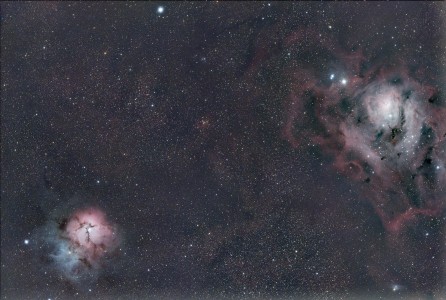
Lagoon and Triffid Celestron C6 Hyperstar4

My Account

New to Astromart?

Register an account...

Need Help?

Meade 10"/12" RCX vs. 6"/7" APO astropics

Started by rumpledoll, 10/17/2007 01:53PM
Posted 10/17/2007 01:53PM Opening Post
Roland piqued my curiosity when he mentioned the performance of the Meade RCX 10"/12" scopes.

Astrophotographically speaking, what could the 10"/12" Meade RCX's do that my old AP 160EDF or my current TEC 180FL couldn't do? Or the converse - what do the APO's do that the RCX's couldn't?

Philip
Posted 10/17/2007 02:16PM #1
Philip, IMHO the main difference would be FOV & magnification, due to the longer FL of the RCX...

Ivan Gastaldo 8)
Coconut Creek, FL

Ivan's Observatory
Lat 26N 16' 48" Long 80W 10' 48"
[COLOR="Red"]Personal Website:[/COLOR] http://www.ivangastaldo.com

CCD Imaging and Processing/Deep Sky - Moderator
I like to complain about everything - Moderator
Posted 10/17/2007 02:45PM #2
In a side by side test using an STL11K camera my 160F7.5 EDF had somewhat better resolution than my 10" F10 LX200R. The 160EDF produced 2.11 x 2.11 times larger field for a total of 4.5 times larger sky area, so the final image looks more detailed - like the difference between a print taken by a large format view camera and one taken by a 35mm camera.

Under my local seeing conditions the SCT produced stars sizes of 4.5 pixels FWHM at .73 arc sec per pixel (resolution of 3.3 arc sec). At the same time the refractor produced stars of 1.5 pixels FWHM at 1.54 arc sec per pixel (resolution of 2.3 arc sec).

Reasons for this difference might be local seeing conditions that favor a smaller aperture and the central obstruction on the SCT that spreads light into the diffraction rings, thus lowering the FWHM resolution. The 10" aperture does gather more light, so theoretically the signal to noise ratio favors the SCT. However the faster focal ratio of the refractor at F7.5 produces a higher signal for any given exposure time, and the higher resolution of the refractor more than makes up for the theoretical difference in sig/noise of the smaller aperture. In effect, the 160 refractor acted more like a 12" obstructed telescope.

Rolando
