Image of the day

Captured by
Byron Davies

M-52, NGC-7635, SH2-157, SH2-158, SH2-159, SH2-161, NGC-7510

My Account

New to Astromart?

Register an account...

Need Help?

Mirror Box Light Baffle for the Starmaster 14.5

Started by fblue, 12/22/2004 02:07AM
Posted 12/22/2004 02:07AM | Edited 12/22/2004 03:55AM Opening Post
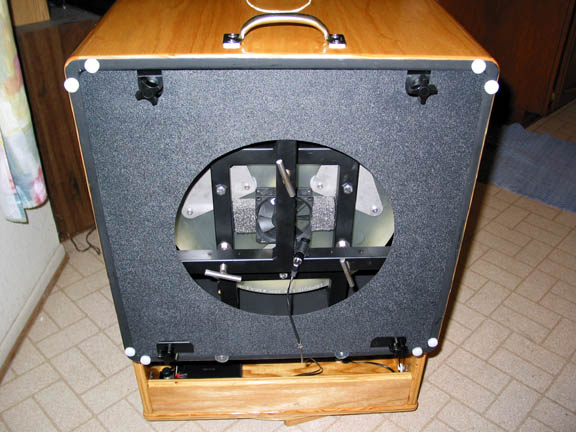
Ok, here is the last of my modifications to my scope. This is a lower light baffle to use at places where the light can get in from the rear. It leaves plenty of room for the fan to draw air (12" hole) and also keeps the air from spilling out the rear. It is held on with Velcro to the mirror cell and can be removed easily. Should help I think. smile
You also get a glimpse of the 12 volt battery and the speed adjustment knob in the rocker box. It also has an off-on switch.
Floyd
Attached Image:

fblue's attachment for post 20945

[SIZE="Large"][/SIZE][COLOR="Blue"][/COLOR] Floyd Blue grin
Amateur Imager
Posted 12/22/2004 05:18AM | Edited 12/22/2004 05:20AM #1
Here are some opinions of mine...

Rick Singmaster would very likely tell you that none of the additions you've made would make any difference at the eyepiece. Many others would agree, and maybe some would not.

Me? I think the rear fan is completely superfluous - if I was going to do a fan thing on a 14.5" SM I'd arrange them so that they blew air across the surface of the mirror. (And that might not make any difference anyway - it doesn't take that mirror very long to cool down to the point where it performs exceptionally well.) And the mirror box baffle? Possibly useful, but probably not.

Overall, I think you'd be better off being well-rested, and over the course of a long night of viewing, hydrated, and stocked with eyedrops.

Sorry for sounding negative, but that's reality. :-) Bone stock, that scope only needs to be dialed in relative to the secondary mirror and the focuser alignment. Maybe a high-end secondary if you want to be fussy - and that's about it.

Floyd, you sound like a nice, well-intentioned fellow. Aside from just using the scope as-is, if you want to get into it, focus on the details of precise focuser and secondary alignment, along with getting good at critical collimation (Catseye tools are the way to go), and when you let the scope cool for an hour or so, you'll be fine.

Doug
