[Note: I posted this thread in the "beginning astronomy" topic forum, but am re-posting here because, although I am just starting out, my questions are more about the equipment and equipment modifications for building a telescope. So, I hope this forum subtopic is better suited to my questions.]
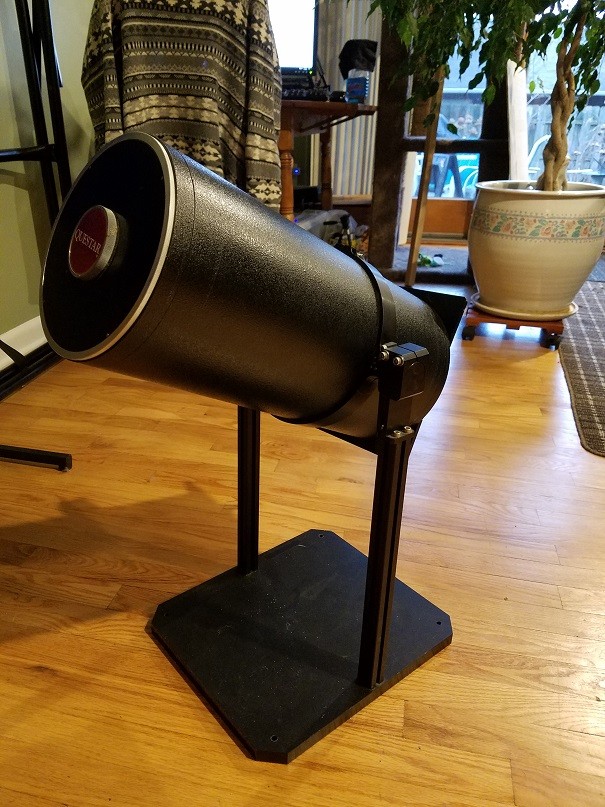
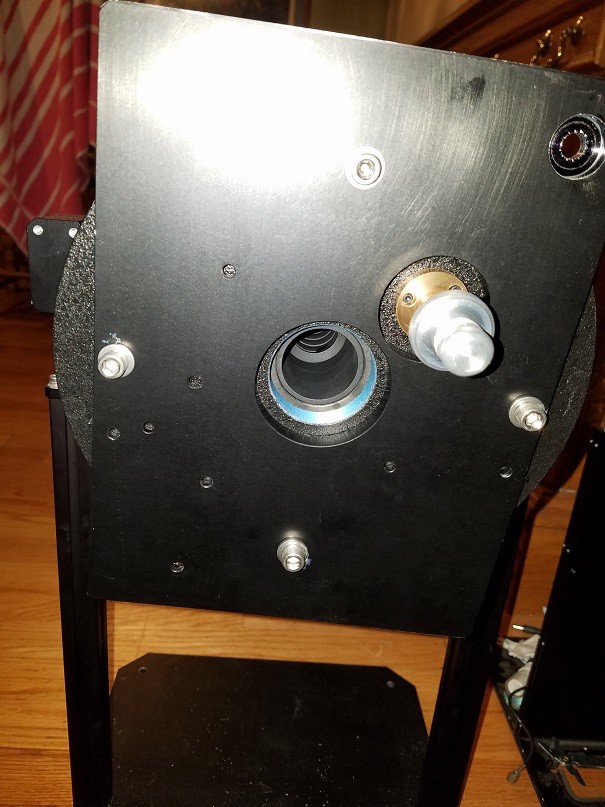
I am completely new to astronomy and telescopes, but I have a partial setup that I think is very high end, and I would like to see if I can get it to create an image. I have a Questar 7" telescope that came from an old, but very high-end atmospheric science instrument that I saved from the trash. When I looked up the 7" Questar, it looks like a fully functional telescope from this manufacturer goes for around $10,000. From what have researched, I have a 178 mm diameter Maksutov Cassegrain with an effective focal length of 2400mm. This gives a focal ratio of 13.48. It has the focusing knob that moves the primary mirror, and that does seem to change the focus when just looking through the axial hole (see picture attached). The mirrors that I can see appear flawless. Please try to answer ANY of the questions I pose below, or just comment on where I have misunderstood my research on this whole topic. My total experience is reading on the internet for the past few days, and I have no practical experience at all with telescopes or optics, but have a solid engineering background, and I am willing to learn.
I am not sure I will stick with this hobby (just joined this forum yesterday), but I thought it might be a good place to get some used parts to complete this and to see if it creates a nice image. I checked on the web, and found that the telescope would normally come with a "swivel" and then a "2" diagonal", into which I can put an eyepiece. To get an image, I don't need the diagonal (which seems to be a simple 45 deg turn mirror, and only needed for convenient viewing). I just need to place an appropriate eyepiece at the correct distance beyond the axial hole in my telescope. Note that I have female threads, and my research indicates that this is a VERY non-standard, 1.64" thread. I measure the minor diameter at 1.6" with a caliper, and close to 32 threads per inch. The website wants a couple hundred dollars just for the coupling piece that provides male threads to male threads, and I think the "swivel" then attaches to that was another couple of hundred. I am not spending that kind of money to see if I might have a working telescope. I do have a 3D printer, and one thought was that I would make a custom press fit black plastic tube that inserts into the axial hole, rather than deal with the threads at all.
First question: Is this a bad idea? Do I risk damaging or mis-aligning the secondary by attaching directly to the tube inside the axial hole? Clearly, this is not the way it is intended, but it seems to be made of sturdy, thick anodized aluminum, and it seems to be the easiest way to get me to a single piece that I need to design with the proper focal length, and insert a good eyepiece to better understand what I have and what is functional, and if it is properly aligned (primary to secondary mirrors inside the telescope tube). There are also 4 bolts that I can use to make a custom adapter plate avoiding the threaded axial hole and the tube inside that holds the secondary, that can be a light-tight box printed in black plastic, that holds my eyepiece at the correct focal distance. This seems slightly safer in terms of not disturbing the alignment between the primary and secondary, and might be a more stable structure that would not flex with the weight of the eyepiece. Would it be better if the box had a tube inside to keep out stray light, or just a big box with the eyepiece at the far end is better? I think a box that holds the structure and bolts on, with a tube inside would be best. Then I only need to seal for light leaks around where my custom adapter plate attaches to the base of the telescope.
2nd Question: Regarding the eyepiece. I do understand that I really cannot evaluate my optics without a good eyepiece, and I am willing to spend a couple hundred on a good part that would complete the telescope (at least initial build for evaluation). For my atmospheric viewing conditions in the suburbs, it seems that much greater than 200x magnification is limited by atmosphere. Given that, and my 2400mm focal length, I could consider
200x with a 12mm eyepiece
150x with a 16mm eyepiece
120x with a 20mm eyepiece
Also, I wear glasses and have astigmatism, so the eye relief spec is important for the eyepiece.
From reading these forums, it seems that a used 17 mm T4 Nagler would give a nice magnification for likely crappy atmospheric conditions, an 18 mm eye relief (for my glasses), and boasts an 82 deg FOV (which I understand is great, but really don't have a clue how this compares). Another calculation that I made was the "exit pupil" which I understand should fall between 0.7mm and 5mm for the human eye to be able to make an image, with 2mm as an optimum. A 17 mm eyepiece divided by 13.48 Focal ratio gives a 1.26mm exit pupil, which sounds small. But if I approach 2 mm, I will lose a great deal of magnification, needing a much longer focal length eyepiece. So, the question is, is this a good choice of eyepiece for my specific setup? Will this give me a good idea of what I can expect with the primary and secondary optics that I have?
Regards,
Roman
I am completely new to astronomy and telescopes, but I have a partial setup that I think is very high end, and I would like to see if I can get it to create an image. I have a Questar 7" telescope that came from an old, but very high-end atmospheric science instrument that I saved from the trash. When I looked up the 7" Questar, it looks like a fully functional telescope from this manufacturer goes for around $10,000. From what have researched, I have a 178 mm diameter Maksutov Cassegrain with an effective focal length of 2400mm. This gives a focal ratio of 13.48. It has the focusing knob that moves the primary mirror, and that does seem to change the focus when just looking through the axial hole (see picture attached). The mirrors that I can see appear flawless. Please try to answer ANY of the questions I pose below, or just comment on where I have misunderstood my research on this whole topic. My total experience is reading on the internet for the past few days, and I have no practical experience at all with telescopes or optics, but have a solid engineering background, and I am willing to learn.
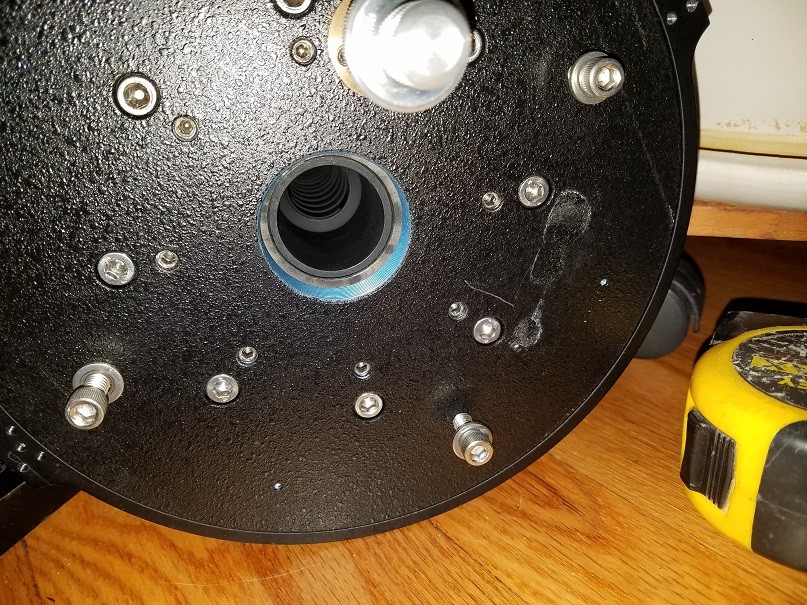
I am not sure I will stick with this hobby (just joined this forum yesterday), but I thought it might be a good place to get some used parts to complete this and to see if it creates a nice image. I checked on the web, and found that the telescope would normally come with a "swivel" and then a "2" diagonal", into which I can put an eyepiece. To get an image, I don't need the diagonal (which seems to be a simple 45 deg turn mirror, and only needed for convenient viewing). I just need to place an appropriate eyepiece at the correct distance beyond the axial hole in my telescope. Note that I have female threads, and my research indicates that this is a VERY non-standard, 1.64" thread. I measure the minor diameter at 1.6" with a caliper, and close to 32 threads per inch. The website wants a couple hundred dollars just for the coupling piece that provides male threads to male threads, and I think the "swivel" then attaches to that was another couple of hundred. I am not spending that kind of money to see if I might have a working telescope. I do have a 3D printer, and one thought was that I would make a custom press fit black plastic tube that inserts into the axial hole, rather than deal with the threads at all.
First question: Is this a bad idea? Do I risk damaging or mis-aligning the secondary by attaching directly to the tube inside the axial hole? Clearly, this is not the way it is intended, but it seems to be made of sturdy, thick anodized aluminum, and it seems to be the easiest way to get me to a single piece that I need to design with the proper focal length, and insert a good eyepiece to better understand what I have and what is functional, and if it is properly aligned (primary to secondary mirrors inside the telescope tube). There are also 4 bolts that I can use to make a custom adapter plate avoiding the threaded axial hole and the tube inside that holds the secondary, that can be a light-tight box printed in black plastic, that holds my eyepiece at the correct focal distance. This seems slightly safer in terms of not disturbing the alignment between the primary and secondary, and might be a more stable structure that would not flex with the weight of the eyepiece. Would it be better if the box had a tube inside to keep out stray light, or just a big box with the eyepiece at the far end is better? I think a box that holds the structure and bolts on, with a tube inside would be best. Then I only need to seal for light leaks around where my custom adapter plate attaches to the base of the telescope.
2nd Question: Regarding the eyepiece. I do understand that I really cannot evaluate my optics without a good eyepiece, and I am willing to spend a couple hundred on a good part that would complete the telescope (at least initial build for evaluation). For my atmospheric viewing conditions in the suburbs, it seems that much greater than 200x magnification is limited by atmosphere. Given that, and my 2400mm focal length, I could consider
200x with a 12mm eyepiece
150x with a 16mm eyepiece
120x with a 20mm eyepiece
Also, I wear glasses and have astigmatism, so the eye relief spec is important for the eyepiece.
From reading these forums, it seems that a used 17 mm T4 Nagler would give a nice magnification for likely crappy atmospheric conditions, an 18 mm eye relief (for my glasses), and boasts an 82 deg FOV (which I understand is great, but really don't have a clue how this compares). Another calculation that I made was the "exit pupil" which I understand should fall between 0.7mm and 5mm for the human eye to be able to make an image, with 2mm as an optimum. A 17 mm eyepiece divided by 13.48 Focal ratio gives a 1.26mm exit pupil, which sounds small. But if I approach 2 mm, I will lose a great deal of magnification, needing a much longer focal length eyepiece. So, the question is, is this a good choice of eyepiece for my specific setup? Will this give me a good idea of what I can expect with the primary and secondary optics that I have?
Regards,
Roman
Attached Image: