You should not just stick with a standard Plossl FOV until you have had a chance to try the alternatives and decided the Plossl FOV suits you better.
Probably only a small minority of experienced observers would prefer the Plossl view to the views obtainable through high quality wide-field EPs such as Naglers, Panoptics, and Radians..
One way I have heard the difference expressed, which seems to match my own experience, is that the wider fields are more emotionally involving. For me, subjectively, a narrow apparent FOV makes the observed object seem as if it is sort of detached, far away, down at the end of a tube. More a picture of the object seen from a distance than the object itself. The wider FOV makes it seem more real.
Al Nagler, who developed the 82 degree AFOV Nagler line of eyepieces uses the term "spacewalk" to market them. My own experience is that you have to use Nagler EPs just right to get that effect...but you can, at least with some of them.
There are other advantages. If you want to do 300x observing of planets off an alt-azimuth mount you are probably going to use an observe-then-track technique as you chase the planet across the sky. The wider the FOV, and the sharper at the edges, the longer you can observe before you have to swing the scope.
Also, there are some very neat views that just can't be had with a narrow field. Sometimes I like to put a 22 Nagler in my TV-102, which delivers only 40x, but 2 full degrees of real field, and look at Jupiter or Saturn. Seeing these planets not as giants, but as tiny little worlds out in the vastness of space gives a different perspective. Once when I was looking at Saturn this way through a 13mm Nagler at 67x, I happened to catch the moons arranged so that four of them were sorted by brightness and apparent distance from the planet simultaneously. The view produced a stunning illusion of immense 3-dimensional space, with the whole tiny system adrift in the dark, and the moons being illuminated by the light of the planet itself, because the brightness of the moons diminished with distance from the planet. Just an illusion, but unforgettable.
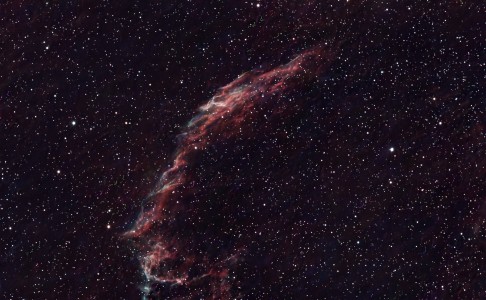
Finally, there are some objects which are so large, such as the Andromeda Galaxy and the Veil Nebula, that only a wide-field EP in a short-focal-length scope will allow you to see them whole.
Steve