Image of the day

Captured by
Lawrence Parchman

Eastern Veil Nebula

My Account

New to Astromart?

Register an account...

Need Help?

Strehl best way to describe optical wavefront ?

Started by Doug Peterson, 08/14/2007 05:39PM
Posted 08/14/2007 05:39PM | Edited 08/14/2007 05:39PM Opening Post
I think so.

Most people do not relate to waves peak-to-valley (PV) or waves RMS (much more meaningful, but numerically 3-5 times smaller).

The Strehl on the other hand--the actual peak intensity of a star (or point spread function if you want to impress people) as a fraction of the theoretical maximum--is something you can see at the eyepiece.

And numerically it is easy to relate to:

80% or 0.8 of 1.0 is nominally diffraction limited. Remember when 80-89% got you a B in school?

90-100% got you an A.

And 95% and above got you a A+.

Your thoughts on this most pressing matter?


"--Granted, that's a worse case scenario. The destruction might in fact be ... limited to our own galaxy."
Posted 08/14/2007 06:21PM #1
Here's how I see optics evaluated by a typical evaluators in a side by side view:

less than 80% - somewhat soft but not bad at all for the money, (maybe the seeing is bad)
80 - 85% - sharp as a tack, (sometimes, when the seeing co-operates)
85-90% - Holy ....! Never saw Jupiter better, got a real good look at the Red Spot (when the seeing settled down)
90-95% - mmm, how come this scope is so sharp even in this crappy seeing?
95-99% - nice view at any power, the seeing seems to be really steady tonight!

Rolando
Posted 08/14/2007 08:51PM #2
Doug Peterson said:

I think so.

Most people do not relate to waves peak-to-valley (PV) or waves RMS (much more meaningful, but numerically 3-5 times smaller).

The Strehl on the other hand--the actual peak intensity of a star (or point spread function if you want to impress people) as a fraction of the theoretical maximum--is something you can see at the eyepiece.

And numerically it is easy to relate to:

80% or 0.8 of 1.0 is nominally diffraction limited. Remember when 80-89% got you a B in school?

90-100% got you an A.

And 95% and above got you a A+.

Your thoughts on this most pressing matter?


Wish it had been that EASY! 84-93 was a "B", 93-100 was an "A", at least in the high school I attended!
Posted 08/14/2007 09:41PM #3
Strehl is certainly a good, single number that can tell you how good (or bad) optics are. It is, unfortunately, often derived in entirely inappropriate ways.

A proper determination of Strehl (or RMS wavefront) requires testing the entire aperture, and testing at a large number of points. Generating Strehl from the limited number of Foucault readings is not appropriate.

Clear skies, Alan
Posted 08/14/2007 10:22PM #4
Agreed that Strehl is more useful than Peak-to-Valley. But
as Alan indicates, one must still be careful about how the
number is derived. Interferometry, Foucault, something else?
Red light, green light, other colors? Is roughness included?
Obscurations are typically excluded.
Posted 08/16/2007 10:16PM #5
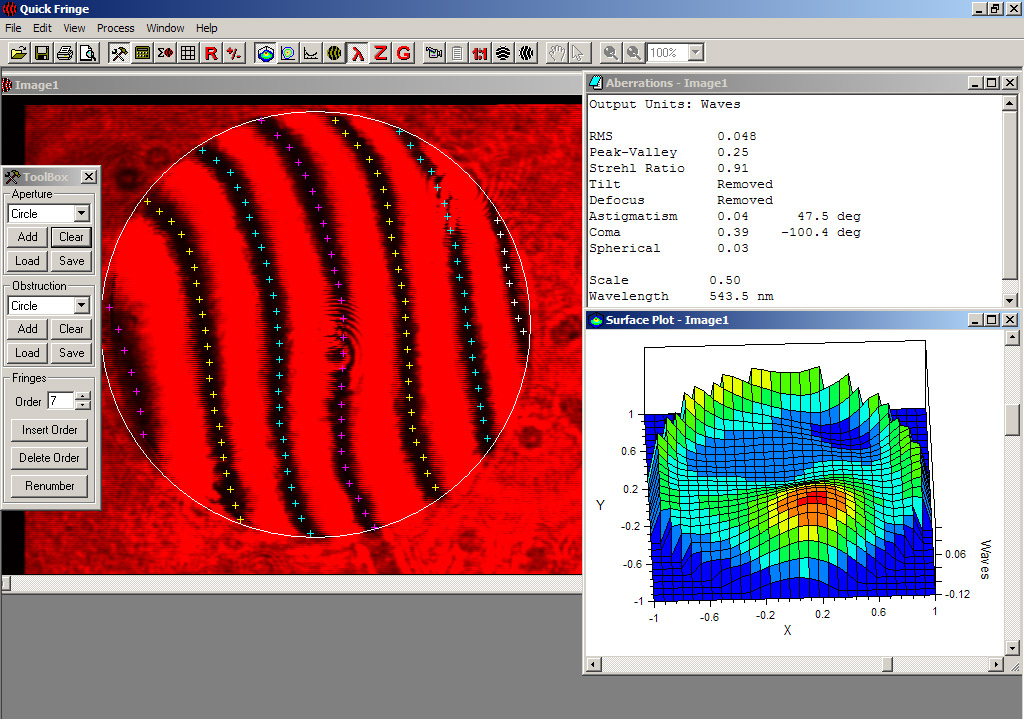
Your question about Strehl is legitimate, but by itself it does not answer the whole question about an optic. Can you have high Strehl and have a not-so-good optic? The answer is yes. In these next 4 images I have captured the process of hand correcting an optic that starts out with a respectable Strehl of .91, and then over a period of about 4 hours convert it to an optic that I can place into a tube assembly and sell.

Optical glass is never really perfect so that if you place a perfect figure on each surface you would get a final perfect wavefront. The internal quality of each element must be extremely high for that to happen, and this is not always the case. Small broad imperfections exist internal to the glass, so one must apply spot hand corrections to achieve the highest level of performance. In my case I can spend anywhere from 2 to 8 hours (or more in some cases) to slowly bring the optics to perfection.

This lens started out with .91 Strehl, 1/20 RMS, 1/4 wave P-V. The numbers, especially the Strehl, sound ok, and I would guess that this lens would pass some company's specs and be on the way to some lucky amateur. Does it work at this level? Well sorta. It would show detail on Jupiter at most powers, but there would always be a bit of something lacking.

The fringe pattern shows a strong S shape which means a non-rotational aberration caused by tiny differences in density internal to one of the elements - a high spot on the wavefront toward the front and a depressed area toward the rear. Spot figuring must be done to flatten the wavefront. 1:00 pm - time to start the hand figuring (basically working the polisher for 5 minutes or so, and then letting the lens sit for 15 minutes on the interferometer until the glass has reached thermal equilibrium so a new reading can be taken).

RC

Attached Image:

RolandC's attachment for post 116183
