Has anyone seen Jupiter as good as it appears in the following link, and if so, what scope does it take to see it like that?
http://www.astronomy.com/images/astrokids/content/jupiter.jpg
Jupter looks maybe a hair better {and without the amber tint} then it appears in this link below in my scope.
http://www.astro.uiuc.edu/~uias/astropics/2000/20001114/jupiter.jpg
Thanks,
Ron
veiwing Jupiter /Equipment
Started by Ron77, 08/17/2002 04:36PM
Posted 08/17/2002 04:36PM
Opening Post
Posted 08/17/2002 05:35PM
#1
The first: A CCD camera setup and photo processing software? I've looked at Jupiter at 6000' in very good seeing with 22" Dob ( with a really good mirror that was well collimated) and it still doesn't look like the first photo, Sorry. I'm not sure any amateur scope can give you that sort of image, to the buck naked eye.
Anyone look through the big Zeiss refractor in LA? Does something like that come closer to the first photo? ( All that light pollution improve contrast, eh? )
The second photo is nearer to any medium aperture decent quality scope, however, to get Jupiter that "size" one would have to push the magnification beyond what I usually like to, because even though the image gets bigger, the image gets messier on the scopes I have access to. No pun intended. A much Smaller Jupiter actually shows more detail on the scopes I use.
Just my experiences... maybe someone with more experience can give you some other ideas.
Posted 08/17/2002 07:01PM
#2
Hi Ron,
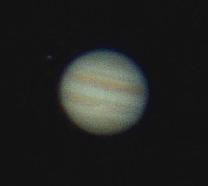
Here is a one shot picture I took of Jupiter in my 12" LX200. I held my Kodak DC3400 camera up to a 13mm Widescan and this is one of the better shots. I also did a light color curve tweak and unsharp mask, but it still looked better to the eye than the image below.
When you stack multiple (30+) good shots of a planet, it can look like the first picture if taken through a scope with around 1/6 wavefront optics in good seeing. It increases the signal to noise ratio of the image, helping bring out the fine details.
Here is a one shot picture I took of Jupiter in my 12" LX200. I held my Kodak DC3400 camera up to a 13mm Widescan and this is one of the better shots. I also did a light color curve tweak and unsharp mask, but it still looked better to the eye than the image below.
When you stack multiple (30+) good shots of a planet, it can look like the first picture if taken through a scope with around 1/6 wavefront optics in good seeing. It increases the signal to noise ratio of the image, helping bring out the fine details.
Attached Image:
Posted 08/18/2002 08:49PM
#3
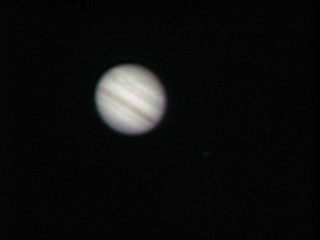
Here's an image shot with a camcorder through my 5.1" f/5 cheap Newt. I can make out some more detail through the scope if the air is very steady, but most of the time I don't see much detail at all.
The details on Jupiter are not very small, but low in contrast (at least in my scope), so it takes time and effort to recognize them.
Increasing contrast is what image enhancement is all about.
Erlend
The details on Jupiter are not very small, but low in contrast (at least in my scope), so it takes time and effort to recognize them.
Increasing contrast is what image enhancement is all about.
Erlend
Attached Image:
Funding Member
