Cleaning a large mirror

Started by RolandC, 04/01/2008 07:53PM
Posted 04/01/2008 07:53PM | Edited 04/01/2008 08:09PM Opening Post
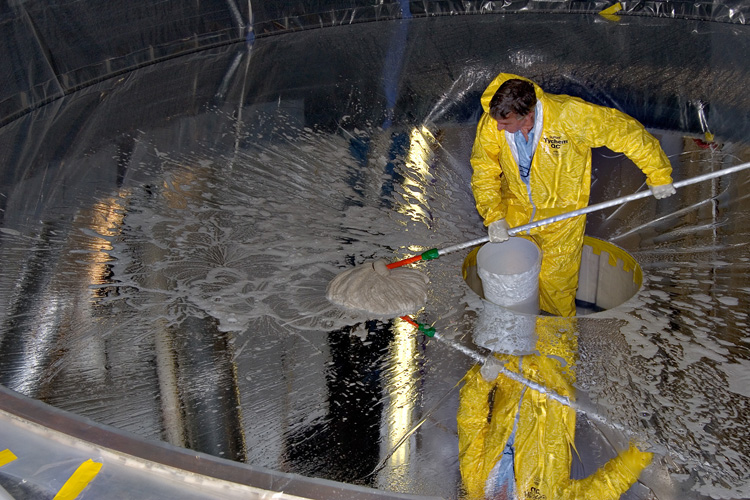
Howard Lester sent me this photo today showing the cleaning the 6.5 meter primary mirror, courtesy MMT Observatory.

Now you know how the professionals do it!

Rolando
Attached Image:

RolandC's attachment for post 41478
Posted 04/01/2008 08:03PM #1
WHAT???? No SWIFFER??!!!! 8)
These guys are OLD SCHOOL! wink

Cool stuff Roland!

Ivan Gastaldo 8)
Coconut Creek, FL

Ivan's Observatory
Lat 26N 16' 48" Long 80W 10' 48"
[COLOR="Red"]Personal Website:[/COLOR] http://www.ivangastaldo.com

CCD Imaging and Processing/Deep Sky - Moderator
I like to complain about everything - Moderator
Posted 04/01/2008 08:21PM #2
That's gotta be kinda nerve wracking. I'd hate to drop that mop handle and scratch it (wonder how big a scratch has to be to matter on a mirror that size?). I wonder what they're using to clean it?

Oklahoma State University--The University of Oklahoma!--GO POKES!! GO STATE!!
Posted 04/02/2008 05:44PM #3
Not in my wildest imagination would I have envisioned this as the process for cleaning a huge mirror. shocked I guess I'll start stopping at the car wash to clean my dob on the way to the observing field. Probably should spring for the extra spot-not rinse option. 8O

DanL
Posted 04/02/2008 05:53PM #4
All right gang, this is how it was done: The technique was to dab the aluminum surface with large (~ 12 inch diameter) cotton swabs. With no lateral scrubbing motion allowed, the very wet, suds-filled pure cotton swabs were dabbed onto the surface manually, resulting in minimum friction drag and no scrubbing action to scratch the aluminum oxide film. Some 1600 pats with pole-handled swab heads (like mops) were carefully administered. The operation took six hours. The mirror was oriented zenith pointing throughout, kept wet with high purity de-ionized water, and rinsed thoroughly. The clean surface was dried in segments using an air-knife discharging some 20 cubic feet per minute of filtered dry air to transport and evaporate water beads off the mirror.

The results were terrific, with a factor of six reduction in measured (visual light) scattering (~7.5% initial scattering to ~1.2%), and a ~3% increase in reflectance at 500 nm (~86.5% reflectance to 89.5%). There is dramatic improvement in the mirror's visual appearance, and accompanying gains are expected in telescope performance.

The former process of blasting the surface with CO2 "snow" could not remove the well-adhered dust that had accumulated over the past 27 months. This is the first time we tried this washing method with giant "Q-tips," and we found it works quite well.. and apparently garnered a lot of laughs from the staff working on it.

Howard Lester, MMT Observatory