Image of the day

Captured by
Douglas Rollain

M20 Trifid Nebula in LRGBHa

My Account

New to Astromart?

Register an account...

Need Help?

off-axis mask

Started by Skyskanner, 11/12/2005 08:22PM
Posted 11/12/2005 08:22PM Opening Post
I enjoy reading these forums but rarely add to them unless I have a question or two.

1. What would be the benefits or drawbacks of putting an off-axis 5" diameter circular mask onto the outer edge of a reflecting telescope of 12" diameter? The mask would permit a 5" diameter column of incoming light and would be placed in such a way that it would be at the outer rim of the the 12" mirror thereby avoiding the shadow of the secondary mirror. I know that there would be loss in brightness since only a portion of the mirror is being used, but on the other hand, there would be no central obstruction since the light path is off-axis.

2. Second question, What would be the benefit of putting three of these masks next to each other onto the 12" mirror? Tbis would increase the brightness and would also have no central obstruction to deal with.

3. Would this arrangement of 3 masks create a sharper image overall as opposed to using the entire 12" mirror since there is no central obstruction?

A million thanks
Bob
Posted 11/12/2005 08:58PM #1
Bob Buchwald said:

I enjoy reading these forums but rarely add to them unless I have a question or two.

1. What would be the benefits or drawbacks of putting an off-axis 5" diameter circular mask onto the outer edge of a reflecting telescope of 12" diameter? The mask would permit a 5" diameter column of incoming light and would be placed in such a way that it would be at the outer rim of the the 12" mirror thereby avoiding the shadow of the secondary mirror. I know that there would be loss in brightness since only a portion of the mirror is being used, but on the other hand, there would be no central obstruction since the light path is off-axis.

2. Second question, What would be the benefit of putting three of these masks next to each other onto the 12" mirror? Tbis would increase the brightness and would also have no central obstruction to deal with.

3. Would this arrangement of 3 masks create a sharper image overall as opposed to using the entire 12" mirror since there is no central obstruction?

A million thanks
Bob
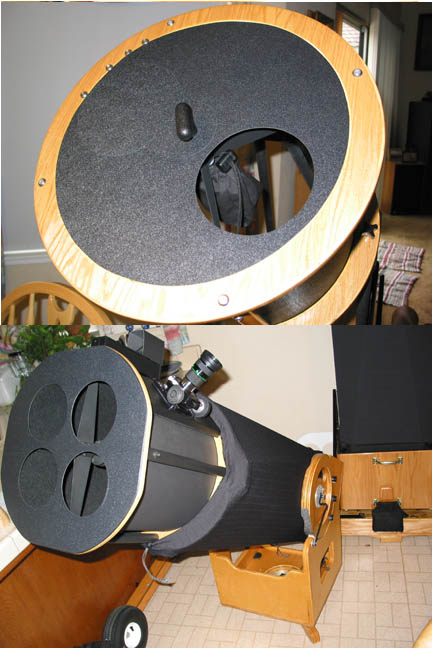
Bob,

I tried a 6" mask on my wife's 14.5" f/6 Newt on several nights, viewing both Jupiter and Saturn. The views were better without the mask.

Using three holes actually produces what is essentially a 12" mirror with a very odd central obstruction. The diffraction effects of the blocking portion of your three holed mask are going to be detrimental. Of course, it is easy enough to try and see for yourself.

Clear skies, Alan
Posted 11/13/2005 12:51AM #2
I use them at times and they can be cool in that they take away the spider spikes. I find the View of mars to be quite nice with the 4 hole mask.
Floyd

Attached Image:

fblue's attachment for post 98197

[SIZE="Large"][/SIZE][COLOR="Blue"][/COLOR] Floyd Blue grin
Amateur Imager
Posted 11/13/2005 05:22AM #3
I remember an RTMC panel discussion where the "off axis mask is sharper" question was asked of a group of very famous mirror makers. (It was eight (?) years ago, and I cannot remember any names.) Each of them said it would not improve the view on a well made mirror. It may mean you are looking at a smaller swection of a bad mirror--and thus avoiding the bad part--but it would not improve a well made mirror.

But, considering the cost--try it and see.

Aex
Posted 11/13/2005 01:03PM #4
1. What would be the benefits or drawbacks of putting an off-axis 5" diameter circular mask onto the outer edge of a reflecting telescope of 12" diameter? The mask would permit a 5" diameter column of incoming light and would be placed in such a way that it would be at the outer rim of the the 12" mirror thereby avoiding the shadow of the secondary mirror. I know that there would be loss in brightness since only a portion of the mirror is being used, but on the other hand, there would be no central obstruction since the light path is off-axis.
=========

Just to state the obvious: The main drawback is that you have reduced the aperture of your scope from a 12 inch scope down to a 5 inch scope. Lost brightness is the least of the problems, decreased resolution would seem to be on top of the list. The effect of the CO is small by comparison.

How it all adds up with a multi-hole mask and how critical the placement of the holes is, need a math guy for that...

I don't think they use an aperture mask on the 200 inch at Palomar...

Jon
Posted 11/13/2005 05:16PM #5
With full aperture, a very large part of the signal to the eye is coming in from the outer portion of the mirror. In addition to removing the central obstruction and defraction from the spider, the off axis mask reverses the signal to noise ratio of the mirror. Only a tiny portion of the signal is comming in at a fast focal ratio. The over whelming majority is now slower, with less coma and astimatism at the ep.

So the mask removes that part of the mirror that can give the most problems, nips off most of the coma, cleans up the image in ep's with regard to astigmatism, cuts the image brightness, removes the central obstruction and spider defraction spikes.

All at a huge loss in resolution.


Another consideration is to try masking off the very outer fraction of an inch of the mirror (turn down edge issues) and use active cooling.