Off-Axis Reflector Astigmatism

Started by pwp818, 02/24/2007 08:41PM
Posted 02/24/2007 08:41PM Opening Post
I have a DGM 5.5, that I have had for over a year. Generally, it gives nice crisp contrasty views, which are quite bright for the 140mm optics. My problem is I have never gotten the superb planetary views I bought it for, probably due to the trace of astigmatism that I see, even after tedious star test collimation. I spoke to Dan McShane a couple times about this, and he says it is the collimation. He also recommends using simple less well corrected eyepiece designs during collimation. I've done this, but still see the astigmatism. Can misaligned optics cause astigmatism in this type of optical system?

Since the primary is a segment of a larger f/4.3 mirror (per Dan), it has a thick end and a thin end. Dan says you point the secondary at the center of this primary section, though intuitively it seems like you would point it at the thin edge, which used to be at the center of the parent primary. I'm thinking that maybe I should be pointing my secondary somewhere other than the very center of the primary segment. Could this be my problem?

Or, what would happen if my primary segment is rotated a degree or two in its cell, so that the light cone is not hitting the secondary with the optimal geometry? I'm now considering getting a Astrosystems secondary holder to replace the non-adjustable holder that came with the scope so I can tweek the secondary during collimation (now you have to tilt the focuser to aim the laser beam). Before I waste my money, I'd like to get some feedback on my ideas and whether or not this could be a collimation issue.
Posted 02/24/2007 09:22PM #1
Paul, Is there any area in the field where you can position the star image and see less astigmatism?
Get the slightly astigmatic, out of focus image, in the center of the field using your low power ocular.
Move it around the field and see if there is any position where the astigmatism disappears. If so, stop there and turn your collimation screws(without moving the scope) until that image is centered. Repeat the process using higher powers. I recomend using Polaris.

This might help. I have an OA-4 that I bought years ago that seems to work well. I compared the image of Delta Cygni through it, with the image through a TV 102. The 102 showed the companion just a bit better because the star image was more steady in the closed tube.

Darian R.
Posted 02/24/2007 10:29PM #2
I'll try to check out Todd's report. I have done the procedure as described in Dan McShane's website instructions - move scope to place image at edge of field where it looks circular, then adjust primary to bring that circular image to center of the field. Doing this numerous times gives me the best image, but I can never eliminate totally the astigmatism, which is obvious when racking inside versus outside focus.
Posted 02/25/2007 12:07AM | Edited 02/25/2007 12:07AM #3
Paul Preto said:
I have a DGM 5.5, that I have had for over a year. Generally, it gives nice crisp contrasty views, which are quite bright for the 140mm optics. My problem is I have never gotten the superb planetary views I bought it for, probably due to the trace of astigmatism that I see, even after tedious star test collimation. I spoke to Dan McShane a couple times about this, and he says it is the collimation. He also recommends using simple less well corrected eyepiece designs during collimation. I've done this, but still see the astigmatism. Can misaligned optics cause astigmatism in this type of optical system?

I do not have one of these scopes, but I did a raytrace
just now and gave it some thought. Yes, collimation errors
on the primary mirror will cause effects similar to
astigmatism. It is really a non-standard form of coma,
but will behave somewhat like astigmatism. See the
spot plots inside and outside focus below.


Since the primary is a segment of a larger f/4.3 mirror (per Dan), it has a thick end and a thin end. Dan says you point the secondary at the center of this primary section, though intuitively it seems like you would point it at the thin edge, which used to be at the center of the parent primary. I'm thinking that maybe I should be pointing my secondary somewhere other than the very center of the primary segment. Could this be my problem?

I think this depends on how Dan has the scope set up.
If the focal plane and focuser are perpendicular to the main
optical axis, then you are right -- the laser should point
back to where the center of the original F/4.3 would have
been. But if Dan has the focuser tilted, then it could
point at the center of the 5.5" mirror.


Or, what would happen if my primary segment is rotated a degree or two in its cell, so that the light cone is not hitting the secondary with the optimal geometry? I'm now considering getting a Astrosystems secondary holder to replace the non-adjustable holder that came with the scope so I can tweek the secondary during collimation (now you have to tilt the focuser to aim the laser beam). Before I waste my money, I'd like to get some feedback on my ideas and whether or not this could be a collimation issue.

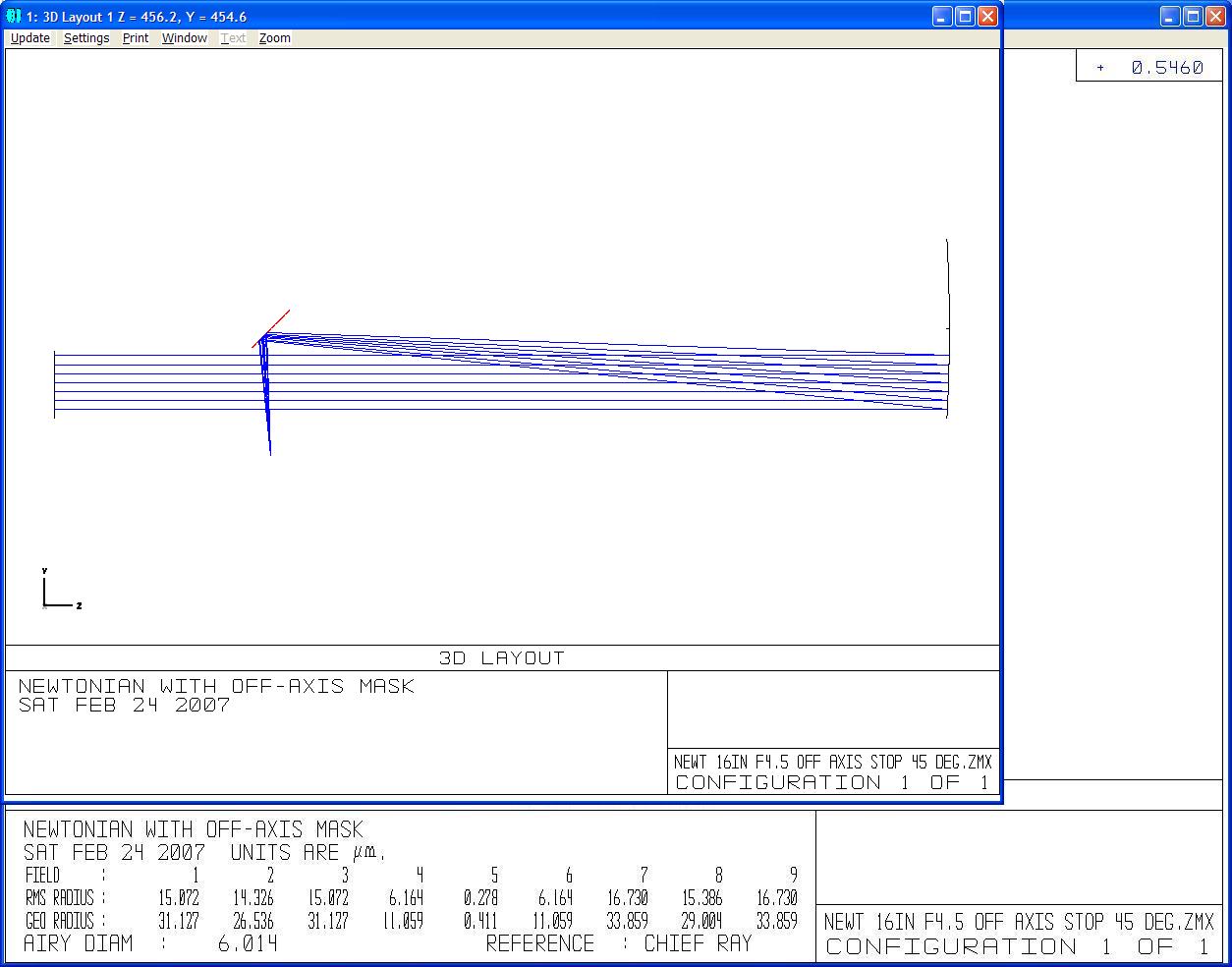
It seems to me that small rotations of the primary
are equivalent to small tilts of the primary. So
a small rotation will be easily fixed by normal
collimation.

Attached Image:

m87's attachment for post 111894
Posted 02/26/2007 06:21AM #4
Paul,
I'm getting in on this late, sorry. I don't own an off-axis scope like yours, but have read and though a lot about how to collimate regular Newtonians, of which I own three. They take some occasional tinkering to get right, as the refractor buffs love to remind us!

After some consideration, I am convinced that the the designer and manufacturer of the telescope knows how to collimate it. Follow his instuctions.

The secondary, as others have noted, is not a likely culprit, but is hard to test. To test your eye, rotate your head about the eyepiece and see if the effect stays put or follows your eye.

The burning question is, is the primary mirror astigmatic? First, as somebody already suggested, make sure the primary is not in a death grip. If it seems unstressed, of if loosening it a tad doesn't help, proceed as follows. Record the orientation of the elongations of a star imaged inside and outside of focus. Then, rotate the primary rougly 90 degrees. Do whatever you must to get some rotation. If the mirror mount can't accomodate a rotated mirror because of the difference in thickness from one side to the other, try to rotate the entire mirror cell in the tube. It doen't have to be 90 degrees, just some significant amount. Recollimate, and star test again. The scope should and must work exactly as well as before the rotation. If the in and out of focus elongations are rotated from their original orientations by the same amount that you rotated the primary, the astigmatism is in the primary.
Good luck, Ron
Posted 02/26/2007 05:48PM #5
If you have a simple laser collimator you can check that the laser hits the center of the mirror (I'm assuming that the eyepiece focuser is square to the mirror and not the original parabola). If that's OK then ajustment of the primary should find a position where the image is perfect. That position should be where the beam exits at a distance equal to the distance of the center of the mirror to the center of the original parabola. If there is no position where the image is perfect then the mirror might have been warped when it was perforated.

Ed Jones
Posted 02/26/2007 06:58PM #6
Paul Preto said:

I have a DGM 5.5, that I have had for over a year. Generally, it gives nice crisp contrasty views, which are quite bright for the 140mm optics. My problem is I have never gotten the superb planetary views I bought it for, probably due to the trace of astigmatism that I see, even after tedious star test collimation. I spoke to Dan McShane a couple times about this, and he says it is the collimation. He also recommends using simple less well corrected eyepiece designs during collimation. I've done this, but still see the astigmatism. Can misaligned optics cause astigmatism in this type of optical system?

Since the primary is a segment of a larger f/4.3 mirror (per Dan), it has a thick end and a thin end. Dan says you point the secondary at the center of this primary section, though intuitively it seems like you would point it at the thin edge, which used to be at the center of the parent primary. I'm thinking that maybe I should be pointing my secondary somewhere other than the very center of the primary segment. Could this be my problem?

Or, what would happen if my primary segment is rotated a degree or two in its cell, so that the light cone is not hitting the secondary with the optimal geometry? I'm now considering getting a Astrosystems secondary holder to replace the non-adjustable holder that came with the scope so I can tweek the secondary during collimation (now you have to tilt the focuser to aim the laser beam). Before I waste my money, I'd like to get some feedback on my ideas and whether or not this could be a collimation issue.

I do not own one of these scopes, nor know or have any experience with aligning them. I have off axis observed with large newts.

I do not see how a laser would work for collimation. The center of the parabola is not there. Perhaps a laser would aid in aligning the rotational position of the primary. And aligning the primary to the same plane as the secondary and focuser. But that's all I can visualize. The mirror would still have to be tipped within that plane into final alignment. The rotational positioning the primary would be critical.

But...after final collimation, I can not see where a laser should hit the pimary at all. But would be pointed at the missing center of the parabolic curve.


In another direction, a non-symetrical piece of glass could cool at different rates over it's surface area. This could cause astigmatism.

My apologies for the speculations.


Posted 02/27/2007 12:09AM #7
In reply to the most recent posts, I appreciate all ideas whether based on optical theory or just careful speculation.

To confirm some things I'm hearing and questions, the focuser is tilted to be at a 90 degree angle to the center of the mirror segment that forms my primary. I have used RTV silicon to mount both primary and secondary (no cell or holder pressure), so stress is probably not an issue. I don't have astigmatism (not in my good eye at least), and I've ruled out the eyepieces.

I thought the orientation of the primary might be critical, that is that it could not be rotated. But someone said that primary collimation would negate any slight rotation of the thin edge of the primary relative to the secondary's major axis orientation. Some others have thought it is critical. I'm still perplexed about this one, though I tend to feel a small rotation could be collimated away.

I suppose worst case I could get the primary tested and replaced by Dan McShane if necessary. Would he give me a free one after some four years??? (I'm not the first owner either).
Posted 03/06/2007 03:39PM #8
I thought this thread was dead, but I can see it has struck a nerve for some, like you Bill. I also have a big dob and have used an aperture mask. That's what made me believe this design could work. Miscollimating the primary certainly does give you strange looking stars, but what most struck me about what you just said is that the thinnest edge of the primary (mirror segment) has to be aligned with the secondary (major axis). I think if it is off at all, you are not looking down the center of the light cone but rather intersecting it at an angle. I can see this in my mind, but don't have any tools to illustrate it. I don't believe tilting the primary can compensate for its rotation, since the outside and inside edges of the cone will now not be aligned with the major axis of the secondary.
Posted 03/06/2007 06:20PM #9
The way I read their instructions is that the focuser is aimed at the center of the primary mirror center dot. Hence a laser should hit the center dot of the primary but it won't return to the focuser.

Ed Jones