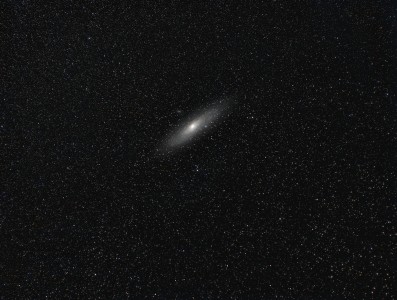

How about an observing report for a change?
I was at a "local" dark site on the Saturday night with three fellow CAS members. Since I had to drive my wife's small convertible, I took my 101mm Tele Vue refractor. The other telescopes present were a 15" Obsession, a heavily modified 16" Meade LightBridge, and a 22" SDM Dob.
Imagine our surprise when we discovered that the area surrounding our secondary observing site (the primary site at the summit was not accessible due to snow) on Peters Mountain had been clear-cut, leaving us exposed to the almost constant wind, which hadn't been mentioned in the forecasts, and light from the closest small town.
Nevertheless, we still had a good time observing numerous celestial objects, including three comets (C/2007 Q3 (Siding Spring), 29P/Schwassmann-Wachmann, and 81P/Wild) and many springtime galaxies and galaxy groups such as M51, M101, M104, NGC 3613, NGC 3619, NGC 3982, NGC 3998, NGC 4565, NGC 4631, NGC 4762, NGC 5746, NGC 5907, the wonderful Draco Trio or Draco Group (NGC 5981, NGC 5982, and NGC 5985), Hickson 44, Hickson 56, Hickson 61, Hickson 68, and Markarian's Chain.
I spent some time with an old Tasco 7x35 binocular that my wife had purchased at the swap meet at Stellafane. My primary target was M51, which was easily visible in my refractor at low power (35mm Panoptic) and a Celestron Ultima 10x50 that I borrowed. After a concerted effort, I was able to detect M51 with the Tasco.
When the waning Moon began to climb into the eastern sky, we began to tear down our gear. As I slewed my telescope to Saturn for a final view, I asked whether anyone had taken a look at it. Soon the big Dobs were pointed that way too. Dione, Tethys, Rhea, and Titan were easily visible through the 15" and the 22". The fellow with the 16" noticed that the S0sp galaxy NGC 4179 was also visible near the edge of the field of view. The conjunction of a planet and a galaxy is always a noteworthy sight.
Dave Mitsky
Chance favors the prepared mind.
De gustibus non est disputandum.


