Some years ago I was a very active poster on this forum, but the last couple of years I haven't contributed much. One of the reasons is that I found it difficult to come up with new stuff, and just wanted to avoid repeating myself too much.
Realising that this hardly is a great problem, I decided now to start posting again, and to begin with I'll write short posts about some of my favourite objects on a regular basis. I'll not be able to do this every day, but hopefully quite frequently. Some posts will be under the deep-sky forum and some under the double and variable star forum. I'll normally write about objects that are well placed for observation from the northern hemisphere at the time of posting. But if I run out of objects I may present objects I have observed from the Canary Islands, and then I'll not bother about time of the year.
I shall usually refer to own observations done with my 12.5-inch Portaball (or smaller telescopes). I consider my observing capabilities as average meaning that whatever I claim to be able to see, most other people will also be able to see with similar (or often smaller) aperture under good conditions.
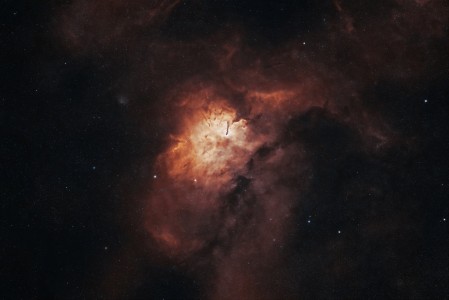
Today's choice is a planetary nebula in Taurus, NGC1514. In my opinion this object is more neglected than it deserves. To get a really good view of it with an instrument with average aperture a filter (O-III, UHC or equivalent) is required, but it isn't very difficult to spot it without a filter since the central star is very bright. First time I aimed my scope at the direction of the object I noticed that one of the stars of the field was surrounded by a haze almost as if some dew was present on the eyepiece. I had to apply the O-III filter to be a 100% sure that this was the object I was looking for. Using the filter I saw a beautiful, round nebula with delicate condensations. I would describe it as a crystal ball floating in space.
Some photos of this nebula displays a double ring superimposed on the nebula. These rings can obviously not be observed visually, and I don't know which wavelength has to be enhanced in order to produce these photos. Anyhow this is a very nice object, recommended to anyone. I assume it can be seen with considerably smaller aperture than my 12.5 inches.


