Image of the day

Captured by
Douglas Rollain

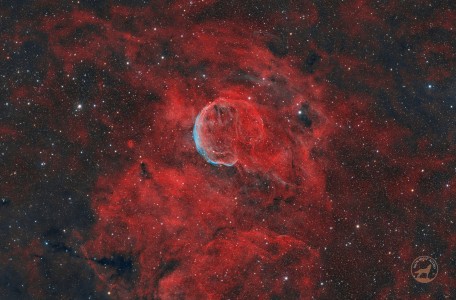
LBN 576 - The Garlic Nebula

My Account

New to Astromart?

Register an account...

Need Help?

Viewing DSOs

Started by dseliger, 06/02/2003 06:39PM
Posted 06/02/2003 06:39PM Opening Post
What is a good lens and filter combination to use to view DS0s to really see them? I have a 10" LX200GPS w/UHTC.

I'm having a hard time seeing objects such as M51, etc...
I can see the planets and closer stuff just great but have been having troubles bringing out those deep sky objects.

Any help is appreciated.

I am in a small city (Liberty Lake, WA) not the darkest, but not terribly bad either.
Posted 06/02/2003 07:01PM #1
There is a rule of thumb that a focal length of double your scopes f/ ratio gives "ideal" deep sky views,which in your case would be something like a 22mm panoptic, or other widefield of your choice.

That would certainly be a good starting point. But, there are a lot a variables (contrast, seeing, transparency, light pollution) around this, and observing experience is one of them. When I first started with my 8" f/6 objects were beginning to fade with a 12.5 mm eyepiece, now I might go down to 9 or even 7 mm on sat M 81 and 82. I also found that I used a 15 a lot. And, of course the venerable 22 mm panoptic gets a lot of use as well.

You might try to find some stars on charts that you can just see unaided and that will give you a sense of how good your local sky gets. If it's around mag 4 you might find that a light pollution filter would help.
Posted 06/02/2003 07:18PM #2
How dark Dan? I just had a great view of the M51 with *easy* spiral arms and (harder) bridge through the sweet 10" LX200 at the "Faithful Star Party" under the naked limiting magnitude of 6.1 sky.

Try bumping up the magnification.

Ron B[ee]
Posted 06/02/2003 08:17PM #3
Liberty Lake Eh...

Well from what I remember it used to be quite dark out there. Of course that was before they put in that lovely shopping center / Mall as you get off of I-90. Have you gone out to Starr Butte yet with the Spokane Astronomical Society? It is pretty dark there from what I can remember, though I was in the club when they still met at the gravel pit near Freeman Wa. Also there are several local star parties you could attend this summer... Table Mountian Star Party (July 25,26 & 27th) Near Ellensburg, Wa. Oregon Star Party I think nearish Bend, OR and Mt Kobau Star Party in Osoyoos B.C. just north of Omak / Tonasket / Oroville WA. and ending the season is the Orion Nebula Star Party again up on Table Mountian.

Good luck, and if you are ever in Wenatchee and want to go observing feel free to drop me a note.

Jack
Posted 06/03/2003 05:17PM #4
Dan,
Please don't take this the wrong way...
What do you mean by trouble seeing M51? Do you mean that it is difficult to detect, even with averted vision, in your ten inch? Or are you disappointed that it doesn't look like the pictures?

My first view of M51, in an 8-inch SCT from small town OK (limiting mag around 6) was disappointing because I expected clearly visible spiral arms and lots of detail. It turns out it isn't nearly as clear as photos.

Anyway, I'm just asking because I'm not sure how "new" you are. Talking to folks in the local astronomy club sounds like a good idea. They can give you a reasonable idea of how dark your skies are and, if they're bad, where a good observing location in the area is. It may well be worth the drive.
Posted 06/06/2003 03:11AM #5
Hello Dan

To view M51 be patient. Despite all the photos you have seen of a majestic pair of galaxies in deep space - IGNORE THEM. This object is FAINT, and SMALL. I have a 10" f6 hand guided dob that I have acquired M51 with for the first time earlier this year. It was tough going.

Use a star chart and your finder to get in the right vicinity of the sky (Don't expect to see m51 in your finder). Use your biggest eyepiece (EP). Since you say you're a beginner, I'll guess you've got a 25mm and a 9 or 10mm, stick with your 25. Scan the sky slowly and patiently. You are looking for a pair of FAINT, Smudgy, fuzzy SMALL spots fairly close together. Once you get your scope close to the right location, stare into the EP and look for the fuzzies, move your concentration around the EP view for a couple of minutes and just ask yourself 'could that be it’. Bring your eye to focus on what you think it might be and consider it for a moment or two, you'll be pretty certain when you've got it. It will look like a pair of smudgy white spots. Only when you’re fairly certain that you’ve got it should you switch up to a higher power EP. If you’ve got an 18mm EP I’d bet you’ll get fairly good detail in a 10”f10 scope. If you use a smaller EP (much higher power) than that, it might be ‘too close’, don’t know I’ve not used a 10”f10.

You may not see the arms at all with your scope. I just looked at M51 through an 18” last weekend and didn’t see the arms connecting the two galaxies at all, although I saw a LOT more detail in the larger galaxy with the 18” scope than I’ve ever seen with my 10”.
It took me about 8 tries to find M51 and I was somewhat underwhelmed when I finally knew I had it. The pictures I’ve seen of this object over sold it to me quite badly. Although I will say that as I look at it more, the more detail I learn to make out.

As for determining the visible magnitude of your skies try the following. Get a good star chart – down to at least 6th magnitude – really, buy one that goes all the way down to at least 8th mag. Go out and look at the little dipper – can you see ALL the stars of that constellation from your back yard? If you can you’ve got about 4.5mag skies – really pretty good for a back yard. Can you see fainter stars? BONUS!
I found M51 in mag 3.5 to 4 skies from my back yard.

Also I’d advise trying star cluster objects first, they are easier to locate and more immediately satisfying than galaxies at first. They will help you learn your eye skills and your star chart reading skills with a little quicker pay off. I find galaxies are usually tough to find and somewhat of a let down when I compare what I see through the EP and what I see in Astronomy or Sky and Telescope magazines. Take your time, be patient and keep trying.

Clear Skys
Leif Edmondson
