Image of the day

Captured by
John Roach

Enhanced Uranus showing Polar Cap and possible Aurora

My Account

New to Astromart?

Register an account...

Need Help?

Can't see with large aperture?

Started by ronbee, 05/24/2004 04:48PM
Posted 05/24/2004 04:48PM | Edited 05/24/2004 04:48PM Opening Post
Before answering this seemingly simplistic question, please read further. Having now seen what the difference between 8" and 4" aperture can do, I was greatly surprised to have found out (in The Planet Saturn book) that Barnard was not able to see the spots on Saturn with his 36-inch Lick refractor that Arthur Stanley Williams could see with his 6.5-inch Calver reflector (and others with aperture ranging from 5-inch to 10.25-inch have reported the spots as well) between 1891-1894. Even Antonaidi reported seeing the spots regular in 1896 and 1897 with aperture no larger than 9.75-inch! Barnard also tried to reduce the aperture down to 12-inch under good
and bad seeing but could see not spots at the time and furthermore, he actually questioned the validity of reports made by much smaller scopes! It wasn't until 1903 that he saw the spot for the first time!

This puzzles me greatly because I've recently come to the conclusion
that larger aperture under the right seeing condition (say 8-10 or Antonaidi II - I) would always reveal any features that others can see with smaller aperture.

So the question is: why did Barnard, one of the world's greatest and most capable observer blessed with one of the largest and finest instrument at the time, fail to see the spots during those time
period with much, much larger aperture (or even stopped down) and in good seeing while others with much, much smaller instruments were able to?

Thanks in advance,
Ron B[ee]
Posted 05/24/2004 09:31PM #1
Ron,

I believe that your true question is "Why do not experienced planetary observers using larger instruments detect more detail over the planets." This actually depends upon many factors such as the quality of the lens or mirror (larger objectives are more difficult to figure to a diffraction-limited surface), structure enclosing the instrument (older observatories used material (e.g. steel) which held heat too readily and were poorly ventilated compared to modern (open) observatories), experience of the observer (a factor not mentioned enough), and most importantly the steadiness of our atmosphere (or seeing conditions).

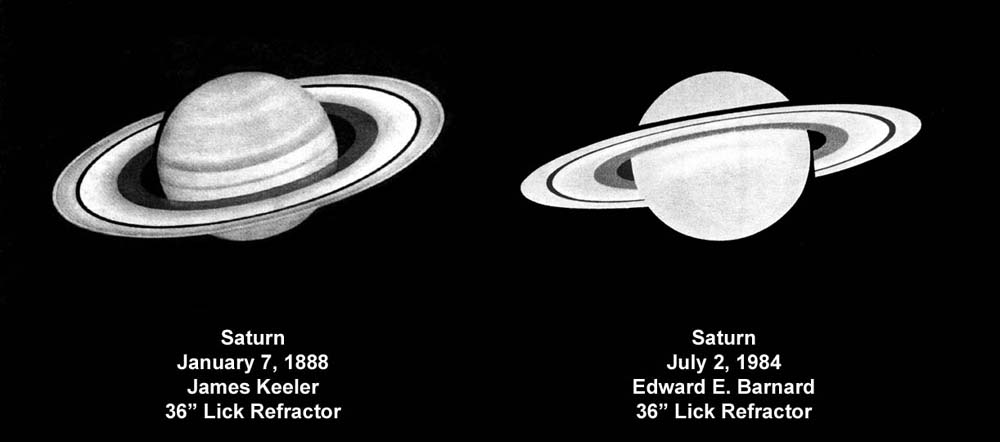
The observation of Saturn made by the famous planetary astronomer Edward Emerson Barnard you refer to (on the right in the attached image) was made on July 2, 1894. Barnard was using the famous 36" Lick refractor at the time to make his observation. Since the Lick refractor was first pressed into service in 1888, ironically the other attached image made by James Keeler was practically the maiden observation using this fine instrument, Barnard had enjoyed many fine views of the Moon and planets which superseded any other made before that time. He wrote of this observation of Saturn "It is true that the picture appears abnormally devoid of details when compared with drawings made with some of the smaller telescopes. I am satisfied, however, to let it remain so." Barnard was, honestly, recording only the features that were held steadily throughout his observation as any observer should do. I understand this statement as I myself have observed details over the planets that were not consistently visible and therefore not recorded in the final drawing. One must remember that the planet Saturn presents very low contrast features over it's globe and not even orbiting instruments (HST) record much more detail over the ringed planet.

James E. Keeler, the first staff astronomer of the Lick Observatory and a pioneer in astrophysics, made his observation of Saturn on January 7, 1888. Keeler was using an impressive magnification of 1,000x on the giant refractor (what a view that must have been!). He stated upon placing Saturn in the field of view "beyond doubt the greatest telescopic spectacle ever beheld by man. The giant planet with its wonderful rings, its belts, its satellites, shone with a splendor and distinctness of detail never before equalled." Keeler discovered a faint gap in the outer portion of ring A during that observation now know as the Keeler division (not to be confused with the Encke division or gap which are closer to the center of ring A).

The point of the above observations is to show that if given the proper atmospheric (seeing) conditions then an experienced observer will detect features over a planetary surface or atmosphere that a smaller instrument will fail to detect. This is not a condemnation of smaller instruments used on the planets but only a fact that a larger aperture instrument (assuming a well-figured objective) will ( by reason of increased resolution) detect finer details upon a planetary surface or atmosphere if the atmospheric (seeing) conditions permit. The smaller instrument, in general, will be useful on many more observing sessions if the seeing conditions at a specific site are average (5/10) at best. That is why we, using our smaller instruments (e.g. 4-10 inches aperture) will "see" more detail upon the planets, in general, than larger instruments as the average air cell is approximately 10 inches (25 cm) in diameter.

Attached Image:

Martian's attachment for post 79939