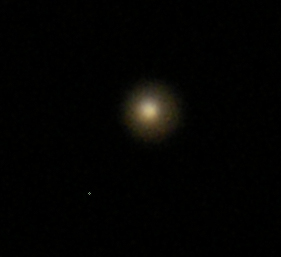

HOT NEWS: Astronomers in Japan, Persia and Europe report that Comet 17P/Holmes is undergoing a spectacular eruption. The 17th magnitude comet has brightened by a factor of five hundred thousand or more during the past 24 hours becoming a naked-eye object in the evening sky. Look for a yellow 2.5th magnitude fuzzball in the constellation Perseus after sunset. [sky map] [ephemeris] [3D orbit]
"This is unbelievable!" says Iranian astronomer Babak Tafreshi. "I was amazed to find Comet Holmes so easily with the naked-eye in the light-polluted skies of metropolitan Tehran." Click on Tafreshi's photo to pinpoint the comet:
The outburst may signify a breakup of the comet's core or a rich vein of ice suddenly exposed to sunlight--no one knows. At present the comet looks more like a star than a comet; it does not have a discernable tail, but it might grow one as the outburst continues. Amateur astronomers are encouraged to monitor developments using binoculars and backyard telescopes. Stay tuned for updates!
Charts at http://www.cometchasing.skyhound.com/
17P/Holmes: An all-night comet visible to the naked eye
This comet is in super outburst, having brightened by many magnitudes on the night of October 24. It is currently (as of 17:00 UT October 24) in Perseus at magnitude 2.8 (and brightening!). Look for a nearly stellar coma in the telescope. It appears as a new star in Perseus to the naked eye. How long this outburst will last is anyone's guess, but according to Gary W. Kronk's Cometography 17P was discovered during a similar outburst in November of 1892. During that outburst it was a naked-eye object for several weeks.
17P is in naked-eye super-outburst! On October 24 this comet brightened to naked-eye visibility! This comet is currently well placed for northern observers in Perseus. It appears very star-like with a reported DC of 9. As of 17:00 UT Seiichi Yoshida (Japan) reports it has brightened to magnitude 2.8. See below for more info and a finder chart.
http://www.cometchasing.skyhound.com/comets/17P.gif
-------- Original Message --------
Subject: Re: [AAVSO-DIS] [cvnet-outburst] Comet Holmes is brilliant object in Perseus
Date: Wed, 24 Oct 2007 20:38:17 +0100
From: Keith Geary
To:, ,
"Baavss"
CC: vsnet alert
References:
Wow!!!!! This is the single most strangest comet I have ever seen in my Life, earlier today, an alert went out that this comet had suddenly brighened from a predicted magnitude 17 to magnitude 3 - incredible, I wonder how this has happened? I quickly set up my 15x70mm binoculars and I easily found it in the constellation Perseus, just about 5 degrees from Alpha Persei at magnitude 1.8, also the star Delta Persei is at magnitude 3.0, from these two stars, I can see the comet at about magnitude 2.5 !!!!! I could immediately see that it is very much yellow in colour, just like the planet Saturn, and it is definitely non star like, with a slighty elongated shape east-west, with no sign of a tail, especially since the near full moon is shining brightly.
This can easily be mistaken for a nova, and is easily visible with the naked eye ! Here is a quick shot that I took.....this will grab many headlines over the next few days...
Keith....
http://farm3.static.flickr.com/2277/1731958125_87c03db8e8_o.jpg
----- Original Message -----
From: cnj999
To: [email protected]
Sent: Wednesday, October 24, 2007 7:25 PM
Subject: [cvnet-outburst] Comet Holmes is brilliant object in Perseus
It is perhaps appropriate to warning observers that the 2nd magnitude object visible in northern Perseus is not in fact a new nova but rather Periodic Comet Holmes, which is undergoing an enormous photometric outburst. Undoubtedly, there will be multiple reports of it as a nova (since it appears stellar) as some unsuspecting European observers spot it dramatically altering Perseus' appearance when darkness falls over the continent.
JBortle
"This is unbelievable!" says Iranian astronomer Babak Tafreshi. "I was amazed to find Comet Holmes so easily with the naked-eye in the light-polluted skies of metropolitan Tehran." Click on Tafreshi's photo to pinpoint the comet:
The outburst may signify a breakup of the comet's core or a rich vein of ice suddenly exposed to sunlight--no one knows. At present the comet looks more like a star than a comet; it does not have a discernable tail, but it might grow one as the outburst continues. Amateur astronomers are encouraged to monitor developments using binoculars and backyard telescopes. Stay tuned for updates!
Charts at http://www.cometchasing.skyhound.com/
17P/Holmes: An all-night comet visible to the naked eye
This comet is in super outburst, having brightened by many magnitudes on the night of October 24. It is currently (as of 17:00 UT October 24) in Perseus at magnitude 2.8 (and brightening!). Look for a nearly stellar coma in the telescope. It appears as a new star in Perseus to the naked eye. How long this outburst will last is anyone's guess, but according to Gary W. Kronk's Cometography 17P was discovered during a similar outburst in November of 1892. During that outburst it was a naked-eye object for several weeks.
17P is in naked-eye super-outburst! On October 24 this comet brightened to naked-eye visibility! This comet is currently well placed for northern observers in Perseus. It appears very star-like with a reported DC of 9. As of 17:00 UT Seiichi Yoshida (Japan) reports it has brightened to magnitude 2.8. See below for more info and a finder chart.
http://www.cometchasing.skyhound.com/comets/17P.gif
-------- Original Message --------
Subject: Re: [AAVSO-DIS] [cvnet-outburst] Comet Holmes is brilliant object in Perseus
Date: Wed, 24 Oct 2007 20:38:17 +0100
From: Keith Geary
To:
"Baavss"
CC: vsnet alert
References:
Wow!!!!! This is the single most strangest comet I have ever seen in my Life, earlier today, an alert went out that this comet had suddenly brighened from a predicted magnitude 17 to magnitude 3 - incredible, I wonder how this has happened? I quickly set up my 15x70mm binoculars and I easily found it in the constellation Perseus, just about 5 degrees from Alpha Persei at magnitude 1.8, also the star Delta Persei is at magnitude 3.0, from these two stars, I can see the comet at about magnitude 2.5 !!!!! I could immediately see that it is very much yellow in colour, just like the planet Saturn, and it is definitely non star like, with a slighty elongated shape east-west, with no sign of a tail, especially since the near full moon is shining brightly.
This can easily be mistaken for a nova, and is easily visible with the naked eye ! Here is a quick shot that I took.....this will grab many headlines over the next few days...
Keith....
http://farm3.static.flickr.com/2277/1731958125_87c03db8e8_o.jpg
----- Original Message -----
From: cnj999
To: [email protected]
Sent: Wednesday, October 24, 2007 7:25 PM
Subject: [cvnet-outburst] Comet Holmes is brilliant object in Perseus
It is perhaps appropriate to warning observers that the 2nd magnitude object visible in northern Perseus is not in fact a new nova but rather Periodic Comet Holmes, which is undergoing an enormous photometric outburst. Undoubtedly, there will be multiple reports of it as a nova (since it appears stellar) as some unsuspecting European observers spot it dramatically altering Perseus' appearance when darkness falls over the continent.
JBortle