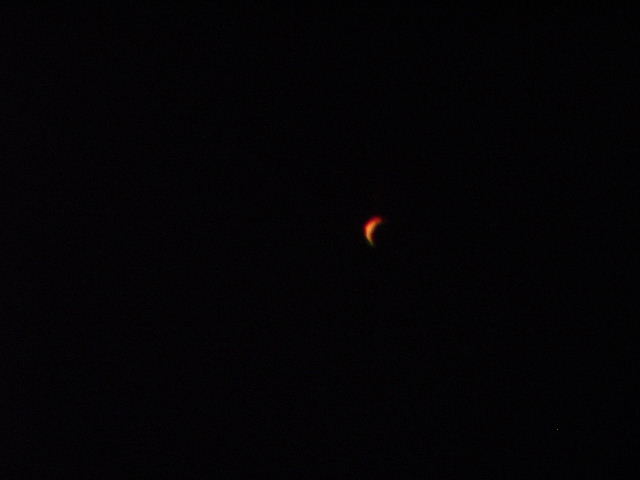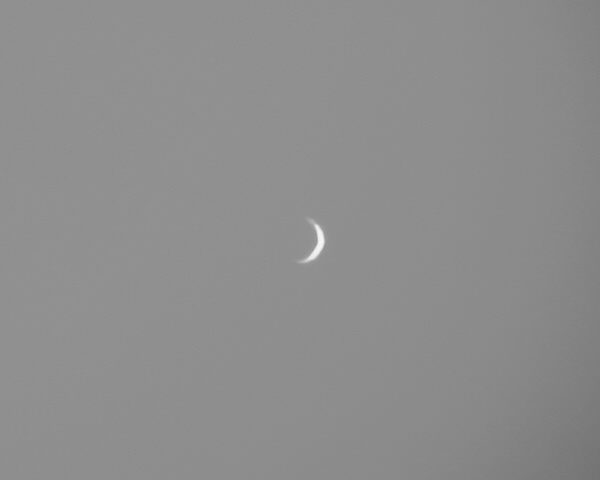

Who will be the last to spot Venus after sunset during its current evening apparition? It is becoming noticeably lower in the western sky at dusk each evening. Its apparent angular size is growing as it comes closer to Earth, while it dims as its crescent narrows.
Next month Venus will pass between the Earth and Sun in inferior conjunction. Here are the hours I’ve calculated for that event by three different definitions.
IC by Right Ascension: 2007 AUG 16 at 10 hr UT
IC by Elongation: 2007 AUG 17 at 20 hr UT
IC by Longitude: 2007 AUG 18 at 4 hr UT
At inferior conjunction Venus will appear to pass 8.0° south of the Sun. That will cause it to disappear even more rapidly from the evening sky for northern hemisphere observers. But it is possible that southern hemisphere observers will be able to spot Venus as both an evening and morning star during the night of August 16/17.
Please reply to this thread with descriptions or photos of your final post-sunset observations of Venus during the current evening apparition. Be sure to note whether you observed by telescope, binoculars or naked eye. We can make it a contest to learn who will be the last Venus spotter for each category. Daytime observations are discouraged due to the danger of peering at the Sun.
I’ve created a graphic that demonstrates the position of Venus in the western sky at dusk. It can be seen on my website. Next month I will post a graphic for the coming morning apparition in the pre-dawn eastern sky. My graphics can be seen at: http://www.curtrenz.com/astronomical.html
For astronomical graphics, including
monthly wallpaper calendar, visit:
CurtRenz.com/astronomical
Curt Renz