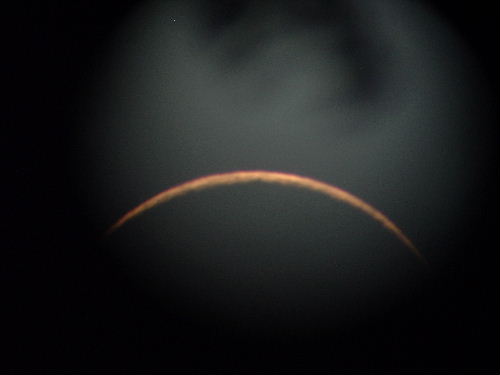
Who will be first to spot the New Moon by naked-eye after its conjunction with the Sun on 2005 JUL 06 at 12:02 UT? After sunset on the 7th the Moon will be seen surrounded by Mercury, Venus and Saturn along with the bright stars Pollux and Castor. That may provide clues for locating the thin young Moon.
This slender young crescent Moon, a day or two old, was traditionally referred to as the New Moon. On the day of conjunction our ancestors called it the Dark Moon. However, most modern calendar makers insist on labeling the conjunction day as that of the New Moon.
Since I began this series in 2004 March within several astronomical message boards, the overall champion is Navneeth (SN1987A) in Madras, India with a 2005 January sighting 24:51 hours after conjunction.
Please report your July observation within this thread, including location and time with zone. Even negative results would be interesting. Photos would be especially nice. No prizes, just bragging rights.
I've created a graphic previewing the western sky 30 minutes after sunset on July 7 as seen from Chicago's Adler Planetarium. Nevertheless, the diagram should be useful for most North American observers. To see it, click:
http://www.curtrenz.com/astronomical.html
Then click the small blue button for the "July New Moon Spotting Contest".
The graphic may be removed soon after July 7.
For astronomical graphics, including
monthly wallpaper calendar, visit:
CurtRenz.com/astronomical
Curt Renz