
Last night, as the moon was setting, I drove to the ASH Naylor Observatory and did a bit of observing with the club's 17" f/15 classical Cassegrain. It was the first clear night for some first time, or at least somewhat clear, since the transparency left a lot to be desired. (I wasted a lot of time trying to catch a glimpse of the dim planetary nebula NGC 6765 near M56.) Of course, Jupiter, being just past opposition, was my primary target. The seeing was rather poor, although I did catch a glimpse of the GRS as it was egressing. Callisto and Ganymede were bunched together to the west of the planet and Io and Europa lay to the east. I then moved on to some bright summer DSOs.
While I was looking at the open cluster M11 at 162x (40mm University Optics MK-70), I noticed a very dim satellite moving slowly through the cluster. At first, I thought that it might be a geosat, since they tend to populate that area of the sky. As I watched, I noticed two other satellites moving in tandem with it, forming a very flattened isosceles triangle, which led me to assume that I was seeing a NOSS triplet, but this was by far the dimmest NOSS pass that I had ever witnessed. Some NOSS triplet passes are visible to the naked eye and, in fact, the first time I saw a NOSS pass was naked-eye at the 1995 Mason-Dixon Star Party. I've also observed some passes that required binoculars to be seen and have tracked a few with telescopes too.
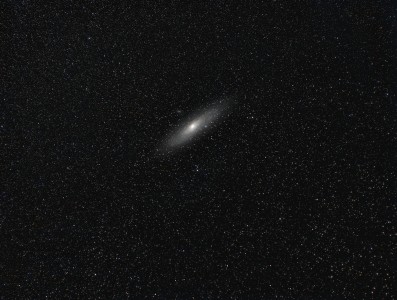
I also observed a nunber of binary stars including Pulcherrima or Izar (Epsilon Aurigae), 15 Aquilae, Otto Struve 525, Albireo (Beta Cygni), Almach (Gamma Andromedae), the carbon star V Aquilae, and M15, M22, M31, M56, M57, and the Double Cluster before calling it a night.
Dave Mitsky
Chance favors the prepared mind.
De gustibus non est disputandum.

