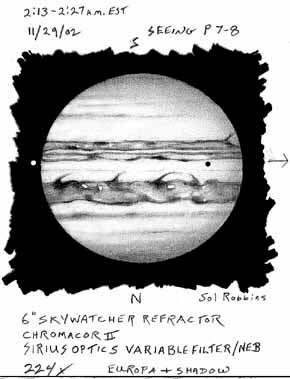
I have made my first observation of Jupiter on November 28, 2002 using my new custom 9-inch (23-cm) F/13.5 Maksutov-Cassegrain. Much detail was noted over the disk even though made under average seeing conditions (5-6/10). I hope to make many observations of Jupiter in the future, including sectional sketches and transit observations. I hope that you all enjoy my observation. Any comments are welcome on this observation.
Date (U.T.): November 28, 2002
Time (U.T.): 02:00
L1 006.6, L2 163.1, L3 327.1
Instrument: 9-inch (23-cm) F/13.5 Maksutov-Cassegrain
Magnification: 248x
Filters: None
Seeing (1-10): 5-6, Antoniadi (I-V): III
Transparency (1-6): 3-4 (Haze)
Notes:
South Polar Region (SPR): Appeared dusky (4/10) with no other detail noted.
South South Temperate Zone (SSTZ): Appeared shaded (6/10) and thin.
South South Temperate Belt (SSTB): Appeared dusky (4/10) with no other detail noted.
South Temperate Zone (STZ): Appeared bright (7/10) and thin with no other detail noted.
South Temperate Belt (STB): Appeared dark to dusky (3.5) with no other detail noted.
South Tropical Zone (STrZ): Appeared bright (7/10) with a very bright (8/10) oval noted adjacent to the SEB southern border following the CM.
South Equatorial Belt-South (SEB-S): Appeared dark (3/10) with condensations noted along the southern border.
South Equatorial Belt Zone (SEBZ): Appeared dull to bright (5-6.5/10) and thin.
South Equatorial Belt-North (SEB-N): Appeared dusky (4/10) with a dark (3/10) section over the CM.
Equatorial Zone (EZ): The southern half appeared bright (7/10) while the northern half was also bright with very bright (8/10) ovals adjacent to the southern border of the NEB.
North Equatorial Belt (NEB): Appeared dark (3/10) with very dark (2/10) blue festoons noted along the northern border and very dark (2/10) barges along the southern border.
North Tropical Zone (NTrZ): Appeared bright (7/10) with no other detail noted.
North Temperate Belt (NTB): Appeared dark to dusky (3/10) with thickened sections noted.
North Temperate Zone (NTZ): Appeared bright (7/10) with no other detail noted.
North Polar Region (NPR): Appeared dusky to dull (4-5/10) with a dark (3/10) condensation noted within.
The best of luck to your own observations and imaging.
Regards,
Carlos E. Hernandez
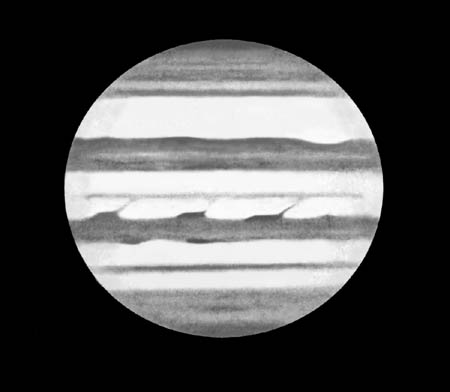
Date (U.T.): November 28, 2002
Time (U.T.): 02:00
L1 006.6, L2 163.1, L3 327.1
Instrument: 9-inch (23-cm) F/13.5 Maksutov-Cassegrain
Magnification: 248x
Filters: None
Seeing (1-10): 5-6, Antoniadi (I-V): III
Transparency (1-6): 3-4 (Haze)
Notes:
South Polar Region (SPR): Appeared dusky (4/10) with no other detail noted.
South South Temperate Zone (SSTZ): Appeared shaded (6/10) and thin.
South South Temperate Belt (SSTB): Appeared dusky (4/10) with no other detail noted.
South Temperate Zone (STZ): Appeared bright (7/10) and thin with no other detail noted.
South Temperate Belt (STB): Appeared dark to dusky (3.5) with no other detail noted.
South Tropical Zone (STrZ): Appeared bright (7/10) with a very bright (8/10) oval noted adjacent to the SEB southern border following the CM.
South Equatorial Belt-South (SEB-S): Appeared dark (3/10) with condensations noted along the southern border.
South Equatorial Belt Zone (SEBZ): Appeared dull to bright (5-6.5/10) and thin.
South Equatorial Belt-North (SEB-N): Appeared dusky (4/10) with a dark (3/10) section over the CM.
Equatorial Zone (EZ): The southern half appeared bright (7/10) while the northern half was also bright with very bright (8/10) ovals adjacent to the southern border of the NEB.
North Equatorial Belt (NEB): Appeared dark (3/10) with very dark (2/10) blue festoons noted along the northern border and very dark (2/10) barges along the southern border.
North Tropical Zone (NTrZ): Appeared bright (7/10) with no other detail noted.
North Temperate Belt (NTB): Appeared dark to dusky (3/10) with thickened sections noted.
North Temperate Zone (NTZ): Appeared bright (7/10) with no other detail noted.
North Polar Region (NPR): Appeared dusky to dull (4-5/10) with a dark (3/10) condensation noted within.
The best of luck to your own observations and imaging.
Regards,
Carlos E. Hernandez
Attached Image: