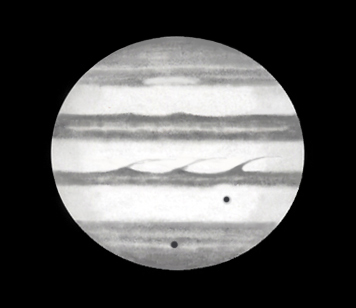

I made an observation of Jupiter under average seeing conditions (4-5/10) which revealed a good amount of detail over the jovian disk. The detail observed will be noted below. A very interesting and captivating sight was a double transit of Callisto and Ganymede over the northern hemisphere of Jupiter. Two dark shadows were noted floating across the North Tropical Zone (NTrZ) and North Polar Region (NPR). I welcome any comments on my observation.
Date (U.T.): December 19, 2003
Time (U.T.): 06:30
L1 249.7, L2 339.7, L3 246.4
Instrument: 9-inch (23-cm) F/13.5 Maksutov-Cassegrain
Magnification: 206x and 281x
Filters: None
Seeing (1-10): 4-5, Antoniadi (I-V): III
Transparency (1-6): 2-3 (hazy)
Notes:
South Polar Region (SPR): Appears dusky to dull (4-5/10) and speckled.
South South Temperate Zone (SSTZ): Appears thin and bright (7/10).
South South Temperate Belt (SSTB): Appears dusky (4/10) and broad.
South Temperate Zone (STZ): Appears thin and bright (7/10).
South Temperate Belt (STB) Appears dark to dusky (3-4/10) with a bright (7/10) segment visible on the CM within it.
South Tropical Zone (STrZ): Appears bright (7/10) without other detail visible within.
South Equatorial Belt (SEB): Appears dark (3/10) with a thin, bright (7/10) zone dividing it. It's southern border appears irregular composed of dark condensations.
Equatorial Zone (EZ): Appears bright (7/10) with dusky to dull (4-5/10) projections originating from festoons along the southern border of the NEB.
North Equatorial Belt (NEB): Appears dark (3/10) containing small, bright (7/10) rifts and condensations within it.
North Tropical Zone (NTrZ): Appears bright (7/10) with the extremely dark (1/10) shadow of Ganymede (disk not visible) over the following half.
North Polar Region (NPR): Appears dull to dusky (3-4/10) with the very dark shadow of Callisto visible on the CM within it.
The best of luck on your own observations of Jupiter. May you all have Happy Holidays and a Happy New Year!
Carlos
Attached Image: