
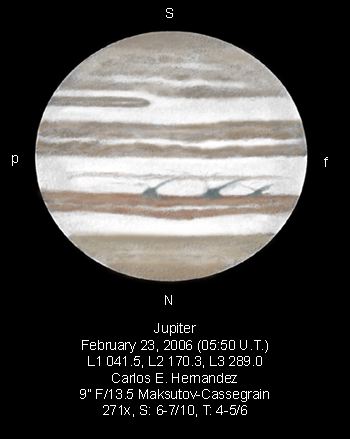
I made an observation of Jupiter on February 23, 2006 at 06:40 U.T. under average to good seeing conditions (6-7/10). The planet displayed much detail and color. An interesting South Tropical Zone Disturbance (STrZD) was note over the south-preceding portion of the disk. I welcome any comments on my observation.
Date (U.T.): February 23, 2006
Time (U.T.): 06:40
L1 041.5, L2 170.3, L3 289.0
De: -3.2, Ds: -3.0, 38.8" (equatorial)
Instrument: 9-inch (23-cm) F/13.5 Maksutov-Cassegrain
Magnification: 271x
Filters: None
Seeing (1-10): 6-7, Antoniadi (I-V): III-II
Transparency (1-6): 4-5 (Haze)
Notes:
South Polar Region (SPR): Appears dark to dusky (3-4/10) and mottled.
South Temperate Zone (STZ): Appears shaded to bright (6-7/10) and incomplete.
South Temperate Belt (STB): Appears dark to dusky (3-4/10) and it's preceding half appears to deviate towards the south due to a South Tropical Zone Disturbance (STrZD).
South Tropical Zone Disturbance (STrZD): Appears over the south-preceding portion of the disk as a dark to dusky (3-4/10) thin band with a thin, bright (7/10) midsection. The following end of the disturbance was timed at L2 184.8 (or L3 303.5).
South Tropical Zone (STrZ): Appears bright with the South Tropical Zone Disturbance (STrZD) as described above.
South Equatorial Belt (SEB): Appears dark to dusky (3-4/10) with a bright (7/10) undulating zone (SEB-Z) over it's midsection.
Equatorial Zone (EZ): Appears bright (7/10) with a thin, dull (5/10) band across it's midsection. North Equatorial Belt (NEB) festoon projections are noted over it's northern half, especially following the CM.
North Equatorial Belt (NEB): Appears dark to dusky (3-4/10) with a thin, bright (7/10) zone (NEB-Z) over it's midsection. Dark (3/10), bluish-gray festoons are noted over it's southern border. It's northern border, on the CM, appears to project into the North Tropical Zone (NTrZ).
North Tropical Zone (NTrZ): Appears bright (7/10) without any other detail within.
North Polar Region (NPR): Appears dark to dull (3-5/10) with thin, dusky (4/10) bands and condensations within it (mottled).
The best of luck imaging and observing Jupiter.
Regards,
Carlos E. Hernandez
Date (U.T.): February 23, 2006
Time (U.T.): 06:40
L1 041.5, L2 170.3, L3 289.0
De: -3.2, Ds: -3.0, 38.8" (equatorial)
Instrument: 9-inch (23-cm) F/13.5 Maksutov-Cassegrain
Magnification: 271x
Filters: None
Seeing (1-10): 6-7, Antoniadi (I-V): III-II
Transparency (1-6): 4-5 (Haze)
Notes:
South Polar Region (SPR): Appears dark to dusky (3-4/10) and mottled.
South Temperate Zone (STZ): Appears shaded to bright (6-7/10) and incomplete.
South Temperate Belt (STB): Appears dark to dusky (3-4/10) and it's preceding half appears to deviate towards the south due to a South Tropical Zone Disturbance (STrZD).
South Tropical Zone Disturbance (STrZD): Appears over the south-preceding portion of the disk as a dark to dusky (3-4/10) thin band with a thin, bright (7/10) midsection. The following end of the disturbance was timed at L2 184.8 (or L3 303.5).
South Tropical Zone (STrZ): Appears bright with the South Tropical Zone Disturbance (STrZD) as described above.
South Equatorial Belt (SEB): Appears dark to dusky (3-4/10) with a bright (7/10) undulating zone (SEB-Z) over it's midsection.
Equatorial Zone (EZ): Appears bright (7/10) with a thin, dull (5/10) band across it's midsection. North Equatorial Belt (NEB) festoon projections are noted over it's northern half, especially following the CM.
North Equatorial Belt (NEB): Appears dark to dusky (3-4/10) with a thin, bright (7/10) zone (NEB-Z) over it's midsection. Dark (3/10), bluish-gray festoons are noted over it's southern border. It's northern border, on the CM, appears to project into the North Tropical Zone (NTrZ).
North Tropical Zone (NTrZ): Appears bright (7/10) without any other detail within.
North Polar Region (NPR): Appears dark to dull (3-5/10) with thin, dusky (4/10) bands and condensations within it (mottled).
The best of luck imaging and observing Jupiter.
Regards,
Carlos E. Hernandez
Attached Image:

