

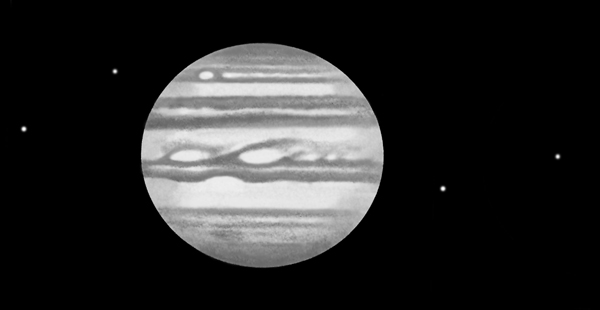
I made an observation tonight under average (5-6/10) seeing conditions with steadier moments (7/10) at times. The entire jovian disk exhibited much detail. The four Galiean satellites were aligned curiously on either side of the planet in preparation for the triple transit which I missed later in the night. I welcome any comments on my observation.
Date (U.T.): Mach 28, 2004
Time (U.T.): 04:25
L1 134.0, L2 181.6, L3 114.9
Instrument: 9-inch (23-cm) F/13.5 Maksutov-Cassegrain
Magnification: 258x and 388x
Filters: None (IL)
Seeing (1-10): 5-6 (moments of 7), Antoniadi (I-V): III
Transparency (1-6): 3-4 (intermittent clouds)
Notes:
South Polar Region (SPR): Appeared dusky to dull (4-5/10) and mottled.
South South Temperate Zone (SSTZ): Appeared shaded (6/10) and thin.
South South Temperate Belt (SSTB): Appeared dusky (4/10) and thin.
South Temperate Zone (STZ): Appeared bright (7/10) and thin. Oval BE appeared bright (7/10) and surrounded by a dark (3/10) collar towards the preceding limb.
South Temperate Belt (STB): Appeared dark (3/10) and thin.
South Tropical Zone (STrZ): Appeared bright (7/10) without any other detail visible within.
South Equatorial Belt (SEB): Appeared dark to dusky (3-4/10) with a thin, bright (7/10) zone (SEBZ) separating the northern and southern components.
Equatorial Zone (EZ): Appeared bright (7/10) with dark to dull (3-5/10) festoon projections (loops) noted within.
North Equatorial Belt (NEB): Appeared dark to dusky (3-4/10) with bright (7/10) condensations and rifts noted within it. Very dark to dark (2-3/10) festoon bases were noted along the southern border (NEBs). A very bright (8/10) bay was noted along the northern border (NEBn) preceding the CM.
North Tropical Zone (NTrZ): Appears bright (7/10) without any detail visible within.
North Polar Region (NPR): Appears dusky to dull (4-5/10) with thin bands and zones noted within. This region also appears mottled.
The following Galilean satellites were observed from preceding to following; Europa, Callisto, Ganymede and Io.
The best of luck in your own observations/imaging of Jupiter.
Regards,
Carlos E. Hernandez
Date (U.T.): Mach 28, 2004
Time (U.T.): 04:25
L1 134.0, L2 181.6, L3 114.9
Instrument: 9-inch (23-cm) F/13.5 Maksutov-Cassegrain
Magnification: 258x and 388x
Filters: None (IL)
Seeing (1-10): 5-6 (moments of 7), Antoniadi (I-V): III
Transparency (1-6): 3-4 (intermittent clouds)
Notes:
South Polar Region (SPR): Appeared dusky to dull (4-5/10) and mottled.
South South Temperate Zone (SSTZ): Appeared shaded (6/10) and thin.
South South Temperate Belt (SSTB): Appeared dusky (4/10) and thin.
South Temperate Zone (STZ): Appeared bright (7/10) and thin. Oval BE appeared bright (7/10) and surrounded by a dark (3/10) collar towards the preceding limb.
South Temperate Belt (STB): Appeared dark (3/10) and thin.
South Tropical Zone (STrZ): Appeared bright (7/10) without any other detail visible within.
South Equatorial Belt (SEB): Appeared dark to dusky (3-4/10) with a thin, bright (7/10) zone (SEBZ) separating the northern and southern components.
Equatorial Zone (EZ): Appeared bright (7/10) with dark to dull (3-5/10) festoon projections (loops) noted within.
North Equatorial Belt (NEB): Appeared dark to dusky (3-4/10) with bright (7/10) condensations and rifts noted within it. Very dark to dark (2-3/10) festoon bases were noted along the southern border (NEBs). A very bright (8/10) bay was noted along the northern border (NEBn) preceding the CM.
North Tropical Zone (NTrZ): Appears bright (7/10) without any detail visible within.
North Polar Region (NPR): Appears dusky to dull (4-5/10) with thin bands and zones noted within. This region also appears mottled.
The following Galilean satellites were observed from preceding to following; Europa, Callisto, Ganymede and Io.
The best of luck in your own observations/imaging of Jupiter.
Regards,
Carlos E. Hernandez
Attached Image:
