
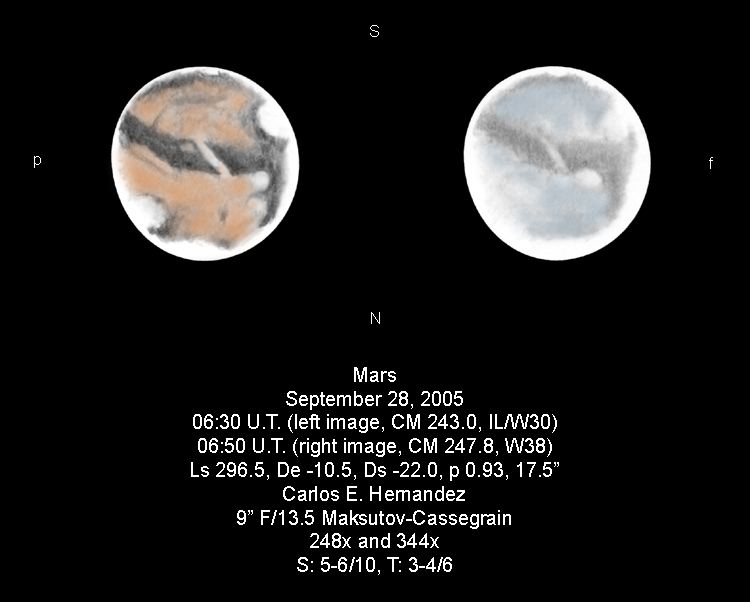
I made observations of Mars on September 28, 2005 (06:30 U.T. (IL/W30) and 06:50 U.T. (W38)) under average seeing conditions (5-6/10). Brief moments of steady seeing (7/10) allowed me to note much detail over the Martian disk, especially over the southern hemisphere. I welcome any comments that you may have on my observations.
Date (U.T.): September 28, 2005
Time (U.T.): 06:30 (left image) and 06:50 (right image)
CM: 243.0 (left image) and 247.8 (right image)
Ls 296.5, De -10.5, Ds -22.0, Dia. 17.5", p 0.93
Instrument: 9-inch (23-cm) F/13.5 Maksutov-Cassegrain
Magnification: 248x and 344x
Filters (Wratten): 30 (magenta) and 38 (blue)
Seeing (1-10): 5-6 (moments of 7), Antoniadi (I-V): III
Transparency (1-6): 3-4 (hazy)
Notes:
06:30 U.T. (Left image, IL/W30): The South Polar Cap (SPC) appeared very small but brilliant (10/10) and surrounded by a dark (3/10) collar (Mare Australe). Mare Cimmerium was prominent (3-4/10) and mottled preceding the CM with Tritonis Sinus on the CM itself. A section of "Valhalla" was visible (5/10) to the north of Mare Cimmerium towards the preceding limb. Scamander was visible along the southern border of Mare Cimmerium (it's base (Scamandri Sinus) was darker (3/10) compared to the rest of the feature (4-5/10)). Electris, Eridania, and Ausonia appeared shaded to bright (6-7/10) and finely mottled. Mare Chronium appeared dusky (4/10) along the CM towards the south. Hesperia appeared as a bright to very bright (7-8/10) angled wedge on the CM between Mare Cimmerium and Mare Tyrrhenum (3-4/10). Syrtis Minor was visible as a dark (3/10) wedge following the CM. Mare Hadriacum was visible as a dusky to dark (3-4/10) eastern (preceding) border of a very bright to brilliant (8-9/10) Hellas. Iapygia Viridis was visible (4/10) adjacent to an extremely bright (9/10) morning limb haze (MLH). Syrtis Major appeared as a dark (3/10) wedge adjacent to the MLH. Moeris Lacus (4-5/10) was visible projecting from the preceding (eastern) border of Syrtis Major. Libya appeared very bright (8/10) possibly due to clouds or haze. Aeolis, Aethiopis, and Aetheria appeared bright (7/10). Elysium was very bright to extremely bright (8-9/10) along the north-preceding limb. Pambotis Lacus (3/10), Eunostos (4/10), and the Hyblaeus Extension (3-4/10) were visible along the following border of Elysium. Nodus Alcyonius was visible as a dark (3/10) oval following the CM. Utopia was partially visible (4/10) south an extremely bright (9/10) North Polar Hood (NPH). An extremely bright (9/10) evening limb haze (ELH) was visible as well.
06:50 U.T. (Right image, Wratten 38): The South Polar Cap (SPC) appeared brilliant (10/10). Mare Cimmerium and Mare Tyrrhenum were visibly dull (5/10) with little other detail towards the center of the disk. Syrtis Major was visible as a dull (5/10) projection towards the following limb. Libya appeared very bright (8/10). Hesperia appeared as a thin, bright (7/10) wedge just preceding the CM. Hellas appeared very bright to extremely bright (8-9/10) with very bright (8/10) projections extending from it's preceding border over Ausonia. Extremely bright (9/10) morning and evening limb hazes (MLH and ELH) were visible. the North Polar Hood (NPH) appeared extremely bright (9/10) as well.
The best of luck in your own observations and imaging of Mars.
Regards,
Carlos E. Hernandez
Date (U.T.): September 28, 2005
Time (U.T.): 06:30 (left image) and 06:50 (right image)
CM: 243.0 (left image) and 247.8 (right image)
Ls 296.5, De -10.5, Ds -22.0, Dia. 17.5", p 0.93
Instrument: 9-inch (23-cm) F/13.5 Maksutov-Cassegrain
Magnification: 248x and 344x
Filters (Wratten): 30 (magenta) and 38 (blue)
Seeing (1-10): 5-6 (moments of 7), Antoniadi (I-V): III
Transparency (1-6): 3-4 (hazy)
Notes:
06:30 U.T. (Left image, IL/W30): The South Polar Cap (SPC) appeared very small but brilliant (10/10) and surrounded by a dark (3/10) collar (Mare Australe). Mare Cimmerium was prominent (3-4/10) and mottled preceding the CM with Tritonis Sinus on the CM itself. A section of "Valhalla" was visible (5/10) to the north of Mare Cimmerium towards the preceding limb. Scamander was visible along the southern border of Mare Cimmerium (it's base (Scamandri Sinus) was darker (3/10) compared to the rest of the feature (4-5/10)). Electris, Eridania, and Ausonia appeared shaded to bright (6-7/10) and finely mottled. Mare Chronium appeared dusky (4/10) along the CM towards the south. Hesperia appeared as a bright to very bright (7-8/10) angled wedge on the CM between Mare Cimmerium and Mare Tyrrhenum (3-4/10). Syrtis Minor was visible as a dark (3/10) wedge following the CM. Mare Hadriacum was visible as a dusky to dark (3-4/10) eastern (preceding) border of a very bright to brilliant (8-9/10) Hellas. Iapygia Viridis was visible (4/10) adjacent to an extremely bright (9/10) morning limb haze (MLH). Syrtis Major appeared as a dark (3/10) wedge adjacent to the MLH. Moeris Lacus (4-5/10) was visible projecting from the preceding (eastern) border of Syrtis Major. Libya appeared very bright (8/10) possibly due to clouds or haze. Aeolis, Aethiopis, and Aetheria appeared bright (7/10). Elysium was very bright to extremely bright (8-9/10) along the north-preceding limb. Pambotis Lacus (3/10), Eunostos (4/10), and the Hyblaeus Extension (3-4/10) were visible along the following border of Elysium. Nodus Alcyonius was visible as a dark (3/10) oval following the CM. Utopia was partially visible (4/10) south an extremely bright (9/10) North Polar Hood (NPH). An extremely bright (9/10) evening limb haze (ELH) was visible as well.
06:50 U.T. (Right image, Wratten 38): The South Polar Cap (SPC) appeared brilliant (10/10). Mare Cimmerium and Mare Tyrrhenum were visibly dull (5/10) with little other detail towards the center of the disk. Syrtis Major was visible as a dull (5/10) projection towards the following limb. Libya appeared very bright (8/10). Hesperia appeared as a thin, bright (7/10) wedge just preceding the CM. Hellas appeared very bright to extremely bright (8-9/10) with very bright (8/10) projections extending from it's preceding border over Ausonia. Extremely bright (9/10) morning and evening limb hazes (MLH and ELH) were visible. the North Polar Hood (NPH) appeared extremely bright (9/10) as well.
The best of luck in your own observations and imaging of Mars.
Regards,
Carlos E. Hernandez
Attached Image:

