
Although I had my watch set for 3:30, I happened to wake up around 3:00 and stepped outside. Although the sky was milky, I could see Mars and some brighter stars and so set up for some morning observing.
I recently purchased a Celestron Advanced Series GOTO mount with the new metal legs in an attempt to lighten the early morning setup effort from my 40 pound Losmandy GM8 to this 30 pound mount. Yesterday, I decided the next time I would try the GOTO mount on the aluminum legs from my 5-year-old Celestron CG5 mount. Pulling out the 15 pound mount was fantastic at 3am, but the resulting views were shaky. Although surprisingly passable for visual use, I was unable to move around at all when the webcam was in place without making the image jump all over the screen. Even the dog in her area about 30 feet away frequently made the image bounce around. I'm still undecided whether the much lighter load is worth the occasional annoyance.
Anyway, while I was setting up, I heard thunder in the north from over the lake, so I realized my session might get cut short and that I might best spend the time getting a quick picture. With only a brief peek at Mars before the camera went in, I went straight to taking two 2-minute movies, and then one infrared-only image. This is my first attempt at trying IR on Mars, and if it came out well I may use it for the luminance channel (p.s. it turned out to be of no use).
After the webcam was set up, I took to viewing with the binoviewer and magnifications between 200 and 400, with 200 being way too small and bright, 300 the best, and 400 being pretty good. The whole southern hemisphere was notably darker, with mottling in which I had difficulty finding a pattern. The best I could do after a half hour was to detect two darker areas within it, and also possibly one isolated dark area on the north side.
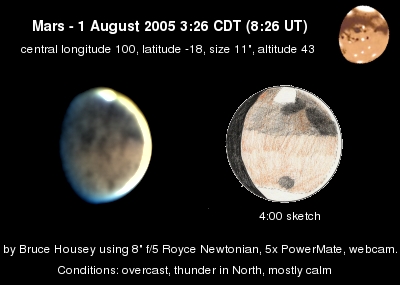
With a CM from 100 to 110 during my viewing time, Solis Lacus was apparently near the terminator, although I could not make out any darker concentration there visually. The dark diagonal zone near the limb is Mare Sirenum, with Chrysokeras hugging the polar cap. I cannot identify the isolated dark area I perceived in the north. Perhaps it was a combination of shadows from one or more of the Tharsis volcanoes, or just a relative darkening between possible clouds over them.
After processing the movies, the resulting picture clearly shows Solis Lacus and additional surrounding detail. If only I could train my eyes to do this level of detail extraction! Also shown in the photo are some dark spots in the Tharsis area... volcano shadows?
I recently purchased a Celestron Advanced Series GOTO mount with the new metal legs in an attempt to lighten the early morning setup effort from my 40 pound Losmandy GM8 to this 30 pound mount. Yesterday, I decided the next time I would try the GOTO mount on the aluminum legs from my 5-year-old Celestron CG5 mount. Pulling out the 15 pound mount was fantastic at 3am, but the resulting views were shaky. Although surprisingly passable for visual use, I was unable to move around at all when the webcam was in place without making the image jump all over the screen. Even the dog in her area about 30 feet away frequently made the image bounce around. I'm still undecided whether the much lighter load is worth the occasional annoyance.
Anyway, while I was setting up, I heard thunder in the north from over the lake, so I realized my session might get cut short and that I might best spend the time getting a quick picture. With only a brief peek at Mars before the camera went in, I went straight to taking two 2-minute movies, and then one infrared-only image. This is my first attempt at trying IR on Mars, and if it came out well I may use it for the luminance channel (p.s. it turned out to be of no use).
After the webcam was set up, I took to viewing with the binoviewer and magnifications between 200 and 400, with 200 being way too small and bright, 300 the best, and 400 being pretty good. The whole southern hemisphere was notably darker, with mottling in which I had difficulty finding a pattern. The best I could do after a half hour was to detect two darker areas within it, and also possibly one isolated dark area on the north side.
With a CM from 100 to 110 during my viewing time, Solis Lacus was apparently near the terminator, although I could not make out any darker concentration there visually. The dark diagonal zone near the limb is Mare Sirenum, with Chrysokeras hugging the polar cap. I cannot identify the isolated dark area I perceived in the north. Perhaps it was a combination of shadows from one or more of the Tharsis volcanoes, or just a relative darkening between possible clouds over them.
After processing the movies, the resulting picture clearly shows Solis Lacus and additional surrounding detail. If only I could train my eyes to do this level of detail extraction! Also shown in the photo are some dark spots in the Tharsis area... volcano shadows?
Attached Image:


