Thanks for the earlier advice on Pluto charts and hunting down this elusive little former planet. I'm happy to say that after quite a struggle I did manage to see it in my 5.5" refractor under reasonable but not pristine skys (about mag 5 outer suburban).
Step one was making up a crude astrophotography rig, nikon coolpix 5000 pointing down a 30mm 2" eyepiece. With this and my less than perfect clock drive I was able to make a 1min exposure that recorded stars down to about mag 14. When overlaid on the excellent Sky and Telescope finder chart, this showed me where the fainter stars were, extending the chart to maybe mag 14 or 14.5.
Then I took photos on a second night to ensure that I could record Pluto, and sure enough, the little trail was right where S&T said it would be. OK, it should be a spot not a trail - hotshot astrophotographers please don't laugh at me
Then on night 3, I set out to look for it visually, knowing exactly where to expect it. With averted vision it was possible to make out the faintest of specks about 30% of the time. Not sure why not 100% perhaps varying seeing or perhaps my retina has bits that work better than others? Having sketched the observed position on the chart I then took a photo to confirm. When overlaid on the computer afterwards, the match was pretty much perfect! 8)
You would never in a million years find Pluto in a 5.5" if you didn't know exactly where and when to look, but I'm happy to say I was able to do it!
I've read an account of a guy doing this in a 6" refractor too and he mentioned Pluto being visible for less than 100% of the time. Does anyone have any ideas why this is?
all the best
Tim
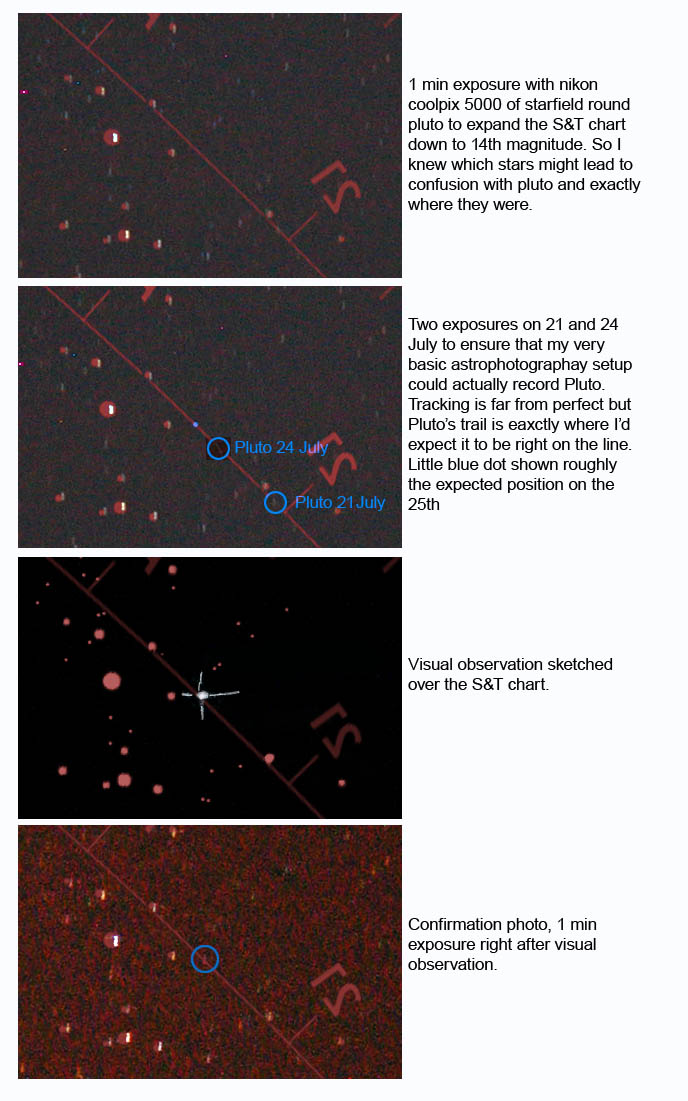
Step one was making up a crude astrophotography rig, nikon coolpix 5000 pointing down a 30mm 2" eyepiece. With this and my less than perfect clock drive I was able to make a 1min exposure that recorded stars down to about mag 14. When overlaid on the excellent Sky and Telescope finder chart, this showed me where the fainter stars were, extending the chart to maybe mag 14 or 14.5.
Then I took photos on a second night to ensure that I could record Pluto, and sure enough, the little trail was right where S&T said it would be. OK, it should be a spot not a trail - hotshot astrophotographers please don't laugh at me
Then on night 3, I set out to look for it visually, knowing exactly where to expect it. With averted vision it was possible to make out the faintest of specks about 30% of the time. Not sure why not 100% perhaps varying seeing or perhaps my retina has bits that work better than others? Having sketched the observed position on the chart I then took a photo to confirm. When overlaid on the computer afterwards, the match was pretty much perfect! 8)
You would never in a million years find Pluto in a 5.5" if you didn't know exactly where and when to look, but I'm happy to say I was able to do it!
I've read an account of a guy doing this in a 6" refractor too and he mentioned Pluto being visible for less than 100% of the time. Does anyone have any ideas why this is?
all the best
Tim
Attached Image:

