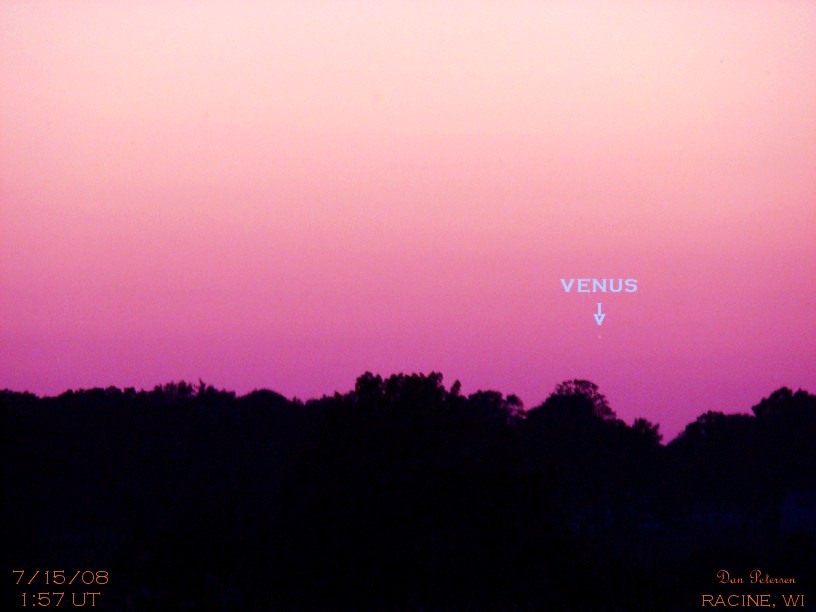

Expect plenty of UFO sightings during the next few months. After a long hiatus, brilliant Venus has begun entering the western sky after sunset as the Evening Star. It is far and away the brightest celestial object after the Sun and Moon.
Venus was in superior conjunction behind the Sun on 2008 JUN 09. As it appears to separate from the Sun, it will climb higher in the sky each evening. But the process will be rather slow at first as the evening ecliptic tilts over during the coming months.
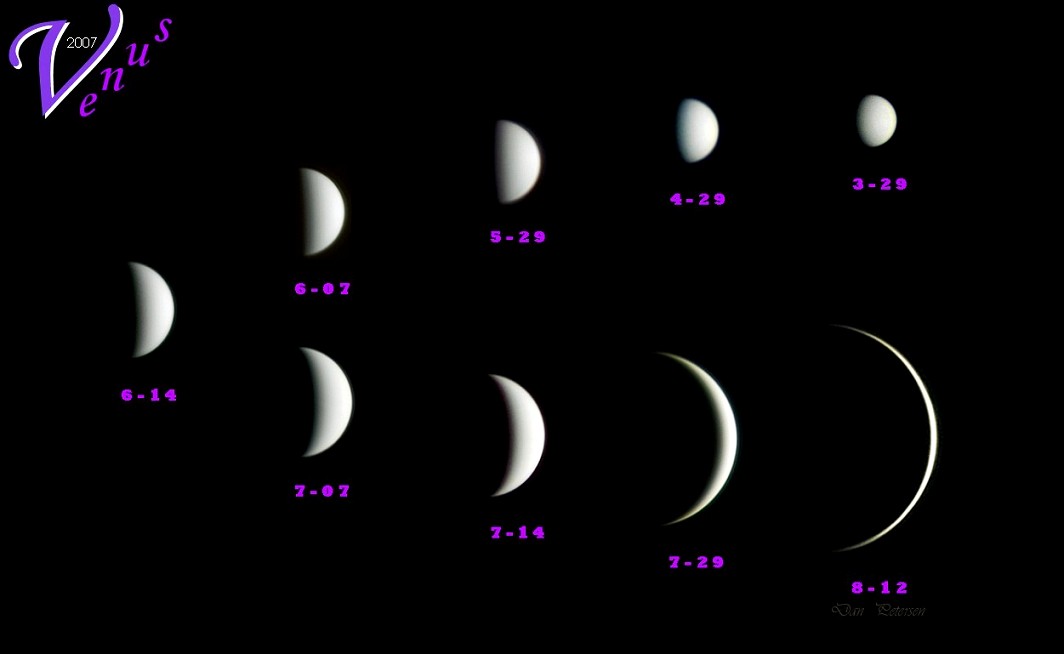
Venus will be waning in phase but increasing in angular diameter throughout this apparition. Dichotomy (like a Half Moon) will occur near 2009 JAN 16. Before that date it will appear gibbous and afterward as a crescent.
Venus will achieve its greatest eastern elongation of 47.1° on 2009 JAN 14. From Chicagoland at 30 minutes after sunset it will reach its highest altitude of 35.5° on FEB 03. Its greatest brilliance at magnitude -4.6 is expected around FEB 20. Apparent retrograde motion will commence on MAR 06. Inferior conjunction between Earth and Sun by right ascension will occur on MAR 25 and by celestial longitude on MAR 27.
The Moon and Venus will appear in conjunction (UT dates) on 2008 AUG 02, SEP 01, OCT 01, NOV 01, DEC 01, DEC 31 and 2009 JAN 30 & FEB 28. The Moon will occult Venus for Europeans on 2008 DEC 01 and for observers in the South Pacific on 2009 FEB 28.
Venus will conjunct with Mercury on 2008 AUG 20 and SEP 12, also with Mars on SEP 12 to form a planetary trio. Venus will conjunct with Jupiter on 2008 DEC 01 (joined by Moon). Venus will conjunct with Saturn on 2008 AUG 13.
Venus will conjunct with Regulus on 2008 AUG 06, with Spica on SEP 19 and with Antares on OCT 27.
I’ve created a panoramic graphic to illustrate Venus’s position (Moon’s too) in the western sky as viewed from Chicagoland at 30 minutes after sunset throughout the current evening apparition. It should well serve most northern hemisphere observers. I also made a diagram to demonstrate the relative positions of Sun, Earth and Venus throughout the 1.6-year synodic cycle. To see them, click: http://www.curtrenz.com/astronomical.html
Photos and descriptions of Venus would be welcome additions to this thread.
For astronomical graphics, including
monthly wallpaper calendar, visit:
CurtRenz.com/astronomical
Curt Renz