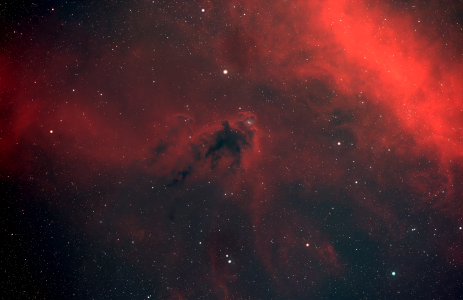
Image of the day

Captured by
Shane Yarnall

LDN 1622

My Account

New to Astromart?

Register an account...

Need Help?

A rediculously simple question... *grin*

Started by SunSpot51, 01/23/2006 06:27PM
Posted 01/23/2006 06:27PM Opening Post
Hi all,

A simple question, in general lets say I'm imaging a globular cluster, is it better to shoot a bunch of .5 sec exposures or fewer of say, 10 sec? Does this also follow with nebula? I'm using an Atik 1HS cams.

Thanks!!
Paul

Paul Maxson
Moderator - CCD Imaging and Processing/Solar System
Celestron C14, Mewlon 250, Orion EON120, ASI120MM, Flea3.
http://www.sunspot51.com
Posted 01/24/2006 04:43AM #1
Hello:
If you're stacking images, the shortest exposure time you should use is one that gives an image where the sky noise (after you flat field) dominates over the read noise by some large number (5, 10, or whatever is your favorite). Whereas counts from the sky obey Poisson statistics and thus its noise can be beaten down by sqrt(n), dark noise does not and taken many more images to beat down to a similar level. So you should takes images long enough so that you're sky noise dominated. When this happens depends on your camera, filter, f/ratio, and probably a host of other things.

Cheers
Mike Connelley
Posted 01/24/2006 02:52PM #2
What Michael wrote about S/N is correct and is most applicable to nubulae.
Most people like to shoot globular clusters RGB unbinned with an exposure time as long as possible without saturating the stars.

dan kowall
Posted 01/25/2006 05:27AM #3
Paul,
I agree with Dan and Mike. If I have a limited time or a time budget, I will generally favor longer/fewer than shorter/more. I think this will generally apply to all but lunar and planet imaging.

However, the 8-bit Atik will offer some challenges balancing the sky noise, read noise and pixel saturation. It may mean that there is a narrower "optimum" exposure time range than with that of a 16-bit camera.

Jim Thommes

Mak-Newt 152 mm
C8
Megrez II APO
Zenithstar 66 mm APO
G11/Gemini
ST8300M
Artemis285 Camera
Canon 350D DSLR

http://jthommes.com/Astro/
Posted 01/27/2006 05:39PM | Edited 01/27/2006 05:40PM #4
I think globulars would present an interesting test case. I agree with what the others say when it comes to nebula imaging.

But it might be true that imaging a globular is more like imaging a planet: lots of detail to resolve along with fairly high surface brightness. I'd like to see a comparison between the 'traditional' ways of shooting globs (say a dozen 30-second images) vs a stack of 1000 images of 0.36 seconds each....both methods with the same total exposure time of 6 minutes. A control shot of a single 6-minute exposure would be nice too.

Or is my premise of imaging a glob being similar to a planet completely faulty? Thanks,

Tim Iafolla
