
Well, on a whim I decided to order a Canon 20Da. I have been doing a lot of wide-field astrophotography in the last few months with my 1Ds Mark II, and was really wondering if I could get better red response. I can make the 1Ds images look good, but it takes long exposures and lots of post-processing.
What kept me from the 20Da so far was that I wanted FF--believe me, once you go FF you never want to go back--and I didn't see a need for the specialty focus modes for the type of work I do. On top of that, I was concerned that daylight imaging would not be any good if they were letting IR leak in, and I still use my 20D for travel, when I don't want to lug the big gun around. Well, the recent S&T article convinced me that I had to give the 20Da a try. So I ordered one from Anacortes (gotta support Astromart, you know) and got in Thursday, just in time to take it with me to our lake house in northern WI, where the skies are dark. Well, except for the moon .
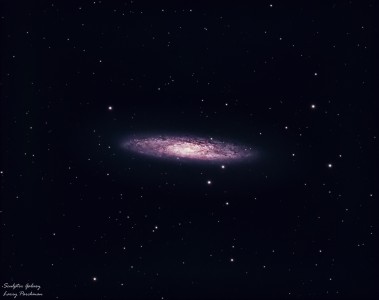
The attached image is a demonstration of just how good the 20Da is for astro-imaging. The details are in the shot, which is a side-by-side comparison with a 20D shot. I simply swapped the lens from camera to camera, and swapped cameras on the mount. The mount was a Takahashi Teegul Star Patrol II.
Post processing of both images was identical so as not to alter the results in any way. I simply pulled the RAW images into PS and used Russ Croman's Gradient Xterminator to kill the gradient from the moon, then tweaked the levels and curves identically on both images, and ran one shot of Noise Ninja. BTW, I turned on dark subtraction on both of these images.
A few things: The 20Da takes perfect images in daylight. I am not sure why Canon does not use the same filter on all of their cameras--I would love to be able to use my 5D or 1Ds Mark II for astrophotography with 20D red-response. The noise on the 20Da is about 1 stop better than the 20D. I measured this with a whole series of shots across all ISO settings, and it's nearly one whole stop better. The Canon 35mm f/1.4L lens is killer for this work but needs to be stopped down to about f/4 for maximum corner sharpness, minimum vignetting and CA reduction. CA is pretty bad wide open on long exposures. Unike the Hutech cameras, this camera is fine in the daytime and needs no special WB settings; the images of the night sky do not have an overwhelming red cast to them, either--the red nebulae are red, and that's it. Great job from Canon.
The 20D is going to go up for sale to some lucky photographer...it has less than 1500 shutter actuations on it. The 20Da can do everything it can do, and more.
Bottom line: Don't buy a 20D--get the 20Da. Since it includes the AC adapter, the price is actually very good, and the kit lens that comes with the regular 20D is trash, so the lack of a lens with the 20Da is no big deal.
I can't my image to load on my putzy dial-up connection up here, so here is just a link for now...

Jeff
What kept me from the 20Da so far was that I wanted FF--believe me, once you go FF you never want to go back--and I didn't see a need for the specialty focus modes for the type of work I do. On top of that, I was concerned that daylight imaging would not be any good if they were letting IR leak in, and I still use my 20D for travel, when I don't want to lug the big gun around. Well, the recent S&T article convinced me that I had to give the 20Da a try. So I ordered one from Anacortes (gotta support Astromart, you know) and got in Thursday, just in time to take it with me to our lake house in northern WI, where the skies are dark. Well, except for the moon
.The attached image is a demonstration of just how good the 20Da is for astro-imaging. The details are in the shot, which is a side-by-side comparison with a 20D shot. I simply swapped the lens from camera to camera, and swapped cameras on the mount. The mount was a Takahashi Teegul Star Patrol II.
Post processing of both images was identical so as not to alter the results in any way. I simply pulled the RAW images into PS and used Russ Croman's Gradient Xterminator to kill the gradient from the moon, then tweaked the levels and curves identically on both images, and ran one shot of Noise Ninja. BTW, I turned on dark subtraction on both of these images.
A few things: The 20Da takes perfect images in daylight. I am not sure why Canon does not use the same filter on all of their cameras--I would love to be able to use my 5D or 1Ds Mark II for astrophotography with 20D red-response. The noise on the 20Da is about 1 stop better than the 20D. I measured this with a whole series of shots across all ISO settings, and it's nearly one whole stop better. The Canon 35mm f/1.4L lens is killer for this work but needs to be stopped down to about f/4 for maximum corner sharpness, minimum vignetting and CA reduction. CA is pretty bad wide open on long exposures. Unike the Hutech cameras, this camera is fine in the daytime and needs no special WB settings; the images of the night sky do not have an overwhelming red cast to them, either--the red nebulae are red, and that's it. Great job from Canon.
The 20D is going to go up for sale to some lucky photographer...it has less than 1500 shutter actuations on it. The 20Da can do everything it can do, and more.
Bottom line: Don't buy a 20D--get the 20Da. Since it includes the AC adapter, the price is actually very good, and the kit lens that comes with the regular 20D is trash, so the lack of a lens with the 20Da is no big deal.
I can't my image to load on my putzy dial-up connection up here, so here is just a link for now...
Jeff
Jeff 8O