
OK, so there has been something done here to reduce the noise. The Sky & Telescope review mentioned the lower noise of the 20Da. I decided to check it myself, and like Alan Dyer, I used Noise Ninja to measure the noise. I fully sampled each image to get a good averaged noise measurement. I have also attached a photo that shows exposures from each camera. Please note that appearance alone is not enough to judge the noise; the images are reduced so much that you can't see the noise on the lower ISO images, but it was there.
Parameters: Both cameras set in the same dark room, no lens (just the body cap), 10-minute exposures. Images were shot in RAW, converted in Photoshop CS2 with the same settings--pushed 4 stops to exaggerate the noise--and then reduced and converted to jpegs. I turned off the Long Exposure Noise Reduction function on both cameras in order to measure the *native* noise of the camera.
Here is what we get for the 20Da:
ISO 3200, Noise 384, 161 Luminance, 223 Chroma
ISO 1600, Noise 287, 123 Luminance, 164 Chroma
ISO 800, Noise 71, 28 Luminance, 43 Chroma
ISO 400, Noise 13, 7 Luminance, 6 Chroma
ISO 200, Noise 3, 2 Luminance, 1 Chroma
ISO 100, Noise 1, 1 Luminance, 0 Chroma
And now the 20D "Classic":
ISO 3200, Noise 625, 285 Luminance, 340 Chroma
ISO 1600, Noise 310, 134 Luminance, 176 Chroma
ISO 800, Noise 151, 66 Luminance, 86 Chroma
ISO 400, Noise 99, 44 Luminance, 54 Chroma
ISO 200, Noise 33, 16 Luminance, 16 Chroma
ISO 100, Noise 20, 11 Luminance, 9 Chroma
Anyway you look at it, the 20Da has a lot less noise. The picture shows it nicely. The one confusing image is the ISO3200 image; here the 20Da looks brighter, but its not noise--at full size you can see it's very fine-grained. I suspect it is leaked IR that makes the image look bright. The Noise Ninja measurements show the real noise.
Anyway, to me the 20Da continues to be a champ: Lower noise, much-increased red sensitivity, yet still useful for regular day-to-day imaging. When you include the live focusing mode, included AC adapter, etc, the price seems much more reasonable. I can't wait for new moon at our house up north, with dark skies, so I can really give this thing a workout for some wide-field milky way imaging before the summer milky way is gone for the year.
Jeff
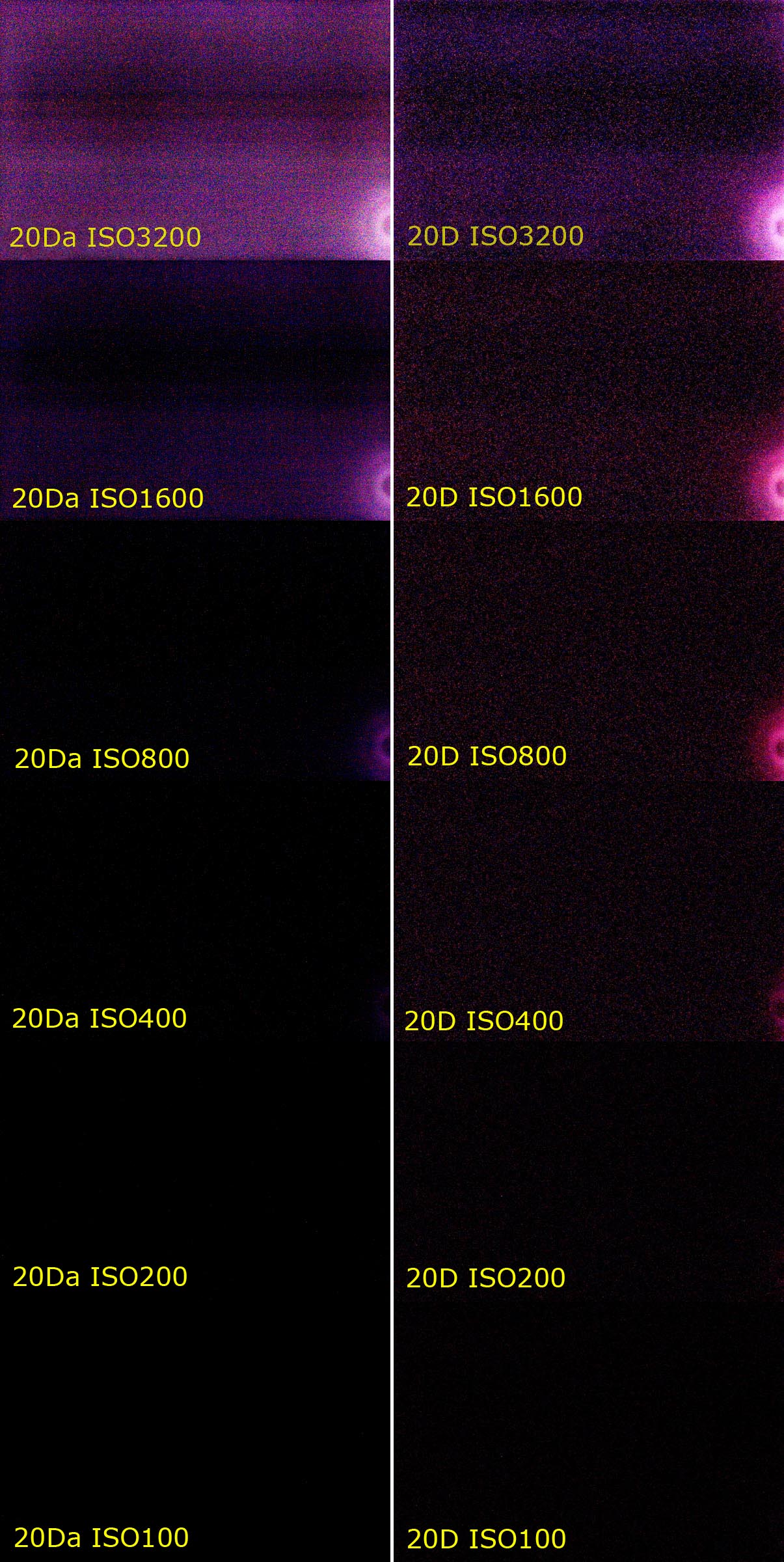
Parameters: Both cameras set in the same dark room, no lens (just the body cap), 10-minute exposures. Images were shot in RAW, converted in Photoshop CS2 with the same settings--pushed 4 stops to exaggerate the noise--and then reduced and converted to jpegs. I turned off the Long Exposure Noise Reduction function on both cameras in order to measure the *native* noise of the camera.
Here is what we get for the 20Da:
ISO 3200, Noise 384, 161 Luminance, 223 Chroma
ISO 1600, Noise 287, 123 Luminance, 164 Chroma
ISO 800, Noise 71, 28 Luminance, 43 Chroma
ISO 400, Noise 13, 7 Luminance, 6 Chroma
ISO 200, Noise 3, 2 Luminance, 1 Chroma
ISO 100, Noise 1, 1 Luminance, 0 Chroma
And now the 20D "Classic":
ISO 3200, Noise 625, 285 Luminance, 340 Chroma
ISO 1600, Noise 310, 134 Luminance, 176 Chroma
ISO 800, Noise 151, 66 Luminance, 86 Chroma
ISO 400, Noise 99, 44 Luminance, 54 Chroma
ISO 200, Noise 33, 16 Luminance, 16 Chroma
ISO 100, Noise 20, 11 Luminance, 9 Chroma
Anyway you look at it, the 20Da has a lot less noise. The picture shows it nicely. The one confusing image is the ISO3200 image; here the 20Da looks brighter, but its not noise--at full size you can see it's very fine-grained. I suspect it is leaked IR that makes the image look bright. The Noise Ninja measurements show the real noise.
Anyway, to me the 20Da continues to be a champ: Lower noise, much-increased red sensitivity, yet still useful for regular day-to-day imaging. When you include the live focusing mode, included AC adapter, etc, the price seems much more reasonable. I can't wait for new moon at our house up north, with dark skies, so I can really give this thing a workout for some wide-field milky way imaging before the summer milky way is gone for the year.
Jeff
Attached Image:
Jeff 8O

