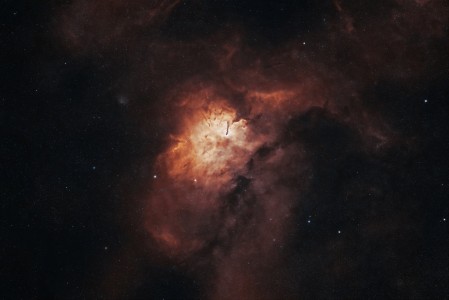
I purchased a CI-700 GEM for imaging a while back, installed it on a permanent pier, and performed a relatively quick polar alignment using the polar scope. I figured the autoguider with my SXV-H9 would guide out any error. The best I could tell the peak to peak guiding error was about 3 to 4 arcseconds plus some field rotation over a several hour series of images. Often stars had a lump on one side, which I now attribute N or S correction always being one direction due to poor polar alignment.
So the other night I decided to perform a CCD drift polar alignment, based loosely on the instructions in the HELP menu of MaximDL. After about 2 hours of fine adjustments the polar alignment was very good. I set up a guide error chart in MaximDL and clicked off actual tracking. Over a period of about 8 minutes the E/W periodic error (PE) was about a 10 arcseconds peak to peak. The N/S error was within 3 arcseconds. With autoguiding on, the total peak to peak tracking error in N/S or E/W appears to be less than 2 arcseconds.
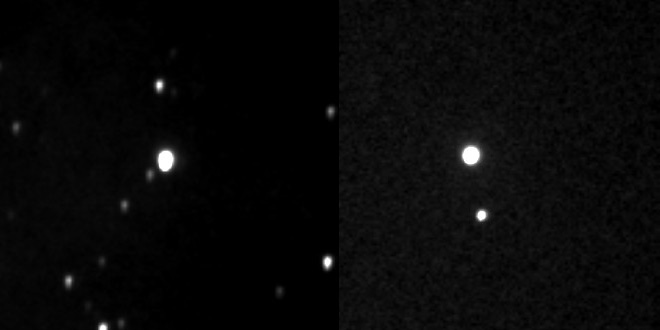
Images the last few nights, since the CCD drift alignment, appear to have considerably better stars (no more lumps). I've attached a picture cropped and stitched from "before" and "after" images, 1-1/2 hour (9 x 10 minute) and enlarged x3.
The bottom line. Don't be like me and get so excited about getting your hardware together and wanting to produce images that you fail to perform an accurate CCD drift alignment. That and good balancing go a long way towards improving your tracking and your images.
Thanks
Steven Jindra
So the other night I decided to perform a CCD drift polar alignment, based loosely on the instructions in the HELP menu of MaximDL. After about 2 hours of fine adjustments the polar alignment was very good. I set up a guide error chart in MaximDL and clicked off actual tracking. Over a period of about 8 minutes the E/W periodic error (PE) was about a 10 arcseconds peak to peak. The N/S error was within 3 arcseconds. With autoguiding on, the total peak to peak tracking error in N/S or E/W appears to be less than 2 arcseconds.
Images the last few nights, since the CCD drift alignment, appear to have considerably better stars (no more lumps). I've attached a picture cropped and stitched from "before" and "after" images, 1-1/2 hour (9 x 10 minute) and enlarged x3.
The bottom line. Don't be like me and get so excited about getting your hardware together and wanting to produce images that you fail to perform an accurate CCD drift alignment. That and good balancing go a long way towards improving your tracking and your images.
Thanks
Steven Jindra
Attached Image:


