

Hi all:
This is the often photographed, but hopefully never boring central portion of the Milky Way as viewed from 40 degrees north latitude. The frame includes parts of Sagittarius, Scutum, Ophiuchus and Scorpius. I centered on M8. Messier objects M 6, 8, 9, 16, 17, 18, 19, 20, 21, 22, 23, 24, 25, 28, 54, 62, 69 and 70 are all included, but as you will see from the full resolution version, all of the globulars except M 22 appear pretty much stellar.
Full Res:
http://home.comcast.net/~jameslbrown/pwpimages/Saggitarius%20RGB.jpg
This image is a 1x1 binned RGB composite with 8 subs of 5 minutes each per color channel. The lens is a 55mm Pentax 67 medium format camera lens stopped down to f 5.6 (one click). The Pentax 67 lenses have 85 mm of back focus which accommodates my regular imaging train of a Finger Lakes Instruments Microline camera, filter wheel and PDF focuser. Richard Crisp pioneered the use of Pentax lenses with FLI gear. It certainly makes lens changes and focusing easy. I did not use an L channel and probably will not, since the non-APO nature of the camera lens seems to cause a noticeable star bloat in the L channel when compared to the RGB channels.
The 55mm lens gives about a 24x36 degree field with a 35mm diagonal chip. This particular image is cropped down to 22 x 32 degrees to avoid dramatic color weirdness at the bottom where I was picking up the horizon. The image scale is 33 arc seconds per pixel. As usual, my Astro-Physics Mach 1 mount made imaging control relatively easy.
Thanks for any comments!
Jim
Pentax 55mm 67 Lens
FLI PDF focuser
FLI Microline 11002 M Camera
FLI CFW7 Filter wheel
Astro-Physics Mach 1 Mount
Starlight Xpress Lodestar guider camera
Borg 50mm achro guide scope
Maxim DL, Focus Max and The Sky 6, all controlled by CCD Commander
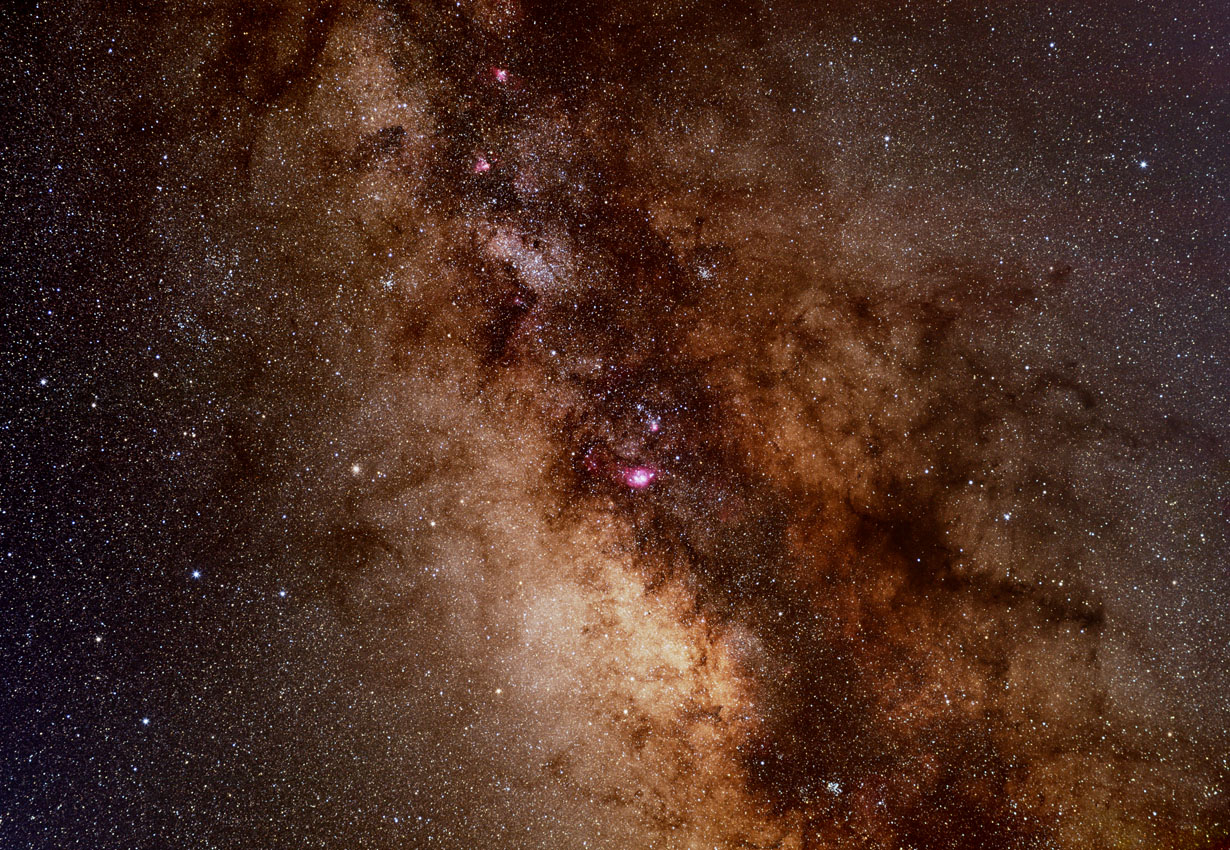
This is the often photographed, but hopefully never boring central portion of the Milky Way as viewed from 40 degrees north latitude. The frame includes parts of Sagittarius, Scutum, Ophiuchus and Scorpius. I centered on M8. Messier objects M 6, 8, 9, 16, 17, 18, 19, 20, 21, 22, 23, 24, 25, 28, 54, 62, 69 and 70 are all included, but as you will see from the full resolution version, all of the globulars except M 22 appear pretty much stellar.
Full Res:
http://home.comcast.net/~jameslbrown/pwpimages/Saggitarius%20RGB.jpg
This image is a 1x1 binned RGB composite with 8 subs of 5 minutes each per color channel. The lens is a 55mm Pentax 67 medium format camera lens stopped down to f 5.6 (one click). The Pentax 67 lenses have 85 mm of back focus which accommodates my regular imaging train of a Finger Lakes Instruments Microline camera, filter wheel and PDF focuser. Richard Crisp pioneered the use of Pentax lenses with FLI gear. It certainly makes lens changes and focusing easy. I did not use an L channel and probably will not, since the non-APO nature of the camera lens seems to cause a noticeable star bloat in the L channel when compared to the RGB channels.
The 55mm lens gives about a 24x36 degree field with a 35mm diagonal chip. This particular image is cropped down to 22 x 32 degrees to avoid dramatic color weirdness at the bottom where I was picking up the horizon. The image scale is 33 arc seconds per pixel. As usual, my Astro-Physics Mach 1 mount made imaging control relatively easy.
Thanks for any comments!
Jim
Pentax 55mm 67 Lens
FLI PDF focuser
FLI Microline 11002 M Camera
FLI CFW7 Filter wheel
Astro-Physics Mach 1 Mount
Starlight Xpress Lodestar guider camera
Borg 50mm achro guide scope
Maxim DL, Focus Max and The Sky 6, all controlled by CCD Commander
Attached Image:


