This is probably the first image ever taken with a Honders-type Cassegrain astrograph.
305mmF3.8 Riccardi-Honders Astrograph, 3600 Mount, MaximDL,
Camera STL11K, Baader H-a and OII combined as RGB, exposure: 9x10 minutes H-a and OIII
Image has been reduced to 1/4 size with full size crop at top right.
For those unfamiliar with Honders, it is a design derived from the Schupmann Medial telescope, invented more than a century ago. Klaas Honders modified the original design into a Newtonian configuration, and from there Massimo Riccardi developed it further into a Cass configuration. My design is a 305mm F3.8 Cassegrain based on the Riccardi-Honders configuration. The basic optical layout is a front positive lens followed by a smaller primary Mangin mirror, a secondary mirror (same as a normal Cass secondary) and finally a small single element field lens about 4" in front of the focal plane.
This astrograph features a very wide,flat, fully diffraction limited field of about 60mm diameter, with essentially zero chromatic aberration and perfect spherical correction for all colors. All surfaces are spherical, and the primary mirror has a second surface aluminized coating, something that will last essentially forever and will never sleek or weather because it is an inside coating not exposed to the air.
Rolando
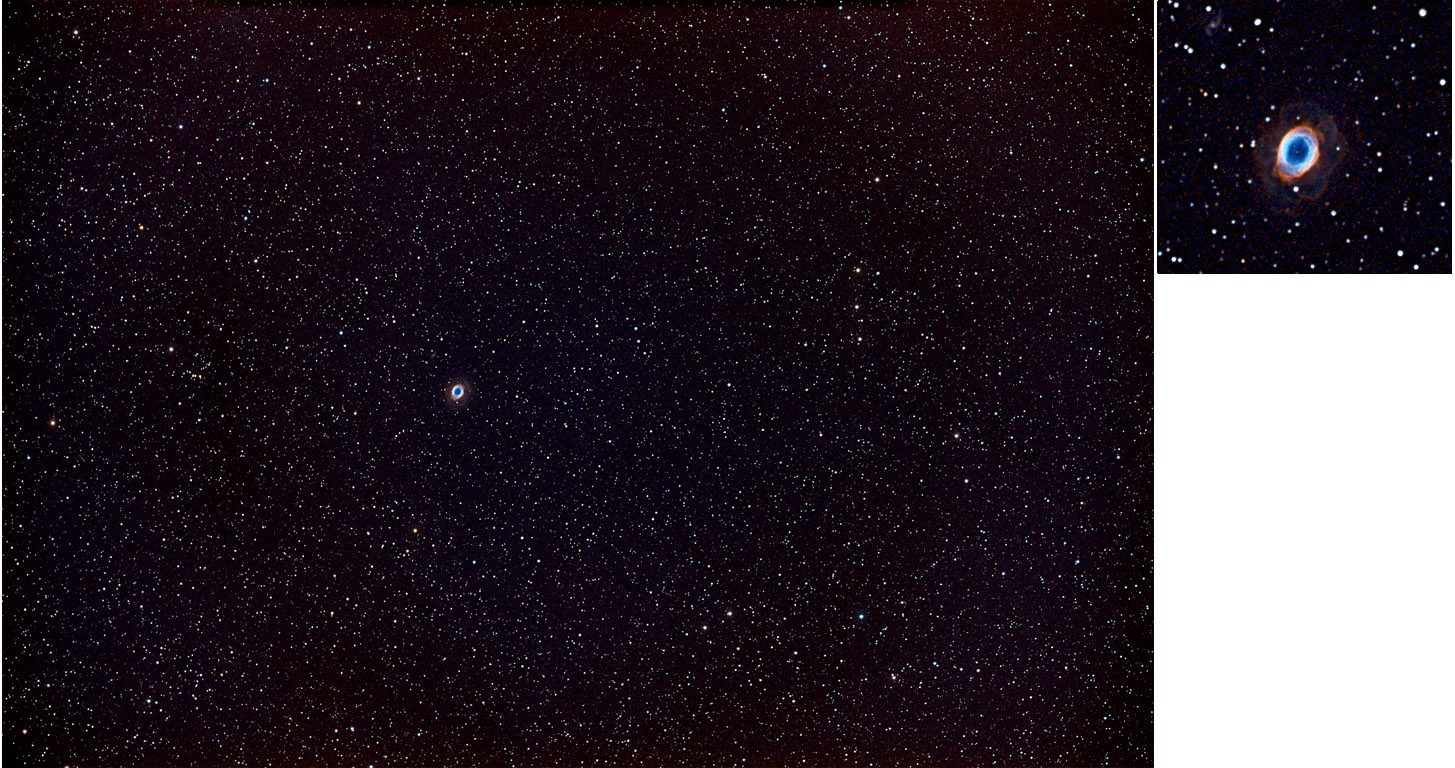
305mmF3.8 Riccardi-Honders Astrograph, 3600 Mount, MaximDL,
Camera STL11K, Baader H-a and OII combined as RGB, exposure: 9x10 minutes H-a and OIII
Image has been reduced to 1/4 size with full size crop at top right.
For those unfamiliar with Honders, it is a design derived from the Schupmann Medial telescope, invented more than a century ago. Klaas Honders modified the original design into a Newtonian configuration, and from there Massimo Riccardi developed it further into a Cass configuration. My design is a 305mm F3.8 Cassegrain based on the Riccardi-Honders configuration. The basic optical layout is a front positive lens followed by a smaller primary Mangin mirror, a secondary mirror (same as a normal Cass secondary) and finally a small single element field lens about 4" in front of the focal plane.
This astrograph features a very wide,flat, fully diffraction limited field of about 60mm diameter, with essentially zero chromatic aberration and perfect spherical correction for all colors. All surfaces are spherical, and the primary mirror has a second surface aluminized coating, something that will last essentially forever and will never sleek or weather because it is an inside coating not exposed to the air.
Rolando
Attached Image:


 8O


