Image of the day

Captured by
Lawrence Parchman

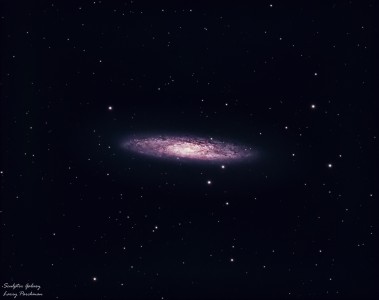
Sculptor Galaxy (NGC 253)

My Account

New to Astromart?

Register an account...

Need Help?

Flats and darks

Started by fblue, 08/14/2007 06:43PM
Posted 08/14/2007 06:43PM Opening Post
How many here use a bias frame and flat frame with their dark frames?
I have been reading about these and have watched some demos regarding their implementation, but am not sure that it is worth the extra time and effort to produce all these flats for each exposure setting as suggested. This would increase the time to make one image by quite a bit. :S

[SIZE="Large"][/SIZE][COLOR="Blue"][/COLOR] Floyd Blue grin
Amateur Imager
Posted 08/14/2007 07:10PM #1
Floyd,

I don't use bias frames unless I need to scale darks (e.g., I have 10-minute images shot at -10 degrees, but only have 30-minute darks shot at -10 degrees).

I use flats almost all the time. To me, they are worth the extra time and effort, as oftentimes it's harder to get rid of the artifacts introduced with no flats than it is to just shoot them to begin with. Put it this way: taking flats will increase imaging time by a few minutes but could save hours of time in post-processing. This of course assumes good flats...

HTH,
Eric
Posted 08/14/2007 07:13PM | Edited 08/14/2007 07:18PM #2
Hi Floyd, you might be confusing what flats are used for. You dont apply a flat to a dark (there is no light in a dark grin )Nor do you need to apply a bias to a dark (the bias is already part of the dark frame so when you calibrate a light frame with a dark, the bias is also done by default) You will however use a bias to calibrate flats if they are not dark subtracted.

I calibrate all my images with darks and flats. With a very small chip and evenly illuminated field calibrating with flats **may** not be necessary. However, one other thing that it will do is get rid of any dust motes that may show up in an image from the camera window, filters or FF/FR's.

You do not have to do flats for each exposure time, only for each filter.

The only thing I use a bias frame for is for calibrating flats, or if I want to scale my darks.
Posted 08/14/2007 07:35PM #3
Floyd,

There is a whole lot going on in astroimaging that needs to get done, but I think it is best to start on just the most important things, and that would be on getting the best possible light frame with the roundest, smallest star images.

After that, you can worry about the other aspects.

I think Darks is one of the next level of tricks to master. They are relatively easy, and get a lot of bang for the buck.

Darks are necessary to remove a lot of bad things you don't want in the way of systematic noise from the chip.

Flats are not much more complicated, but don't do as much as darks. There's not as much bang for your buck. Flats are necessary to remove bad things that come from your optical system. However, they are not as important as darks (unless you have a real problem system).

Bias frames are relatively unnecessary unless you want to use a set of dark frames at a time or exposure different than what they were taken at.

However, my big piece of advice is to just get the smallest stars possible. And do dark frames. When you have that as well as you can, take some flats and see how much they can help.

Biases will probably not be necessary as long as you take sufficient matched darks.
Alex
Posted 08/15/2007 01:00PM #4
Floyd,
Here's my take on flats (far from expert advice, mind you!):

I do not always take them due to the time imvolved. I will certainly take them if my subs are showing lots of nasty dust artifacts--you just can't get rid of those through software it seems. But then I'll feel that I'm just trying to make up for not keeping all my surfaces clean, a real worthwhile activity.

But if the issue is either vignetting or a true gradient (the kind that invades from one side or corner and progressively thins out) I am finding that software solutions are really quite good. This makes me feel much less lazy about not having spent the extra time at the end of the evening (which I would have to do since I set up each time).

My favorite software for this is PixInsight. But I know it can be done if AstroArt, PS and others I'm sure.

When I do shoot flats, it's still iffy how effective they'll be--I never can seem to hit upon one standard background count that works every time. I find it's safer to go underexposed than over or you risk a "reverse" flattening effect.

I have not found that applying biases or darks to the flats made a worthwhile difference, and I never shoot darks now for my lights (I guess an advantage of SX cameras, and I also find that PixInsight has good noise-reduction routines.) Probably just being lazy here, too!

Sorry for the ramble, and I hope this is at least a bit of what you were looking for.

Keep up the good work,
Larry
