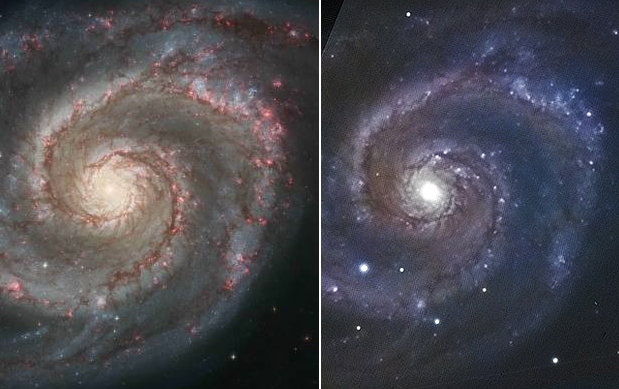
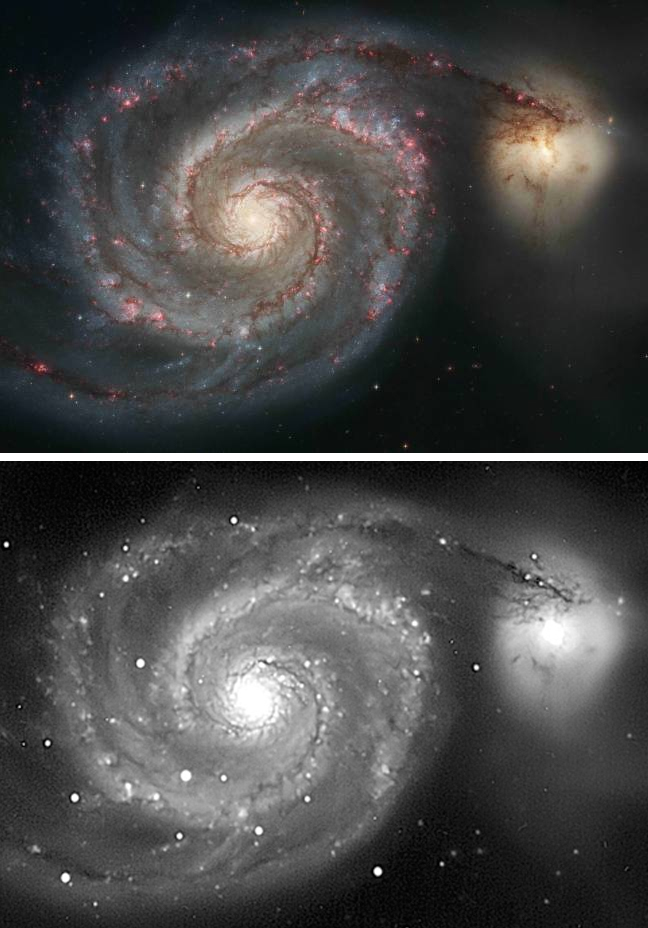
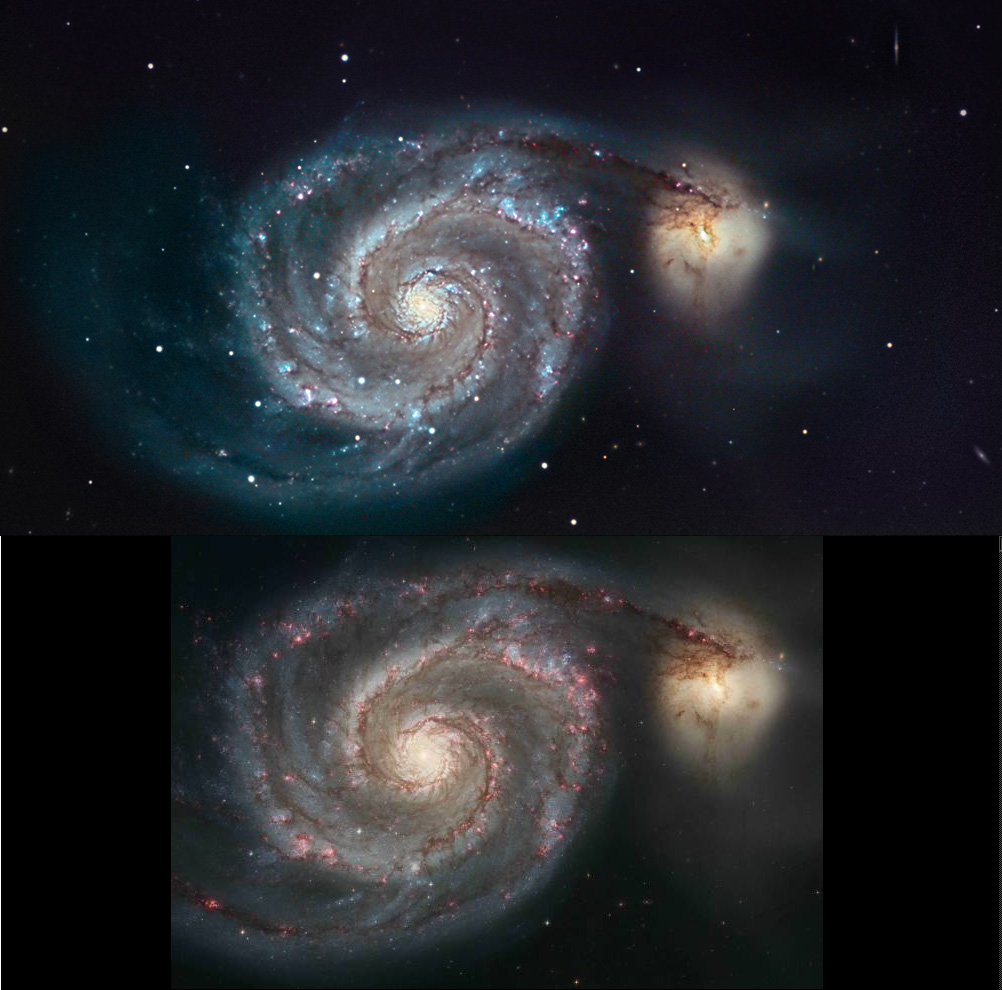
So... how does my (your?) image stack up to a scope with REALLY good seeing? Some of you may have done this exercise already, and you likely would have done a better job of it. I didn’t plug it in to TheSky for really accurate scaling, but I did get ~.051”/pixel from “eyeball” scaling to my image.
This is the Hubble image of M51 scaled by ~17.2x smaller so its pixels are now ~.88”, which is about what I have. I next rotated and cropped my image (on the next post) to the same size and fiddled with the color intensity a little to get a closer match.
This obviously works better when you can blink between the images, but there are a couple of things that jump out. The first are the foreground stars - no matter how hard I try, I will never get the stars to fit into just a pixel! But some of those stars are really background galaxies, that you can see when you zoom in really far to the Hubble shot. (the original, not this one) I never would have caught them as such on mine, but they don’t bloom out, so there is much less difference between the apparent size between the two shots. You can really find them using the blink test. The second are the star forming regions. I didn’t look hard enough on line, but it sure looks to me like the red is from some “extra” Ha exposure. Does anyone know for sure?
Oh well, here they are… First one is from Hubble.
Charlie
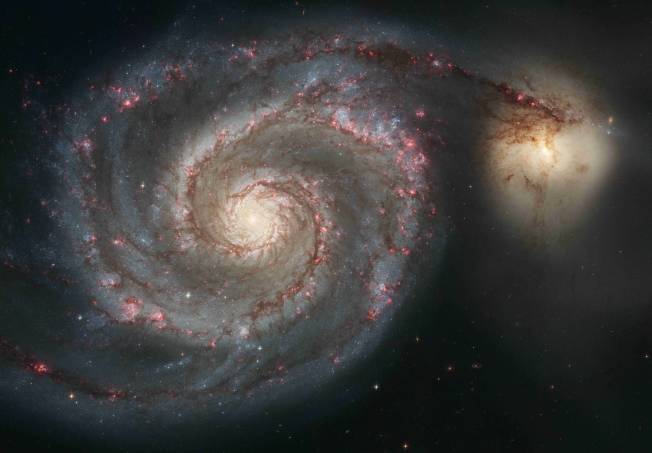
This is the Hubble image of M51 scaled by ~17.2x smaller so its pixels are now ~.88”, which is about what I have. I next rotated and cropped my image (on the next post) to the same size and fiddled with the color intensity a little to get a closer match.
This obviously works better when you can blink between the images, but there are a couple of things that jump out. The first are the foreground stars - no matter how hard I try, I will never get the stars to fit into just a pixel! But some of those stars are really background galaxies, that you can see when you zoom in really far to the Hubble shot. (the original, not this one) I never would have caught them as such on mine, but they don’t bloom out, so there is much less difference between the apparent size between the two shots. You can really find them using the blink test. The second are the star forming regions. I didn’t look hard enough on line, but it sure looks to me like the red is from some “extra” Ha exposure. Does anyone know for sure?
Oh well, here they are… First one is from Hubble.
Charlie
Attached Image:
Fort Lewis Observatory: (37.238, -108.052) ~2360m (7744 ft.) elevation.
Darkness - typically 6.5+
Scope - Meade 16" LX200; f6.3 focal reducer
Focus - JMI Smart focus
Camera - SBIG ST-10XE; (~.5"/pixel)
Guiding - AO-8 and/or Meade 5"/DSI/PHD
http://www.fortlewis.edu/observatory