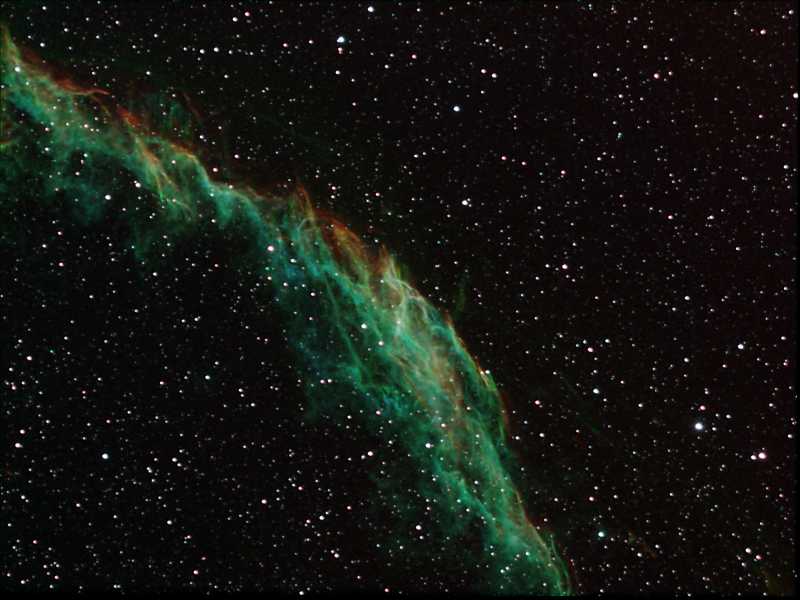
There are two versions. The first at http://www.pbase.com/steelnavy/image/81778146
was done using the Hubble pallette, which assigns (or "maps" in current parlance) SII to red,
HA to green, and OIII to blue. This mapping is necessary because the light emitted
by SII and OIII is not visible to the human eye, so assigning these invisible wavelengths
to visible wavelengths lets one "see" where SII and OIII are present.
The second version is at http://www.pbase.com/image/81778281 and uses a pallette
where LRGB channels consists of HA_HA_OIII_SII.
In both versions HA consists of 180 minutes of exposure with 10 minute
sub-exposures. SII and OIII each consist of 120 minutes in 10 minute subs.
Total exposure time for the image was 7 hours.
All imaging done on bright, near full moon evenings. These are my first attempts at
narrow band imaging. I used Custom Scientific 4.5nm HA, SII, and OIII filters, ST-10XE camera
and AP 130 F/6 ota. The Tak EM200 mount was guided by an SBIG STV.
My results are amateurish to be sure, but what did you expect. I Am an amateur.
Comments and criticisms most welcome.I'm trying narrow band because I image from a
light polluted SF Bay Area location and it seems like it's clear only on bright moonlit nights.
Rob Mackie