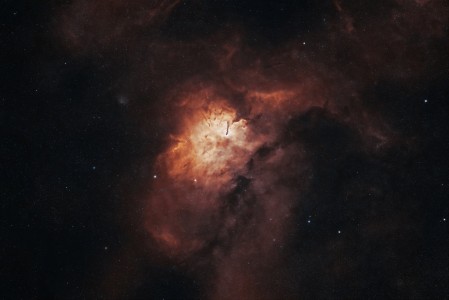
Image is at
http://www.pbase.com/steelnavy/image/82060459
I used the Hubble palette, where red is SII, green is HA, and
blue is OIII and followed the processing routine outlined by Ron Wodaski
in his Zone Processing book.
I prefer this result over my first narrow band effort,
which you can view at http://www.pbase.com/steelnavy/image/81778146
All filters Custom Scientific 4.5nm. ST-10XE, STV guider,
AP 130 F/6,Tak EM200 mount. Ratio of RGB channels is S2=2.0, HA=1, O3=2.5
Background was manually normalized in Maxim with pedestal=100
3 hrs HA, 2hrs SII, 2hrs OIII. All subs 10 minutes in duration.
Colors combined in Maxim, then digital development applied.
More stretching using levels and curves in PS, then addition
of HA luminance channel. Also some smoothing and noise reduction
of luminance channel in PS.
I'll gather more data with the goal of doubling 7 hour exposure time
when the marine layer departs.
Rob Mackie


