
Well guys,
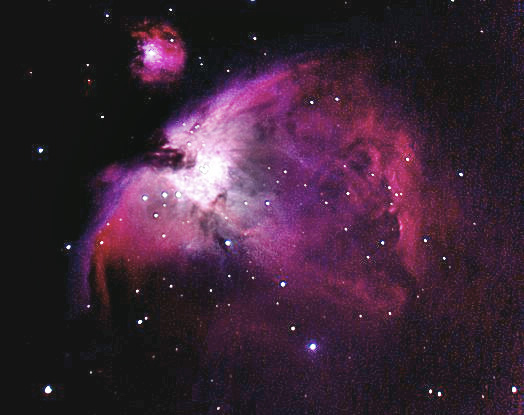
I finally was able to take my first CCD shot. It seems like the way will be steep and long! I also had to go through the experience of taking flat fields, since I imaged at F3.3 and all shots had a very noticeable vignetting.
Focusing has been a nightmare, as predicted. I tried to apply some tape to provide diffraction spikes, but they were nowhere to be seen! (how wide should an obstruction be to create proper diffraction spikes?). I am astigmatic so I need an objective tool to judge focus and the brightest pixel offered by CCDOps is not enough.
I also had some problems guiding (my 1st experience) since I could not find a proper guide star. So I had to go unguided and my mount had a hard time tracking at F3.3 for 30 seconds even though my polar alignement is very very good!! So it has not been an easy one for me.
So the attached picture is a crop of the image I took and reduced with a t-shirt flat (alas, not so good, but I have another 4 sets to try out with diffeent average saturation levels). It is 50% the original size (1600x1200) and cropped.
On top of all this I know very little about processing.
Nexstar 11 on APT wedge
.33 FF/FR
SBIG ST-2000 XCM+IDAS LPS
20 5" shots averaged to which I added 10 averaged 30" shots (adding or averaging? I never know which to use!). So it is only a 6 min. exposure.
The ST-2000 XCM "one shot color processing" applies a DDP to the single color channels and I must admit I am not crazy about it (very noticeable dark haloes around stars)but the simple RGB processing provided with the camera software is not great either. I applied only a very light unsh. mask.
Help and advice would be greatly appreciated, as usual.
Ciao
Luca
I finally was able to take my first CCD shot. It seems like the way will be steep and long! I also had to go through the experience of taking flat fields, since I imaged at F3.3 and all shots had a very noticeable vignetting.
Focusing has been a nightmare, as predicted. I tried to apply some tape to provide diffraction spikes, but they were nowhere to be seen! (how wide should an obstruction be to create proper diffraction spikes?). I am astigmatic so I need an objective tool to judge focus and the brightest pixel offered by CCDOps is not enough.
I also had some problems guiding (my 1st experience) since I could not find a proper guide star. So I had to go unguided and my mount had a hard time tracking at F3.3 for 30 seconds even though my polar alignement is very very good!! So it has not been an easy one for me.
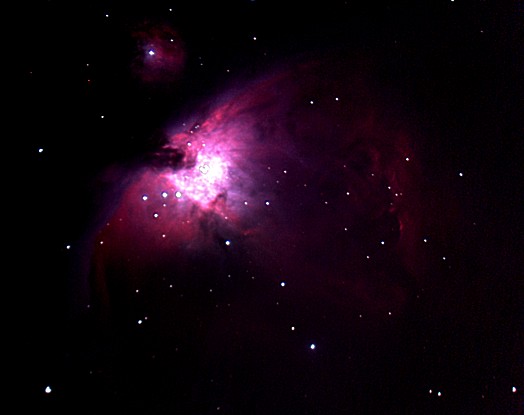
So the attached picture is a crop of the image I took and reduced with a t-shirt flat (alas, not so good, but I have another 4 sets to try out with diffeent average saturation levels). It is 50% the original size (1600x1200) and cropped.
On top of all this I know very little about processing.
Nexstar 11 on APT wedge
.33 FF/FR
SBIG ST-2000 XCM+IDAS LPS
20 5" shots averaged to which I added 10 averaged 30" shots (adding or averaging? I never know which to use!). So it is only a 6 min. exposure.
The ST-2000 XCM "one shot color processing" applies a DDP to the single color channels and I must admit I am not crazy about it (very noticeable dark haloes around stars)but the simple RGB processing provided with the camera software is not great either. I applied only a very light unsh. mask.
Help and advice would be greatly appreciated, as usual.
Ciao
Luca
Attached Image:
www.amun-ra.org
Solar Imaging Website